
MGIC Investment Corp’s Q2 2026 Update Highlights Challenges in New Insurance Written Amid Housing Market Shifts
MGIC’s quarterly results reflect evolving mortgage insurance volumes shaped by macroeconomic pressures and ongoing capital management strategies.
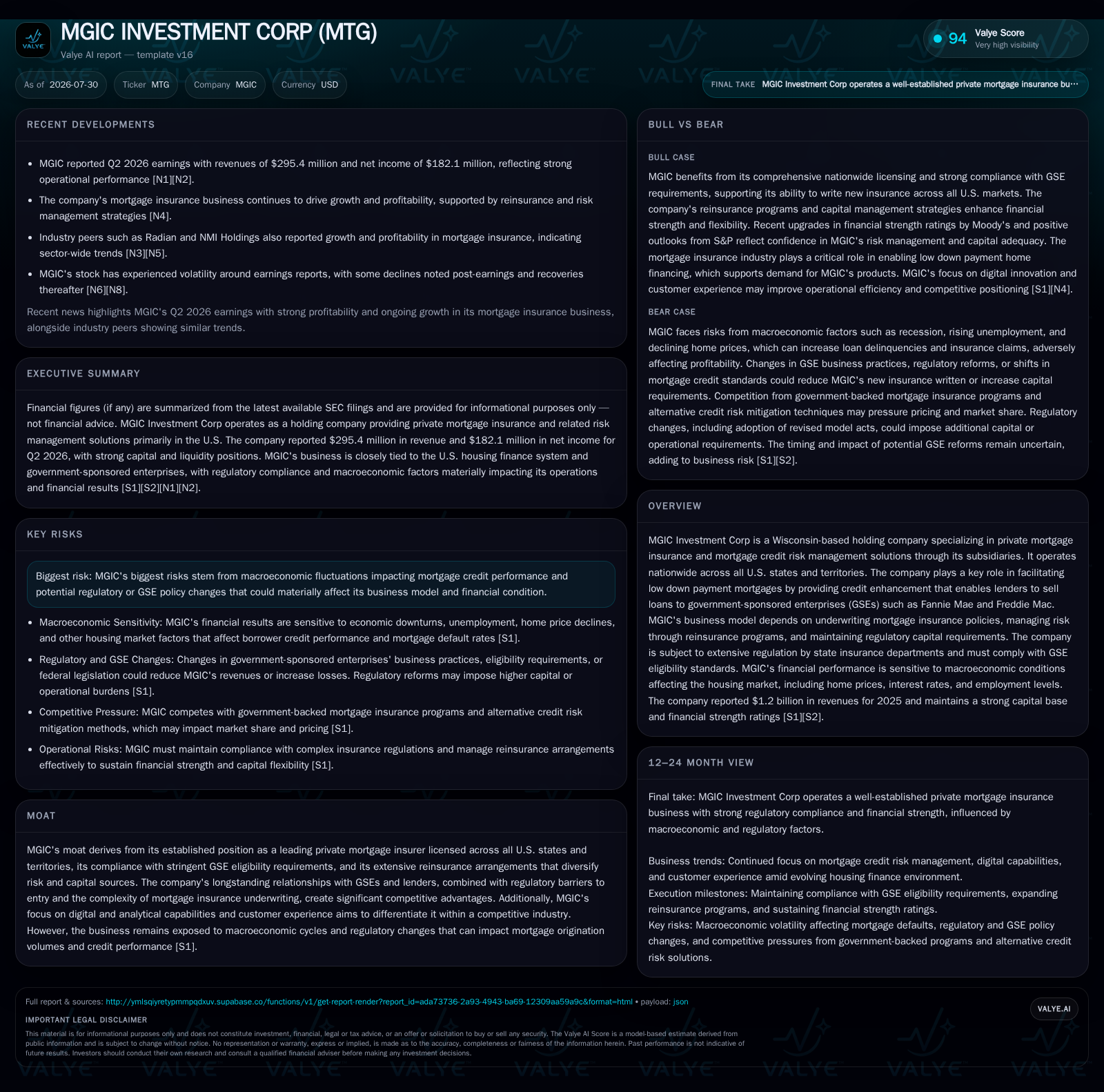
MGIC Investment Corporation reported second-quarter 2026 results signaling a decline in new insurance written, aligning with moderated mortgage origination activity amid rising interest rates and housing affordability constraints. Despite revenue softness, the company maintains compliance with GSE private mortgage insurer eligibility standards (PMIERs) and continues to leverage reinsurance programs to manage risk and capital effectively. The firm’s position as a leading private mortgage insurer remains supported by its nationwide license footprint and longstanding GSE relationships, but mortgage credit risk remains sensitive to macroeconomic cycles and policy shifts. Key growth drivers include mortgage originations volume and pricing, while risks center on economic downturn-induced delinquencies, capital adequacy under evolving regulatory frameworks, and potential GSE policy changes.
Recent Operating Update: Q2 2026 Earnings Highlights
MGIC Investment Corporation’s second quarter 2026 performance underscored a continuation of recent mortgage market headwinds with a decline in new insurance written (NIW). While detailed Q2 NIW figures were not explicitly quantified in the filing, management commentary aligned with industry-wide reduced mortgage origination activity driven by elevated interest rates and persistent housing affordability issues impacting borrower demand [S2][N1]. This contraction in insured loan volumes directly impacts MGIC’s premium revenue generation since premiums are largely volume-driven on newly underwritten policies protecting lenders against borrower default risk.
Despite volume softness, MGIC reaffirmed compliance with the government-sponsored enterprises’ (GSEs) private mortgage insurer eligibility requirements (PMIERs), maintaining its critical status as an approved insurer for loans delivered to or purchased by Fannie Mae and Freddie Mac [S1][S2]. This compliance signals sustained capital adequacy under PMIERs regulatory frameworks governing available assets relative to minimum required assets—a key structural moat that preserves the company’s access to the lucrative GSE-backed loan flow.
Business Model Overview
Operating primarily through wholly-owned subsidiaries like Mortgage Guaranty Insurance Corporation (MGIC), MGIC Investment Corp provides private mortgage insurance (PMI) across all states plus territories such as Puerto Rico and Guam [S1]. The core product protects residential mortgage lenders from losses if borrowers default on low down payment mortgages—typically those below 20% equity. Insured lenders gain credit enhancement enabling them to sell loans into the secondary market backed by the GSEs while satisfying capital requirements per regulatory and investor standards.
Revenue is chiefly earned through premiums tied to new insurance written volumes and the in-force portfolio comprising risk in force (RIF) or insurance in force (IIF). Premium yield—premium per unit of insurance coverage—is influenced by underwriting models that price risk based on borrower creditworthiness, loan attributes, geographic exposures, and prevailing economic conditions. Losses arise when claims are paid upon borrower defaults; thus, loss ratios, claim frequency, and claim severity are vital operating metrics directly affecting earnings volatility.
Risk management is augmented by robust reinsurance arrangements that transfer portions of exposure away from MGIC’s balance sheet while preserving capacity for new business. These reinsurance programs also provide protection against emerging portfolio losses on both existing IIF and future NIW volumes [S1]. Operational efficiencies stem from technological investments aiming at improving underwriting accuracy and customer experience—critical differentiation levers within a competitive PMI space.
Industry Structure & Competitive Position
The U.S. private mortgage insurance industry is characterized by a small set of licensed insurers competing for primary relationships with mortgage originators who require credit enhancement for low down payment loans destined for the secondary market. MGIC ranks among the largest players historically alongside peers such as Radian Group Inc., Essent Group Ltd., NMI Holdings Inc., and Genworth Financial.
MGIC benefits from several structural competitive advantages: it holds licenses across all U.S. jurisdictions ensuring a national footprint; it meets stringent PMIERs standards essential for GSE approval; it has significant reinsurance partnerships diversifying risk; and it boasts upgraded financial strength ratings from Moody's (A2) with positive outlooks recently affirmed by S&P [S1]. These ratings reflect robust capital surplus levels supportive of absorbing losses arising from economic cycles.
Nonetheless, competitors invest similarly in digital underwriting tools aiming to improve risk selection precision to protect margins as price competition intensifies during periods of tighter credit conditions. Regulatory policy developments concerning the scope of PMI coverage or GSE eligibility could also alter the competitive landscape materially.
Growth Drivers
Primary growth stems from expansion in mortgage originations requiring PMI coverage—specifically first-time buyers or borrowers lacking substantial upfront equity. Favorable housing market dynamics such as increased homeownership rates, demographic tailwinds supporting demand for entry-level homes, or federal policies encouraging affordable housing can stimulate NIW growth.
Conversely, interest rate declines often spur refinancing activity bumping premium volume temporarily higher through renewed originations. Technological enhancements targeting digital platforms allow MGIC to streamline underwriting workflows which can attract lender partners seeking efficiency gains.
Moreover, ancillary services beyond conventional PMI—such as data analytics for credit risk assessment or customized risk transfer via reinsurance innovations—represent potential value-enhancement avenues though not currently mainline revenue contributors [S1]
Risks & Growth Constraints
Macroeconomic factors remain paramount risks. Economic downturns can escalate delinquencies leading to higher claims frequency coupled with worsening claim severity if home price depreciation causes collateral shortfalls underlying insured loans [S1][S8]. These trends pressure loss reserves increasing earnings volatility.
Shifts in lender or governmental underwriting guidelines or tighter regulatory capital standards under evolving PMIERs rules could impose incremental capital burdens or curtail eligible insured loan volumes [S8]. Changes in policies governing GSE charters or their approach towards PMI reliance would directly influence MGIC’s business model stability.
Legal contingency exposure due to litigation related to claims handling practices or regulatory compliance further adds risk layers despite historical claim outcomes not materially impairing financial results [S8][S24]. Competitive pressures from alternative credit enhancements solutions or boutique insurers might erode market share albeit gradually given high barriers associated with licensing and regulatory approvals.
What To Watch Next
Milestones include upcoming quarterly filings which will reveal trend clarity on NIW volumes amid mortgage origination cycle fluctuations. Monitoring loss ratio trajectories will help assess claim development sensitivities tied to regional economic conditions and borrower performance patterns.
Key indicators include adherence to PMIERs capital benchmarks ensuring eligibility continuity; developments around reinsurance renewal terms impacting ceded premium levels; expense ratio trends reflecting operational leverage gains through platform upgrades; and regulatory updates regarding GSE mandates impacting PMI demand profiles.
Investor focus should also encompass evolving interest rate environments influencing refinancing incentives alongside housing affordability metrics determining broad-based purchase demand sustainability.
Financial Profile Discussion
As of mid-2026 latest data points show MGIC maintained substantial liquidity with cash and equivalents approximately $207 million at June-end [F1]. Although no recent debt figures are explicitly available post-2018 from public filings indicating unchanged leverage assumptions would be speculative; nevertheless, prudent balance sheet management is implied given PMIERs mandates demanding adequate capitalization with available assets exceeding minima.
This analysis uses only verified company-reported data sources up to July 29, 2026. Any forward-looking inference about market conditions incorporates general sector knowledge but avoids speculative forecasts without direct disclosures. readers may want to monitor macroeconomic volatility effects on underlying housing finance dynamics when evaluating PMI sector entities including MGIC Investment Corp.
Disclaimer: This is research-only, informational analysis and not investment advice. It may include AI-generated interpretation and general industry context. Always verify important details using primary sources.

Comments