
Robinhood Markets Advances Commission-Free Innovation While Managing Regulatory Headwinds
Robinhood’s Q2 2026 results reveal revenue resilience driven by expanding product lines amid evolving regulatory challenges.
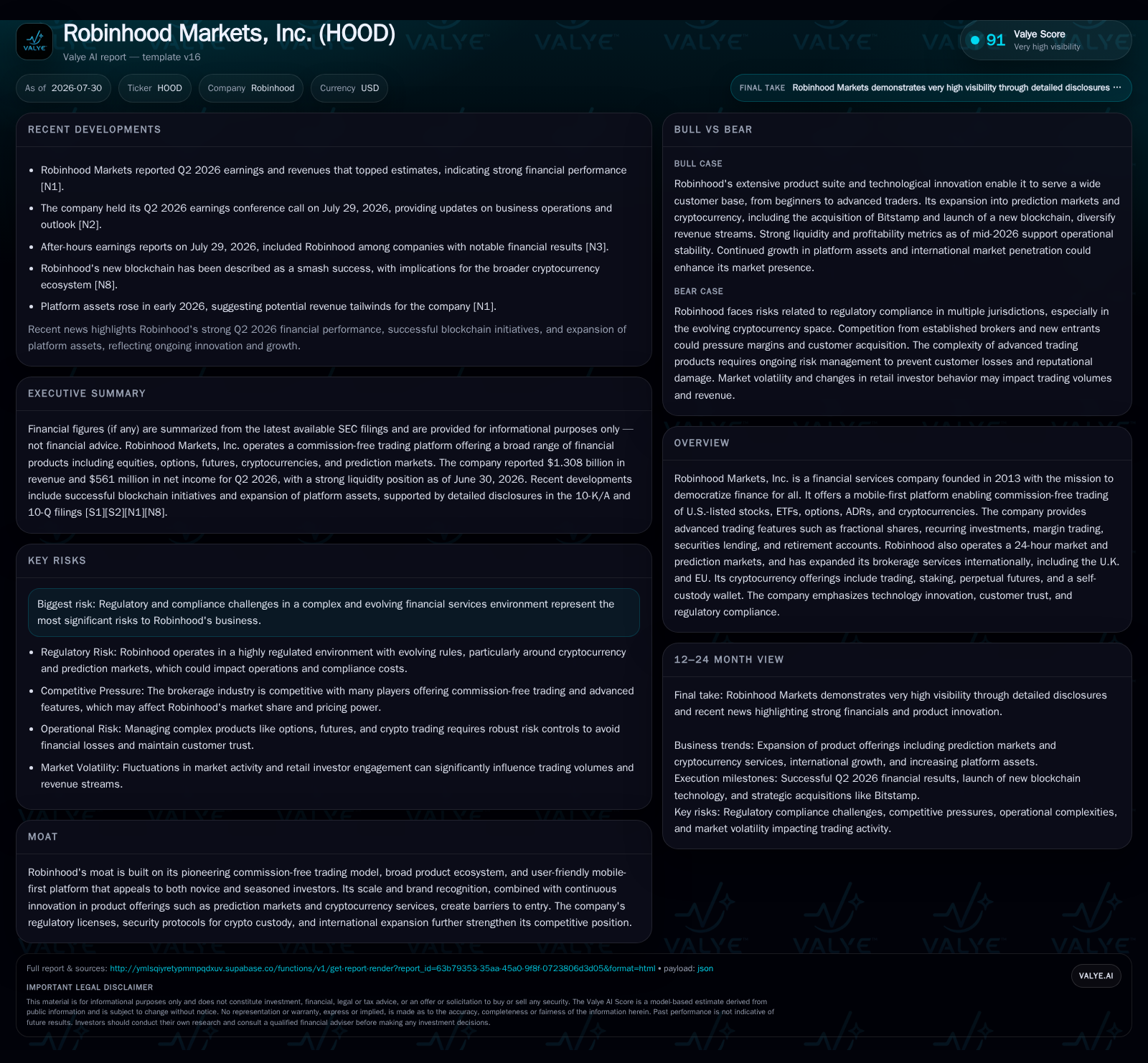
Robinhood Markets reported a second-quarter 2026 operating beat, driven by a diversified revenue mix that extends beyond traditional commission-free trading. Growth in cryptocurrency offerings, prediction markets, and international expansion have tempered cyclicality in trading volumes while presenting new monetization pathways. However, the company continues to navigate significant regulatory scrutiny particularly around payment for order flow (PFOF) and best execution standards. User engagement metrics remain steady despite market volatility, supporting revenue stability. The firm maintains strong liquidity to fund ongoing product investments and compliance efforts.
Q2 2026 Operational Results Signal Momentum Beyond Core Trading Revenues
Robinhood Markets delivered an earnings beat for the quarter ended June 30, 2026 [S2], [S3], with sustained top-line strength amid a challenging macro backdrop for retail trading platforms. The company reported robust transaction-based revenue complemented by meaningful contributions from net interest income associated with margin lending and customer cash balances. Payment for order flow (PFOF) revenues remained a vital earnings pillar despite intensified regulatory scrutiny constraining this practice industry-wide [S1]. Notably, Robinhood disclosed record average daily trading volumes across equities, options, and prediction markets in June month-to-date, underscoring resilient user engagement even as overall market volatility fluctuated [S20]. Such volume trends hint at durable customer activity rather than transient spikes seen in prior quarters.
The latest earnings confirm Robinhood's strategic shift toward multi-product diversification has begun materially moderating revenue cyclicality inherent in brokerage transaction fees alone [N1]. This evolution is critical given the historical volatility of trading revenues sensitive to broader market dynamics and competitor responses.
Expanding Product Horizons: Crypto, Prediction Markets, and International Growth Paths
Robinhood has deepened its footprint in cryptocurrency services beyond spot trading to include staking programs, perpetual futures contracts, and a proprietary self-custody wallet offering [S1]. This diversification aligns with evolving consumer demand for integrated digital asset management within a trusted fintech ecosystem. The addition of staking not only boosts fee-generating assets under custody but also incentivizes prolonged customer asset retention—a recognized driver of lifetime value in digital finance platforms.
Parallel efforts in prediction markets represent an innovative expansion into alternative financial products aimed at enhancing engagement through gamified investment approaches. Though nascent, the scaling of this segment signals potential new revenue streams less correlated to standard equity trading cycles [N11]
Internationally, Robinhood capitalizes on regulatory licenses such as the MiCA authorization from the Bank of Lithuania enabling lawful EU crypto operations [S1]. These jurisdictional approvals position the company advantageously to access progressively regulated European retail investors despite compliance complexity. Success hinges on navigating fragmented regulations which could constrain agility but offer first-mover benefits relative to peers still limited to U.S.-centric services.
Competitive Dynamics in Commission-Free Brokerage Amid Regulatory Pressures on PFOF
The commission-free model pioneered by Robinhood has reshaped retail brokerage economics but faces intensifying headwinds from proposals targeting payment for order flow bans or restrictions under "best execution" requirements [S2]. Any limitation or elimination of PFOF would directly compress margins given its sizable contribution across equities and options trades [S1].
Compared to discount brokerages like Charles Schwab and E*TRADE—which have broader product portfolios including advisory services—Robinhood’s reliance on PFOF is more concentrated though mitigated by rising subscription fees and crypto-related revenues. Nonetheless, evolving regulatory environments requiring heightened compliance impose incremental cost burdens potentially eroding operational leverage gains.
Liquidity providers, critical intermediaries sustaining trade execution economics via order routing agreements, may recalibrate relationships under these regimes affecting both pricing power and stability of fee flows. The need for best execution compliance further demands sophisticated trade monitoring systems increasing technical investment needs.
User Engagement Metrics Reflect Steady Trading Volume Despite Market Volatility
Operational KPIs reveal that Robinhood has maintained its active user base alongside consistent trade volume metrics despite variable macroeconomic conditions [S2], [N1]. This steadiness suggests effective user acquisition and retention strategies bolstered by mobile-first design facilitating fractional shares and recurring investment plans which broaden participation beyond one-off trades.
Average revenue per user (ARPU) is linked directly to transaction counts and margin lending utilization; Q2 trends indicate resilience in these markers supported by diverse product usage inclusive of crypto staking uptake [S2]. Early signs imply churn rates remain controlled without notable deterioration amidst sector peer pressures.
Key Risks: Compliance Headwinds, Interest Rate Sensitivity, and Liquidity Provider Dependence
Robinhood’s most salient risks stem from regulatory uncertainties impacting core operations such as PFOF prohibitions, stricter social media marketing constraints affecting customer acquisition channels, best execution rule enforcement tightening trade routing flexibility, and elevated compliance costs arising from multi-jurisdictional licensing regimes [S1], [S2]. The company remains exposed to shifts in interest rates which can variably affect net interest margins derived from margin loans and cash holdings—a significant portion of non-transaction revenue.
The bilateral settlement framework with cryptocurrency liquidity providers injects credit risk absent centralized clearinghouses. Large intraday receivables towards these counterparties pose financial fragility concerns if defaults materialize during volatile conditions [S9]. Further reputational risks persist due to past regulatory investigations culminating in material fines totaling over $70 million across SEC and FINRA settlements since 2024 [S8], underscoring potential future litigation costs.
Pathways to Growth: Leveraging Technology Innovation and Expanding Financial Ecosystem Integration
Robinhood’s technology platform operates as a scalable base capable of supporting product innovations without commensurate fixed cost inflation—a key advantage enabling rapid deployment of new features such as prediction markets or deeper wallet integrations benefiting recurring investment vehicles [S1]. Ongoing technology investments prioritize compliance automation alongside user experience enhancements crucial for sustaining growth amid heightened industry competition.
Particularly promising is the integration of cryptocurrency custody solutions with staking products serving as hooks for asset stickiness and cross-selling opportunities in both existing U.S. customers and international segments newly accessed under MiCA authorization frameworks.
Financial Profile Discussion: Current Liquidity Position Supports Strategic Flexibility
As of June 30, 2026, Robinhood reported $5.36 billion in cash and equivalents with current assets totaling approximately $54.5 billion against liabilities near $44.6 billion yielding a current ratio of 1.22—signaling healthy near-term liquidity supportive of ongoing investment programs while reserving capacity to absorb unexpected regulatory or litigation expenses [F1], [S2].
This liquidity buffer reflects prudent capital stewardship amidst unresolved risks related to evolving financial regulations impacting broker-dealer activities plus cryptocurrency sector complexity. It also underpins the company’s ability to continue share repurchase activities selectively without undermining operational funding priorities.
Looking Ahead: Metrics to Watch as Regulation Evolves and New Products Scale
Key upcoming milestones revolve around periodic updates on crypto custody scale measures alongside prediction market adoption rates—both prospective indicators of successful monetization beyond traditional securities trading revenues [S3], [N2]. Guidance clarity regarding regulatory developments around PFOF reforms will also critically influence operating margin trajectories.
Additionally, vigilance toward user engagement metrics such as churn rate fluctuations or average trade sizes will be essential to assess sustainable growth amid competitive retail brokerage pressures. Monitoring litigation exposures and compliance program effectiveness remain material given past settlements and ongoing agency inquiries.
Continued international market penetration within compliant frameworks offers another vector for incremental growth provided localized execution matches customer expectations.
This analysis is based exclusively on publicly available filings through July 2026 combined with established industry knowledge. It does not constitute investment advice or research views. Readers should consider all disclosures before forming conclusions on company prospects or valuation considerations.
Disclaimer: This is research-only, informational analysis and not investment advice. It may include AI-generated interpretation and general industry context. Always verify important details using primary sources.

Comments