
Bristol Myers Squibb's Growth Ports Outpace Legacy Pressures In Q2 2026
BMS’s latest quarterly beat and raised guidance underscore how innovation-driven growth mitigates generic erosion in its legacy portfolio.
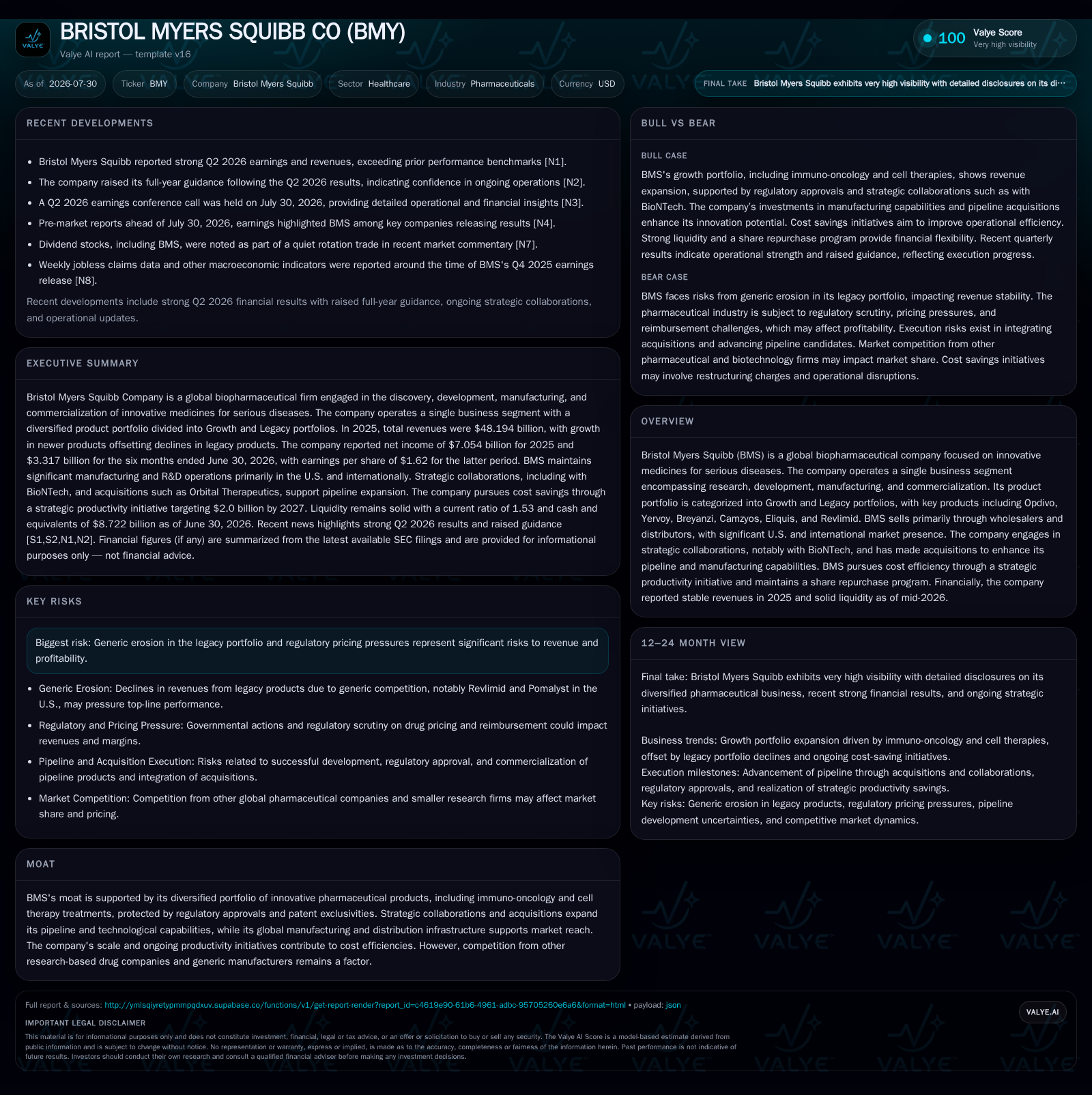
In Q2 2026, Bristol Myers Squibb delivered better-than-expected revenues supported by robust sales in immuno-oncology and cell therapy, offsetting continued declines in its legacy drug franchise due to generic competition. Strategic collaborations, including with BioNTech, alongside investments in R&D and manufacturing capacity expansions, reinforce BMS's resilient business model. While generic erosion of legacy assets like Revlimid poses ongoing risks, the diversified portfolio and productivity initiatives provide a sustainable growth pathway.
Q2 2026 Results: Growth Momentum Overcomes Legacy Setbacks with Upward Guidance
The interplay between stable top-line performance despite a maturing legacy portfolio reflects the company's strategic emphasis on diversifying revenue streams [S2][N3]. Management commentary emphasizes sustained R&D investments underpinning this transition as a crucial lever for future resilience — particularly maintaining clinical trial throughput and reducing time-to-approval for next-generation therapies. Verifying this momentum in subsequent quarters will require tracking continued product sales growth juxtaposed against volume erosion in mature franchises
Portfolio Dynamics: How Innovative Assets Offset Generic Pressures on Revenue Mix
BMS structures its revenue into two distinct portfolios — Growth and Legacy — delineating innovation-driven agents against aging brands vulnerable to generic entrants. The Growth Portfolio centers on products enjoying patent exclusivity or recent regulatory approvals typically generating higher margins due to limited direct substitutes. Flagship drugs Opdivo and Yervoy remain critical pillars within immuno-oncology, showing broad clinical adoption across multiple indications [S1]. Complementing these is the cell therapy asset Breyanzi, which benefits from specialized distribution channels via specialty pharmacies targeting refractory hematologic malignancies.
Conversely, the Legacy Portfolio comprises mostly small molecules like Revlimid whose patents have expired or face imminent expiration. Here, generic erosion drives volume declines yielding price compression and margin squeeze. The impact in the U.S. market is pronounced given stronger generic penetration versus international regions [S1]. These dynamics shift product mix towards biologics and novel modalities — an evolution demanding elevated manufacturing sophistication but promising enhanced commercial pricing power. This dual-revenue stream structure manifests economically as trading off declining volumes with higher-margin new product expansions.
The presence of switching costs mainly pertains to physician familiarity and patient insurance formularies balancing generics’ cost advantage. Distribution through well-established wholesale channels ensures efficient buy-and-bill mechanics but also implicates rebate expense management impacting net realizations [S1][S2].
Sales Channels and Manufacturing Capability: Foundations of BMS’s Commercial Strength
BMS’s global commercial infrastructure relies heavily on wholesalers and specialty pharmacies as primary sales conduits, optimizing market reach especially within the U.S. where payer complexity necessitates specialized channel management [S1]. Manufacturing capacity spans multiple geographies including the U.S., Puerto Rico, Ireland, Netherlands, and Switzerland ensuring supply continuity crucial for biologics requiring cold chain logistics and complex formulations
Economies of scale from integrated manufacturing operations contribute to gross margin resilience even amid cost pressures from rebates or pricing adjustments mandated by government contracts or private payers. The company’s efforts to improve capacity utilization underpin operational leverage that supports fixed-cost absorption as volumes grow for newer treatments [S1]. Channel penetration analytics likely track distribution volume segmented by geography to anticipate shifts due to regulatory environments or payer policy changes.
Competitive Context: Positioning Among Pfizer, Merck & Novartis in Immuno-Oncology and Biologics
Within the global research-based pharmaceutical space, BMS competes with diversified giants like Pfizer known for broad commercial reach across many therapeutic areas while Merck & Co. has deep expertise focused sharply on immuno-oncology with blockbuster Keytruda offerings. BMS’s immunotherapy lineup differentiated by multi-indication approvals compares favorably yet must continuously innovate to retain share amidst rapid competitor pipeline activity.
Meanwhile, BMS’s strategic licensing deals and acquisitions resonate with Novartis’s approach of augmenting pipeline through external innovation sourcing. Unlike some specialty biotech firms narrowly focused on single modalities or indications, BMS balances breadth and depth facilitating cross-pipeline synergy but facing heightened complexity in portfolio integration.
The company’s competitive moat derives from patent exclusivities protecting key biologics alongside advanced manufacturing scale enabling rapid commercialization globally underpinned by strategic collaborations expanding scientific capabilities [S1].
Key Growth Catalysts: R&D Investment, Pipeline Advancement, Collaborations, and Strategic Acquisitions
BMS continues allocating significant resources towards R&D sustaining a healthy funnel of candidates progressing through clinical trials building future revenue streams beyond existing launches. Clinical-stage drug count serves as a predictor for mid- to long-term earnings potential given typical drug development timelines.
Partnerships such as the global collaboration with BioNTech broaden access to mRNA technology platforms fostering new modality launches while targeted acquisitions like Orbital Therapeutics deepen biologics expertise enhancing therapeutic breadth beyond core oncology offerings [S1].
Execution on these fronts signals structural revenue growth drivers evidenced in increased sales contribution from newly commercialized drugs relative to plateauing legacy brands [S1][S2]. Continuous improvement in regulatory approval timelines further accelerates time-to-market advantages critical amid intensifying sector competition
Watchpoints Ahead: Patent Expiries, Pricing Pressures, Regulatory Risks, and Productivity Initiatives
Patent expiries remain a fundamental risk concentrated on high-revenue older drugs such as Revlimid whose loss of exclusivity catalyzes rapid generic substitution impacting revenue continuity [S11][S14]. Pricing pressures amplify risks particularly within evolving payer reimbursement frameworks emphasizing cost containment policies both domestically and internationally
Regulatory uncertainties around clinical trial outcomes or approval delays add volatility to pipeline realization assumptions requiring close monitoring of milestone achievements.
To counteract margin compression risks, BMS pursues productivity initiatives targeting streamlined manufacturing processes and administrative cost efficiencies aiming to bolster overall operating leverage without compromising innovation funding commitments [S2]. Balancing these efforts is critical to sustain profitability trajectories amid external headwinds.
Financial Profile Discussion: Liquidity Cushion and Capital Structure amid Productivity Drives
As of June 30, 2026, companyfacts shows BMS held $8.7 billion in cash and equivalents with total debt near $4.5 billion, resulting in a net cash position exceeding $4 billion that supports substantial financial flexibility for acquisitions or shareholder return programs [F1]. The current ratio stands at approximately 1.53, indicating solid short-term liquidity cushioning balance sheet resiliency necessary for managing supply chain contingencies or abrupt market changes during patent transitions [F1].
Operating income trends reflect margin sensitivities linked closely to product mix shifts toward higher-margin biologics offsetting legacy volume declines [S2]. Share repurchase programs continue funded by internal cash flow generation aligned with long-term value creation discipline reflecting confidence in core business durability even as cyclical generics pressure persists
This analysis synthesizes the latest quarterly disclosures alongside annual context highlighting how Bristol Myers Squibb strategically manages dual business dynamics: leveraging innovative drug launches while navigating inevitable legacy product erosion due to patent cliffs. Its comprehensive manufacturing footprint combined with partnerships enhances competitive defenses common among top-tier global pharma peers. Continued attention should focus on pipeline progression metrics and regulatory interactions shaping medium-term growth prospects.
This content is intended solely for informational purposes without any investment research view.
Disclaimer: This is research-only, informational analysis and not investment advice. It may include AI-generated interpretation and general industry context. Always verify important details using primary sources.

Comments