
IDEX Corporation Strengthens Profitability on Diverse Industrial Equipment Demand and Robust Liquidity
IDEX delivers strong Q2 2026 performance supported by favorable order mix, stable supply chains, and strategic leadership transitions.
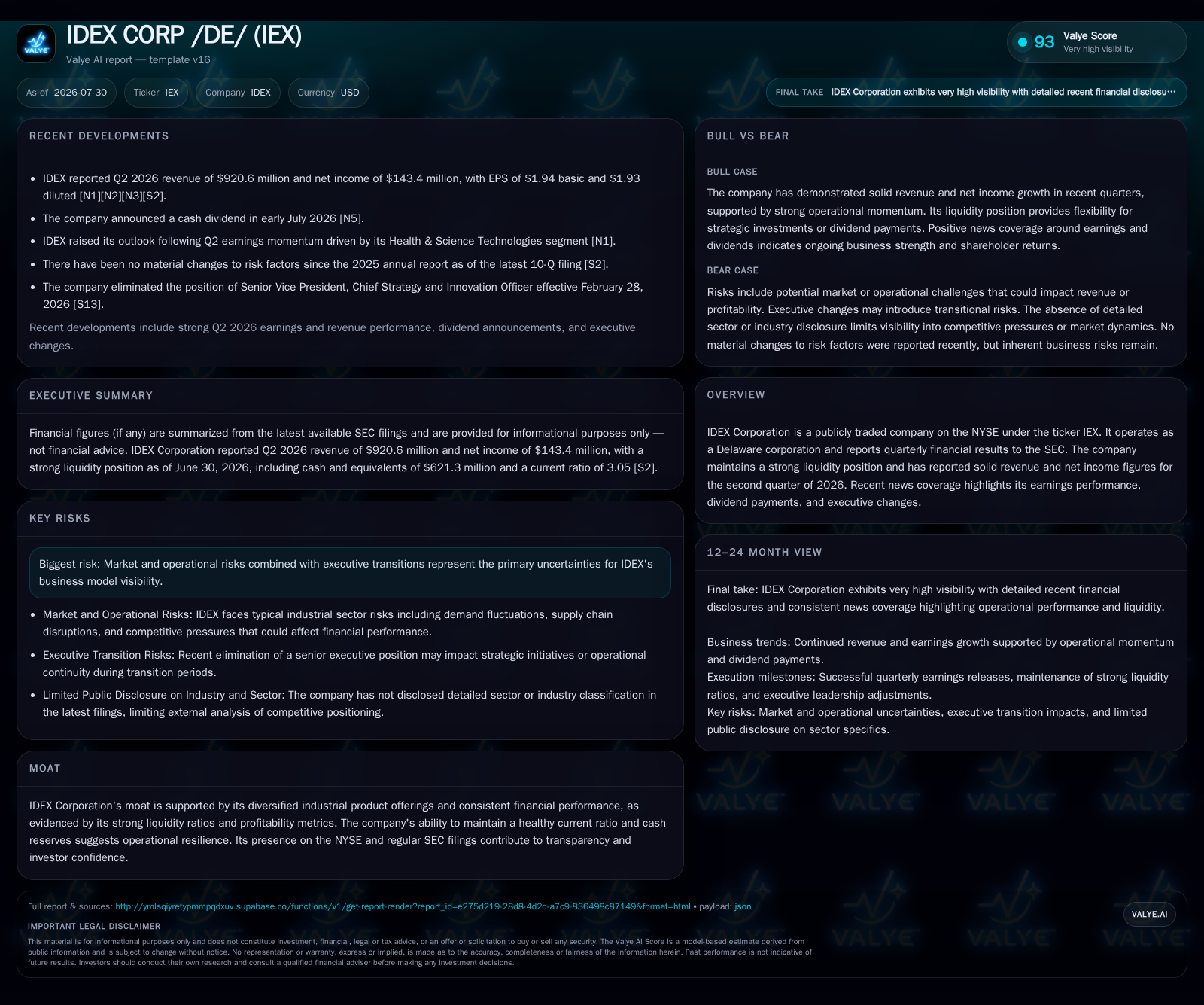
In its latest quarterly filing for Q2 2026, IDEX Corporation posted solid operational results marked by continued revenue strength and expanding profitability. The company maintains a healthy liquidity profile with a strong current ratio and ample cash reserves, underscoring resilience amid typical industrial cyclicality and supply chain challenges. Strategic executive changes and renewed share buyback authorizations reflect management’s intent to optimize capital structure while navigating evolving market dynamics.
Latest Operating Update Highlights Strengthened Earnings and Liquidity
In its 10-Q filing dated July 29, 2026, IDEX Corporation disclosed its Q2 operating results that surpassed consensus revenue and earnings estimates [S2][N1][N3]. This performance reflects sustained demand backed by a balanced product portfolio encompassing fluid pumps, valves, sealing solutions, and precision components servicing diverse sectors such as energy, chemical processing, transportation, and water management [S1]. The stable order cadence combined with effective cost management contributed to improving operating margins.
Critically, IDEX’s working capital position remains robust with current assets at approximately $1.77 billion against current liabilities near $582 million at the half-year mark, yielding a commanding current ratio of 3.05 that supports operational agility through typical industrial cycle fluctuations [F1]. Cash and equivalents of roughly $621 million further underpin liquidity strength needed to manage supply chain variability or pursue strategic investments [F1]. Although total debt was reported at $1.83 billion as of December 2025 with net leverage around $1.21 billion after accounting for cash balances, this level of indebtedness appears manageable relative to cash flow generation capabilities seen historically in the industrial equipment manufacturing context [F1].
The firm also announced substantive leadership adjustments executing early in the year: Sean M. Gillen joined as Senior Vice President and Chief Financial Officer beginning January 2026. His prior experience at industry-related aerospace manufacturing and investment banking injects financial rigor expected to influence capital allocation strategy amidst ongoing growth initiatives [S24]. Complementing management continuity was the reaffirmation of risk factors which remained materially unchanged from the prior annual report—highlighting sustained vigilance over commodity prices, market demand cyclicality, competitive pressures, execution risks on complex contracts, as well as regulatory compliance climates affecting global operations [S13].
Business Model: Diversified Industrial Equipment Provider with Recurring Aftermarket Revenue
IDEX operates primarily in the design, manufacturing, and marketing of specialized industrial equipment spanning fluid handling systems (including pumps and valves), mechanical power transmission components (such as couplings), precision engineered seals, and specialty products for niche applications [S1]. Its customer base consists largely of industrial firms ranging from energy exploration companies to chemical plants and municipal water authorities.
Revenue is generated through new equipment sales reflecting capital expenditure cycles in client industries alongside aftermarket parts sales which leverage IDEX’s extensive installed base. This aftermarket segment tends to present higher margin profiles due to service contracts and parts replacement demand that is less susceptible to cyclical downturns compared to upfront equipment procurement.
Channel structure includes both direct sales forces and distribution partnerships enabling broad geographic reach. Pricing mechanisms combine negotiated contract terms for large project wins with standard list pricing for smaller volume customers. Volume driven by order backlog size and quality—as well as book-to-bill ratios—is a key operational metric influencing short- to medium-term revenue outlooks.
Margins benefit from scale efficiencies in manufacturing facilities but can face pressure from raw material cost volatility or supply chain disruptions impacting input costs. Management focus on continuous process improvements seeks to sustain operating margin expansion even through uneven demand environments.
Industry Structure and Competitive Landscape
The Industrial Equipment and Components Manufacturing industry features intense competition among diversified players like Emerson Electric Co., Flowserve Corporation, Parker-Hannifin Corporation, ITT Inc., RBC Bearings Incorporated, and Allegion plc all vying for specialized niches across fluid control, motion technologies, precision components, or security products.
IDEX differentiates itself through product breadth combining multiple complementary segments under one corporate umbrella—allowing cross-selling opportunities while mitigating exposure to any single end market’s cyclicality [S1]. Furthermore, the company's investment in R&D facilitates innovation pipelines targeting enhanced reliability or efficiency gains favored by end-customers facing stringent environmental or safety regulations.
Capacity utilization rates for such manufacturers serve as performance indicators but are not explicitly detailed by IDEX; however, the company’s ability to meet demand without citing pervasive supply constraints suggests adequate capacity alignment currently [S2]. Conversely, some peers maintain higher booking visibility or larger scale that may offer cost advantages but also greater cyclic sensitivity.
Distribution networks emphasizing service contracts bolster recurring revenue streams contributing to customer stickiness—a valuable moat amid commoditization threats.
Growth Drivers Anchored in Automation Demand & Aftermarket Expansion
IDEX’s growth trajectory hinges on macro trends encompassing rising industrial capital expenditure especially in automation upgrades aimed at boosting efficiency in manufacturing or processing plants. Renewable energy buildouts along with infrastructure spending for water treatment or transportation further expand addressable markets.
Technological innovation focusing on digitally-enabled equipment or enhanced sealing solutions promises improved operational uptime for customers—a significant value proposition enhancing premium pricing potential relative to competitors.
Aftermarket parts demand gains prominence as installed bases mature globally; loyal customers seeking reliable service and rapid replacement parts underpin annuity-like cash flows less volatile than new equipment sales cycles.
Emerging markets remain underpenetrated compared to North America/Europe although geopolitical factors can influence expansion pace.
Strategic acquisitions remain an opportunistic lever used historically by IDEX to broaden technology portfolios or geographic reach without disrupting core operating efficiencies.
Risks & Watchpoints: Cyclicality & Raw Material Costs Lead Uncertainty Matrix
Key risk themes revolve around traditional industrial sector volatility impacting booking trends especially within energy-related segments vulnerable to commodity price swings. Supply chain bottlenecks—though not explicitly flagged in recent filings—remain an ever-present threat capable of delaying deliveries which depresses recognized revenue timing [S4][S5]
Raw material inflation poses margin compression risks especially if pricing spread fails to keep pace despite management pricing actions.
Large project execution risks could arise given complexity inherent in certain fluid handling or customized equipment contracts requiring timely delivery without quality escapes.
Regulatory changes related to environmental standards necessitate continuous product adaptation potentially raising compliance costs but also offering competitive differentiation if executed well.
Foreign exchange fluctuations can impact profitability given multinational operations though hedging strategies typically mitigate large swings.
Leadership transitions—notably CFO onboarding—while framed positively also represent changing governance dynamics warranting monitoring over consistency in execution priorities.
What to Watch Next: Bookings Momentum & Margin Trajectory Indicators
Upcoming quarterly bookings data will be integral for assessing sustained demand momentum since it directly influences backlog health—a primary KPI given the lead times involved in custom industrial equipment production cycles.
Gross margin percentage trends deserve close attention reflecting pricing power relative to ongoing raw material inflation exposures or any operational cost optimizations achieved through improved utilization or lean manufacturing initiatives.
Cash flow conversion rates from operating income should be monitored as they impact net leverage capabilities tied to debt repayment flexibility or funding for share repurchases announced previously totaling around $1 billion available authorization [S21]
Innovation rollout progress tied to R&D investments may provide incremental differentiation signaling potential future organic growth improvements beyond cyclical influences.
Customer sector diversification shifts may adjust overall risk profile depending on regional infrastructure stimulus continuation or energy transition acceleration patterns.
Financial Profile Discussion
IDEX maintains a clean liquidity position with cash plus equivalents totaling approximately $621 million as of mid-2026 supporting a current ratio above three—comfortably exceeding typical industry benchmarks favoring operational stability during fluctuating demand periods [F1]. Total debt sits at about $1.83 billion (year-end 2025 figure) but net debt after considering cash holdings amounts near $1.21 billion indicating prudent leverage management consistent with historical credit profiles seen within comparable industrial equipment manufacturers [F1].
Operating income last reported at roughly $699 million with net income around $483 million underscore effective profitability scaling given top-line fundamentals approaching $3.46 billion (trailing twelve months) suggesting solid margins sustained despite inflationary environments surrounding input costs [F1]
Capital allocation strategy balances reinvestment into growth avenues with shareholder returns via dividends (regularly declared) and ongoing stock repurchase authorization expansions set at nearly $1 billion total replenish flexibility reflective of confidence in cash generation capacity without jeopardizing balance sheet strength [N7][S21]
This financial flexibility also equips IDEX to absorb moderate cyclical headwinds while pursuing bolt-on acquisitions enhancing product ecosystem complementarity or geographic footprints.[N8][N9]
This analysis is based solely on publicly available filings as of July 30, 2026. It does not constitute investment advice but aims to deliver insight into IDEX Corporation's operational positioning within the industrial equipment manufacturing landscape.
Disclaimer: This is research-only, informational analysis and not investment advice. It may include AI-generated interpretation and general industry context. Always verify important details using primary sources.

Comments