
Relativity Holdings Secures $150M Equity Facility Amid Biotech R&D Expansion
Recent equity financing arrangements enhance Relativity Holdings’ capital flexibility to support its biotechnology development programs.
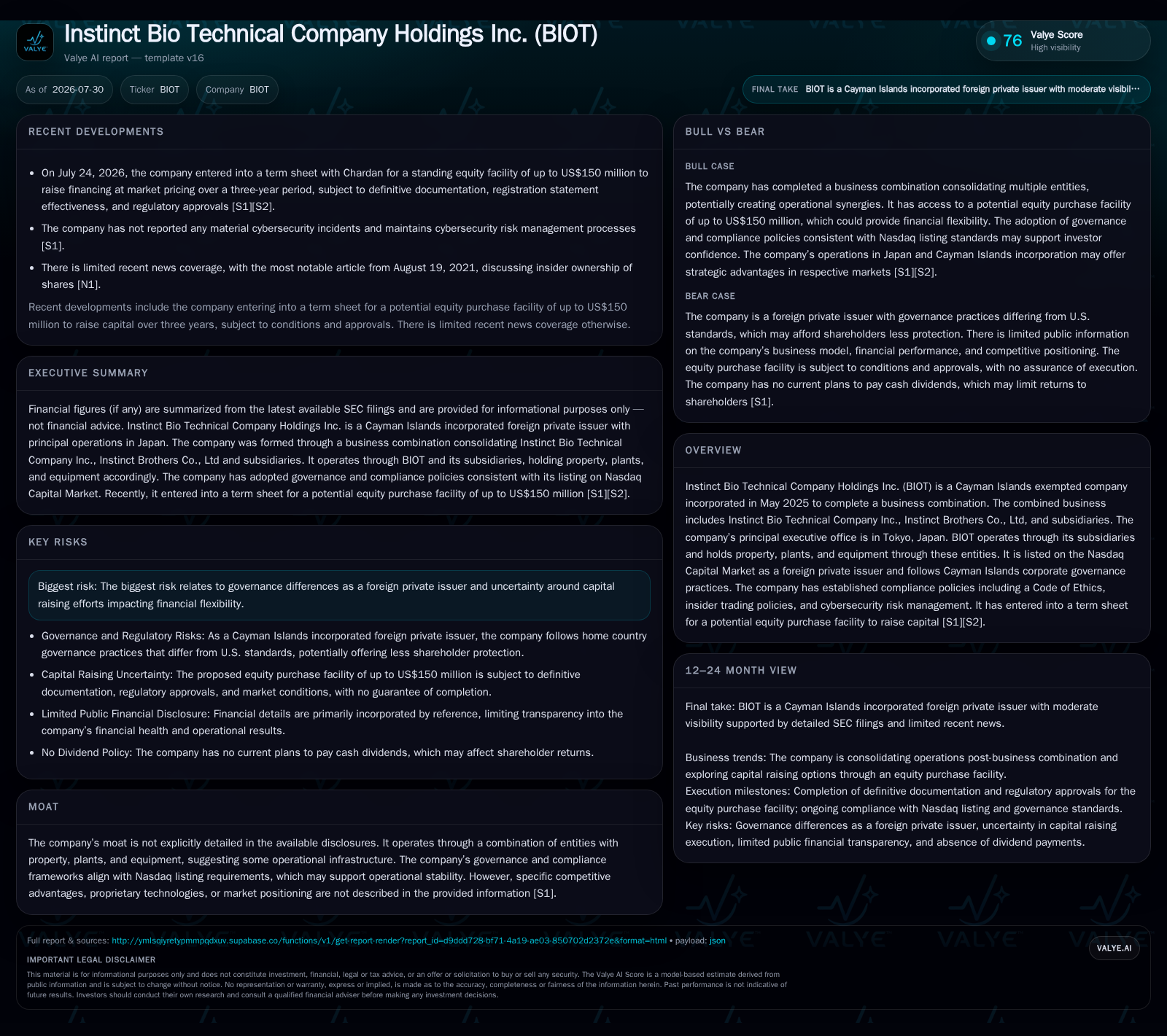
Relativity Holdings Inc. (BIOT), a Cayman Islands-incorporated biotech holding company with operating subsidiaries in Japan, disclosed a new equity purchase facility of up to $150 million to bolster funding options for its research and development activities [S2][S1]. Operating within the capital-intensive biotech sector, the company relies heavily on external financing to advance its drug pipeline, which remains early in development post-business combination [S1]. As a foreign private issuer listed on Nasdaq, governance nuances and regulatory paths shape its operational profile and investor risk. The company’s future growth hinges on successful capital raises, regulatory approvals, and strategic partnerships typical of early-stage biotech players.
Recent Operating Update
Relativity Holdings Inc. (BIOT) announced on July 28, 2026, that it had entered into an indicative term sheet with investment bank Chardan for a standing equity purchase facility (ChEF) up to $150 million, designed to provide flexible market priced financing over a three-year horizon [S2][S1]. Upon execution of definitive agreements and regulatory clearances—including filing a registration statement enabling resale of shares and receipt of FINRA no-objection—the facility would allow Relativity Holdings to require Chardan to purchase shares at volume-weighted average daily prices with a modest discount (4% during market hours; 5% off-market). Importantly, use of this facility remains at Relativity Holdings’ discretion based on market conditions and capital needs. However, no guarantees exist that documentation will be completed or that funding will be drawn down under the ChEF [S1].
This near-term capital arrangement signifies management’s intent to maintain financial flexibility critical in the biotechnology sector. Biotech companies often face protracted development timelines before securing revenue-generating milestones or product launches; access to ready equity capital mitigates liquidity risks and supports pipeline advancement [S1][S4]. The timing also follows the business combination consummated previously that consolidated Instinct Bio Technical Company Inc., Instinct Brothers Co., Ltd., and subsidiaries under BIOT as the corporate parent headquartered in Tokyo with Cayman Islands incorporation
Business Model Overview
Relativity Holdings functions as a wholly-owned parent via its subsidiaries engaged in biotechnology R&D activity—a typically high fixed-cost industry involving laboratory facilities and manufacturing assets leveraged toward developing novel biological products. The disclosed ownership of property, plants, and equipment underscores operational infrastructure supporting ongoing research efforts [S1]. Revenue generation is currently prospective: commercial output depends on progressing drug candidates through preclinical studies into active clinical trials requiring FDA and other regulatory approvals. Monetization avenues in this archetype include licensing intellectual property rights out to pharma partners, milestone payments upon development stage achievements, royalties on sales of licensed therapies, or eventual direct commercialization.
Industry Context and Competitive Position
The biotechnology sector embodies scientific innovation amidst stringent regulatory scrutiny and lengthy timeframes before product commercialization—rendering it uniquely capital intensive and inherently risky. Firms like Relativity Holdings typically operate upstream in the value chain prioritizing discovery through clinical dev phases. Successful transition beyond proof-of-concept typically necessitates external partnerships or licensing deals for late-stage development scalability given significant manufacturing complexity or sales infrastructure needs.
Peers providing useful reference include Moderna (benchmarked for mRNA platform development approaches), Amgen (recognized for biologic product commercialization expertise), Regeneron Pharmaceuticals (noted for pipeline breadth management), Gilead Sciences (specialized in antiviral biologics), and Biogen (focused on neurological therapeutics). These companies illustrate varied stages from discovery through commercialization with diverse revenue models blending direct sales with licensing income streams.
Relativity Holdings’ status as a Cayman Islands entity listed as a foreign private issuer imparts governance distinctions relative to U.S.-domiciled competitors. Its exemption from certain SEC reporting rules such as proxy statements or Section 16 insider reporting reduces shareholder visibility into internal operations compared to domestic firms. While compliance policies including Code of Ethics and cybersecurity risk management have been adopted per Nasdaq requirements, these differences may heighten perceived investment risk linked to transparency norms [S1][S12][S13].
Growth Drivers
The growth engine within biotechnology remains firmly tethered to scientific breakthroughs driving new therapeutic modalities—ranging from gene editing technologies to biologics addressing unmet medical needs. Relativity Holdings stands positioned at the intersect of these trends by consolidating R&D talent and facilities under its umbrella post-business combination.
Advancements in genetic engineering techniques globally promise expanded pipelines while regulatory trends favoring expedited approval pathways can shorten time-to-market intervals when appropriately navigated. Strategic collaborations or licensing agreements serve as crucial accelerants for smaller firms lacking scale but rich in innovation.
Capital availability under the newly arranged ChEF facility is notable given typical biotech dependence on periodic equity infusions reflecting high cash burn rates during trial phases without immediate product monetization opportunities. This heightened financial optionality may allow the firm more autonomy versus contemporaries reliant solely on unpredictable venture capital or initial public offering proceeds.
Emerging market penetration is another tailwind axis given increasing healthcare demand worldwide especially for novel biologics though such expansion requires solid manufacturing capabilities and international regulatory compliance aligning well with BIOT’s asset holdings.
Risks and Watchpoints
Primary risks stem from clinical trial failures which remain endemic across biotech due to scientific uncertainty impacting drug efficacy or safety profiles—potentially halting costly programs abruptly. Regulatory hurdles remain unpredictable; delays or rejections extend cash runway pressures needing additional financing rounds under dilutive terms.
The current facility with Chardan itself introduces conditional uncertainties around final documentation execution and registration effectiveness needed before deployment—any delays could tighten liquidity timing mismatch exacerbating operational stress [S1][S2]
Operating as a foreign private issuer anchored offshore introduces governance complexities including reduced disclosure rigidity that might dissuade certain U.S.-based institutional investors sensitive to transparency constraints. This factor compounds valuation discount risks relative to comparable domestic peers.
Dependency on equity markets subjects BIOT’s capacity to raise funds at reasonable pricing directly impacting its ability to sustain expensive pipeline advancement efforts given absence of near-term revenues—a classic biotech valuation challenge exacerbated by macroeconomic volatility.
Lastly technological obsolescence risk—rapid shifts toward newer modalities could render existing platforms less commercially attractive unless continuously innovated.
What to Watch Next
Key milestones encompass definitive execution of the ChEF agreement alongside SEC filings achieving registration statement effectiveness enabling share sales without restrictions—these events would concretely augment liquidity resources allowing selective drawdowns aligned with specific R&D milestones [S1]
Operationally monitoring disclosures about clinical pipeline progression such as initiation/completion of key trials or regulatory submissions will provide signals about maturity pace translating into potential revenue catalysts.
Corporate governance updates revealing how BIOT navigates foreign issuer rules could influence investor confidence—especially any adjustments enhancing transparency or aligning closer with U.S. standards.
Watch also partnership/licensing deal announcements signaling external validation of intellectual property or technology platforms enhancing competitive moat perception relative to peer early-stage developers.
Continued execution efficiency regarding manufacturing capacity utilization within its facilities will be essential once product candidates advance toward commercialization phases necessitating scale-up reliability.
This analysis reflects available information as of July 2026 based on disclosed SEC filings without speculative projections regarding commercialization success or detailed pipeline data not publicly provided. It situates Relativity Holdings within prevalent biotechnology sector dynamics emphasizing typical capital formation patterns, operational challenges inherent in early-stage biopharma entities, and governance considerations unique to Cayman-incorporated foreign private issuers listed on U.S markets.
Disclaimer: This is research-only, informational analysis and not investment advice. It may include AI-generated interpretation and general industry context. Always verify important details using primary sources.

Comments