
Eagle Materials Advances Low-Cost Leadership Amid Sectoral Demand Shifts
Q2 2026 results highlight resilience in heavy materials and ongoing challenges in light materials amid economic and regulatory pressures.
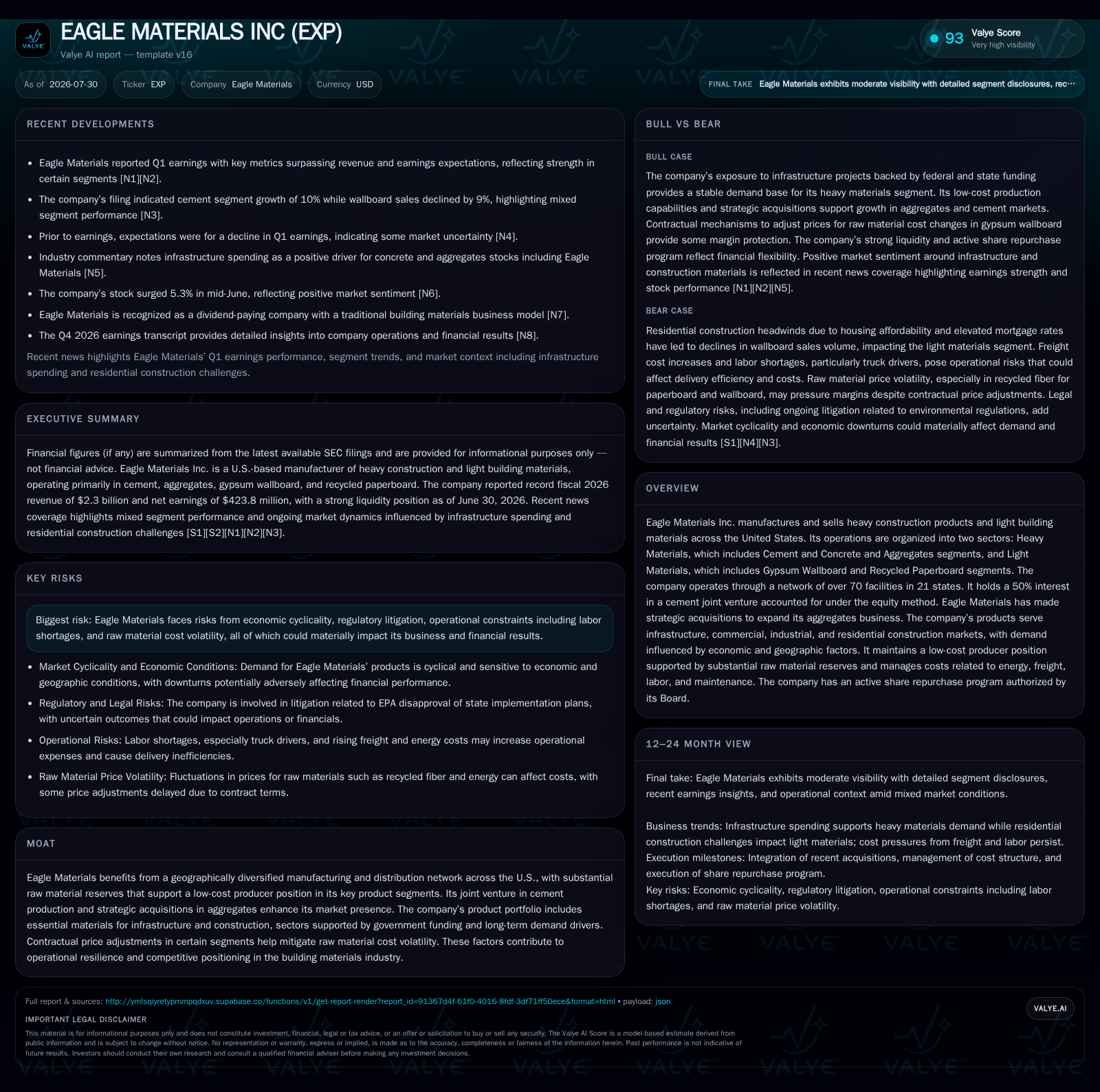
Eagle Materials Inc. reported steady performance in its Heavy Materials sector during Q2 2026, supported by strategic acquisitions and stable pricing in cement and aggregates despite cost headwinds. Conversely, the Light Materials sector faced volume softness, particularly in gypsum wallboard, reflecting broader residential construction challenges. The company's extensive manufacturing network and raw material reserves underpin its cost-competitive position, while contractual price adjustments help mitigate input cost volatility. Financially, Eagle maintains a strong liquidity cushion with moderate leverage, enabling ongoing capital allocation for growth and shareholder returns. Key risks revolve around economic cyclicality, regulatory litigation linked to EPA actions, labor constraints, and input cost volatility.
Recent Operating Update: Q2 2026 Highlights
Eagle Materials posted its quarterly results for the three months ended June 30, 2026, reinforcing the resilience of its Heavy Materials sector while navigating softness in Light Materials demand [S2], [S3]. Specifically, the Concrete and Aggregates segments benefited from price increases and volume expansions partly fueled by recent acquisitions such as Western Pennsylvania [S1], [S13]. The company's geographic diversification across more than 70 facilities positions it well to capitalize on localized infrastructure activity [S26]. However, gypsum wallboard sales volume declined around 7%, reflecting tempered new home construction activity linked largely to high mortgage rates and residential affordability concerns [S13], [N6]. This bifurcation between the sectors signals structural shifts in end-market demand.
Business Model Nuances
Eagle operates primarily as a producer and distributor of critical construction materials via two broad sectors: Heavy Materials (Cement & Concrete plus Aggregates) and Light Materials (Gypsum Wallboard and Recycled Paperboard) [S1], [S26]. Revenue arises from selling these products through direct channels largely to contractors, infrastructure projects, industrial builders, and commercial developers. Its monetization model is volume-driven but significantly aided by realized pricing mechanisms that include contractual price escalators—particularly important in cement production where input costs like energy are volatile [S1]. Having substantial raw material reserves such as limestone for cement quarries confers a cost advantage given the capital-intensive nature of these assets; this low-cost positioning is central to sustaining margins when commodity prices fluctuate.
The company’s recent acquisitions expand its aggregates footprint and enhance distribution reach. For example, the Western Pennsylvania acquisition integrated $150 million in assets into concrete & aggregates operations starting early fiscal 2025, bolstering sales volume and geographic presence [S1], [S13], [S26]. Such moves align with sector norms where consolidation assists scale and network density advantages.
In contrast, the Light Materials sector's exposure to residential markets makes it more sensitive to housing cycles—currently pressured by higher mortgage rates dampening new home starts. This dynamic materially affects gypsum wallboard sales volumes though recycled paperboard benefits indirectly since it feeds into wallboard production inputs [S13]
Industry Structure and Competitive Positioning
The building materials industry is marked by high capital intensity due to the need for manufacturing plants (cement kilns, concrete batch plants) and quarries for raw materials (limestone, sand, gravel). Competitors compete on scale, cost leadership through efficient reserves management, distribution breadth to minimize freight expenses—often a significant margin lever—and contractual price pass-through mechanisms to mitigate input inflation.
Eagle’s extensive U.S.-wide manufacturing footprint (8 cement plants; over 30 distribution terminals) gives it a competitive edge compared with smaller regional operators who may lack such scale or reserve quality [S1], [S26]. The company’s equity interest in a cement joint venture further diversifies risk exposure while enhancing supply capacity.
Effective logistics management is crucial due to freight-intensive nature of aggregates transport; Eagle reports freight costs around $215 million annually recorded both in revenue (customer billings) and cost of goods sold (delivery expenses), underscoring symbiotic cost-revenue accounting practices typical in the sector [S20]. This bilateral treatment aids transparency but also underscores exposure to fuel-price volatility.
Growth Drivers
Several factors underpin Eagle’s growth outlook:
- Federal Infrastructure Spending: Large-scale government initiatives such as the Infrastructure Investment and Jobs Act continue funneling funds into public works requiring cement/concrete/aggregates usage [S13]. The bipartisan nature of these investments provides some cyclical insulation.
- Residential Market Cyclicality: Although currently subdued by mortgage rates impacting gypsum wallboard volumes negatively, a potential easing could unlock pent-up demand owing to chronic housing supply deficits regionally [S13],.
- Acquisitions & Joint Ventures: Carefully targeted acquisitions enhance product mix breadth and geographic penetration. These deals add acreage/reserves for mining operations or expand production capacity that can translate into top-line growth margins if integration is seamless [S1], [S13].
- Price Escalation Contracts: These contractual constructs allow Eagle to adjust pricing periodically based on changes in input costs like energy or raw materials—a margin protection tool crucial when commodity volatility spikes.
- Operational Efficiencies: Increasing plant utilization rates and streamlining operating expenses contribute directly to margin expansion; fiscal 2026 data reflect meaningful cost reductions tied to maintenance and freight throughput optimization [S13].
Risks and Watchpoints
Key risks relate largely to:
- Cyclicality: Given heavy dependence on construction activities which closely follow macroeconomic trends—including interest rate sensitivity—the company faces demand variability especially visible in its Light Materials segment [S13].
- Regulatory Litigation: Eagle is involved in ongoing litigation following EPA disapproval of certain State Implementation Plans relating to ozone standards with possible operational constraints or financial liabilities looming uncertainly [S1], [S22]. Regulatory outcomes here pose execution risk.
- Input Cost Volatility: Energy prices account for a large portion of production costs especially cement kiln operation; despite contract price adjustments some short-term margin compression is possible with rapid inflation shifts or unforeseen supply chain disruptions.
- Labor Availability: The industry-wide challenge of skilled labor shortages combined with wage inflation pressures could raise operating costs or limit production capacity utilization rates.
- Logistics Constraints: Freight disruptions due to external factors can delay deliveries or increase costs beyond pass-through capacity affecting net operating margins.
What To Watch Next
Investors should monitor:
- Quarterly production volumes across cement, aggregates, gypsum wallboard for early signs of demand trajectory shifts.
- Pricing trends versus input cost inflation metrics—frequency and magnitude of contractual price escalations will indicate margin sustainability.
- Developments in EPA litigation for any disclosure clarifying financial impacts or required operational changes.
- Capital allocation signals such as acquisitions pipeline updates or evolving share repurchase activity revealing confidence levels.
- Macroeconomic indicators around federal/state infrastructure funding disbursements plus mortgage rate trajectories informing residential construction dynamics.
Financial Profile Discussion
As of June 30, 2026, Eagle held $233.5 million in cash equivalents along with total debt approximating $1.78 billion resulting in net debt near $1.54 billion—a leverage profile common for capital-intensive building materials players managing large fixed asset bases [F1]. Current assets substantially exceed current liabilities with a current ratio over 3x indicating solid near-term liquidity cushions supporting working capital needs.[F1]
Available borrowing capacity under its revolving credit facility stands at roughly $740 million after accounting for outstanding letters of credit providing operational flexibility should capital needs or market conditions shift unexpectedly [S4], [F1].
This analysis synthesizes recent SEC disclosures together with industry context relevant as of mid-2026. It focuses on business fundamentals without endorsing investment positions or speculating beyond documented facts.
Disclaimer: This is research-only, informational analysis and not investment advice. It may include AI-generated interpretation and general industry context. Always verify important details using primary sources.

Comments