
Markel Group's Q2 Struggles Spotlight Underwriting Discipline and Capital Allocation Challenges
Markel Group’s Q2 2026 earnings reveal mounting underwriting profit pressures despite sustained revenue growth, underscoring the critical balance between specialty insurance discipline and capital allocation within its diversified holding company model.
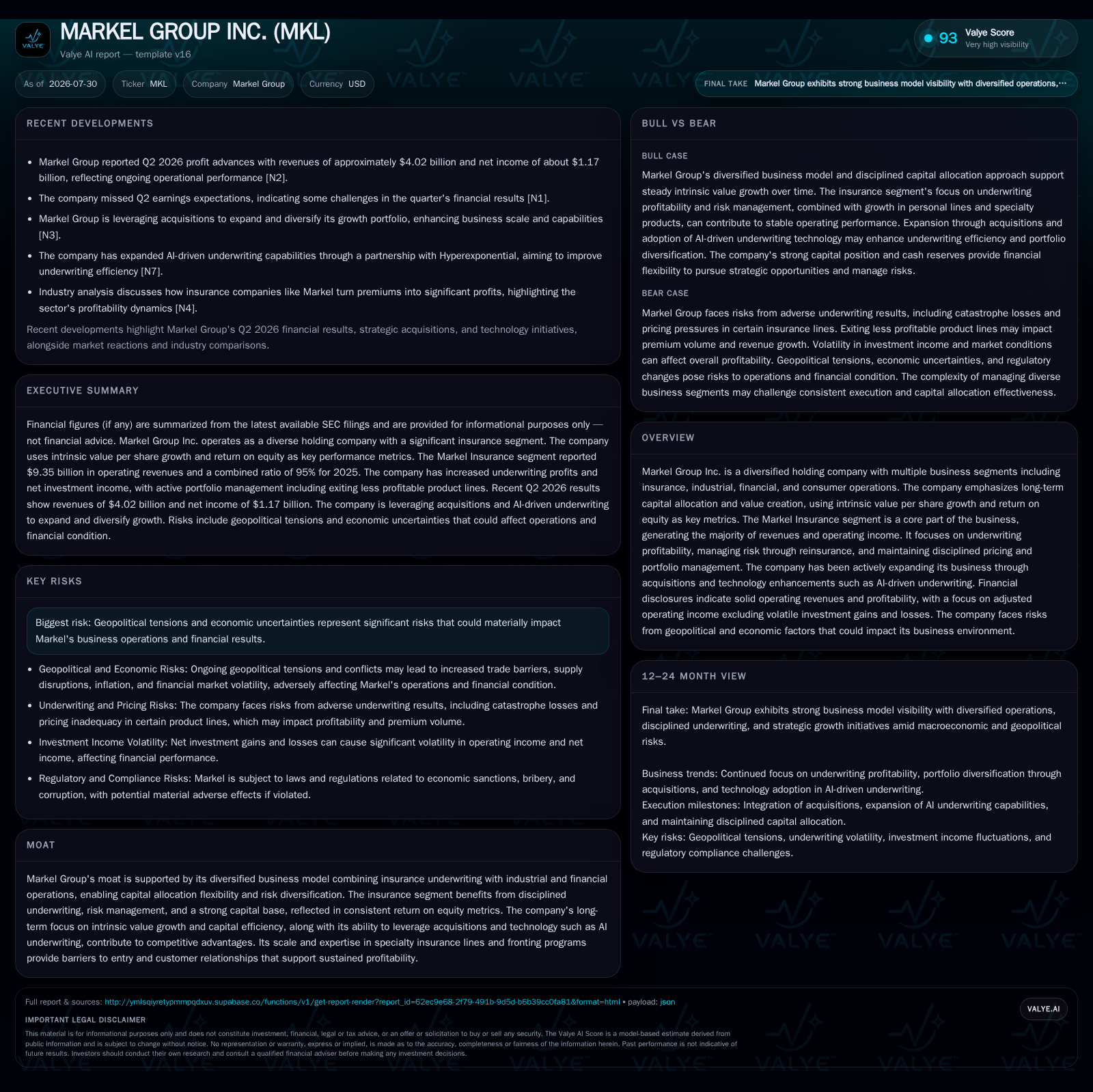
In its latest quarterly filing, Markel Group Inc. reported a Q2 earnings miss driven chiefly by underwhelming underwriting results amidst ongoing investments in acquisitions and AI-driven underwriting technology. The company’s core specialty insurance segment continues to generate the majority of revenues, but combined ratio pressures reflect cyclical headwinds and loss reserve uncertainty. Meanwhile, Markel’s diversified holding structure affords capital allocation flexibility supporting industrial and financial businesses. Yet, navigating macroeconomic volatility and geopolitical risks remains essential for sustaining long-term intrinsic value per share growth. Key metrics like gross written premiums, combined ratios, and return on equity will be pivotal in assessing recovery momentum.
Q2 Results Reveal Underwriting Pushback Amid Earnings Miss
Navigating Specialty Insurance: Markel's Diverse Product Mix and Risk Management
At its core, Markel Insurance specializes in hard-to-place risks across multiple divisions: U.S. Wholesale & Specialty, Programs & Solutions (including Bermuda operations), International markets spanning Europe to Asia-Pacific, plus the now run-off Global Reinsurance unit [S1][S20]. In 2025, the segment produced $12.5 billion in gross premium volume—with approximately $10.6 billion attributed to underwriting premiums—underpinned chiefly by specialty lines distributed largely through wholesale brokers (71%) alongside retail agents (26%) and binding authorities for smaller accounts [S1]. This distribution mix reflects a complex multi-channel strategy designed to reach niche markets where standard insurers exhibit reluctance.
The Global Reinsurance division’s transition into run-off following contract renewal rights sale adds a layer of complexity; although it no longer writes new business, legacy multi-year agreements prolong premium recognition but also inflate loss reserve uncertainty requiring careful actuarial monitoring over several years [S1][S20]. Fronting arrangements via Bermuda operations further enhance risk transfer flexibility but depend on careful reinsurance cessions earning fronting fees rather than direct risk retention.
Risk management remains differentiated through disciplined portfolio oversight, use of reinsurance treaties to mitigate peak losses, conservative loss reserves policy adjustments, and asset-liability matching in the investment portfolio—a hallmark of specialty insurers balancing underwriting float with market exposure.
Capital Allocation at the Helm: Balancing Investments, Acquisitions, and Shareholder Returns
Markel Group’s identity as a diversified holding company allows it to allocate capital flexibly across its insurance core plus expanding industrial, financial services (including insurance-linked securities management), consumer products, and emerging segments like education services acquired through Educational Partners International (EPI) consolidation in early 2025 [S1][S16]. This diversification dilutes earnings volatility intrinsic to specialty insurance while amplifying long-term intrinsic value per share creation.
The company adheres to a disciplined capital allocation framework prioritizing intrinsic value growth over five-year horizons using return on equity (ROE) measurements and maintaining prudent leverage with a consolidated debt-to-capital target range that stood at approximately 19%-20% through year-end 2025 [S1]. Share repurchases continue under the Board-authorized $2 billion program with $1.5 billion capacity remaining at end-2025; liquidity remains robust with $3.4 billion cash reserves balancing net debt near $945 million as of Q2 2026 providing ample runway for opportunistic acquisitions or technology investments [F1][S2].
Technology investments notably include AI adoption aimed at enhancing underwriting efficiency by improving risk assessment precision and streamlining workflow—key given competitive pressure from peers like W.R. Berkley Corporation who also focus heavily on data-driven underwriting discipline [S1].
Peer Prism: Evaluating Underwriting Discipline and ROE Versus Industry Comparables
While Markel shares characteristic specialty insurance market cycles with peers such as Arch Capital Group and W.R. Berkley, its diversified holding structure bears resemblance to Berkshire Hathaway’s approach combining insurance float generation with strategic capital deployment beyond core underwriting margins. Markel's historical average ROE near 13% compares favorably but indicates modest compression risk given current rising loss trends revealed in Q2 filings.
Investment portfolio composition—with a meaningful allocation toward public equity securities—adds earnings volatility due to mark-to-market fluctuations but supports long-term compounding potential [S1]. Hence adjusted operating income metric excluding transient unrealized gains/losses offers better clarity on underlying business health.
The recent combined ratio uptick evidences industry-wide pricing pressure and increased claims severity possibly linked with natural catastrophe frequency or evolving coverage claims—which require heightened reserving vigilance as well as pricing calibration to sustain underwriting profit margins.
Growth Trajectory: Technology Adoption, Acquisitions, and Expanding Specialty Lines
Markel continues deploying capital toward scaling specialty lines organically plus via acquisitions like EPI for Consumer segment expansion—a move broadening the company’s exposure to less cyclically sensitive revenue streams while leveraging existing administrative infrastructure for returns enhancement [S16]. The continued rollout of AI tools targets not only cost efficiencies but also faster throughput increasing competitiveness in wholesale broker channels that dominate placement flows.
Molten together with geographic expansion—in markets like London wholesale through Lloyd’s syndicate participation—and Program & Solutions’ niche insured portfolios including surety bonds and small commercial lines promotes diversification within core insurance operations adding resilience during adverse rate cycles [S1].
Risk Radar: Geopolitical Uncertainty, Reserve Adequacy, and Market Cyclicality
Markel’s latest filings underscore ongoing geopolitical risks affecting supply chains, inflationary cost pressures impacting claim costs severity, cybersecurity threats against operational continuity, interest rate fluctuations altering investment yields, and foreign exchange volatilities complicating international subsidiaries’ earnings translation [S2]. Reserve adequacy remains a critical watchpoint given run-off reinsurance exposures where loss emergence timing can stretch over multiple years invoking actuarial recalibrations.
Competition from other specialty insurers intensifies pricing discipline demands forcing tighter risk selection; failure here elevates combined ratios undermining historical profitability consistency treasured by investors seeking durable underwriting franchises.
What to Watch Next: Underwriting Trends, Premium Volume Momentum, and Investment Yield
Near-term investor focus should track upcoming quarterly releases for trajectory shifts in combined ratio components—attritional losses versus catastrophic impacts—and renewal pricing success across specialty lines evidencing effective cycle navigation. Growth signals from program expansion or geographic penetration will complement volume trends.
Investment income trends amid rising rates will test yield enhancement versus potential equity portfolio volatility damping immediate returns but preserving long-run capital appreciation potential. Monitoring technology integration advances may provide edge improving loss cost prediction accuracy enabling more granular price segmentation.
Share repurchase activity pacing will signal confidence levels alongside any material M&A transactions extending footprint or capabilities beyond current scope.
Financial Profile Discussion
Disclaimer: This is research-only, informational analysis and not investment advice. It may include AI-generated interpretation and general industry context. Always verify important details using primary sources.

Comments