
Impinj Surpasses Q2 Expectations with Strong Liquidity Amid Geopolitical Supply Risks
Impinj’s Q2 2026 earnings demonstrate operational resilience supported by robust liquidity, yet flagged geopolitical and investor risks present near-term execution challenges.
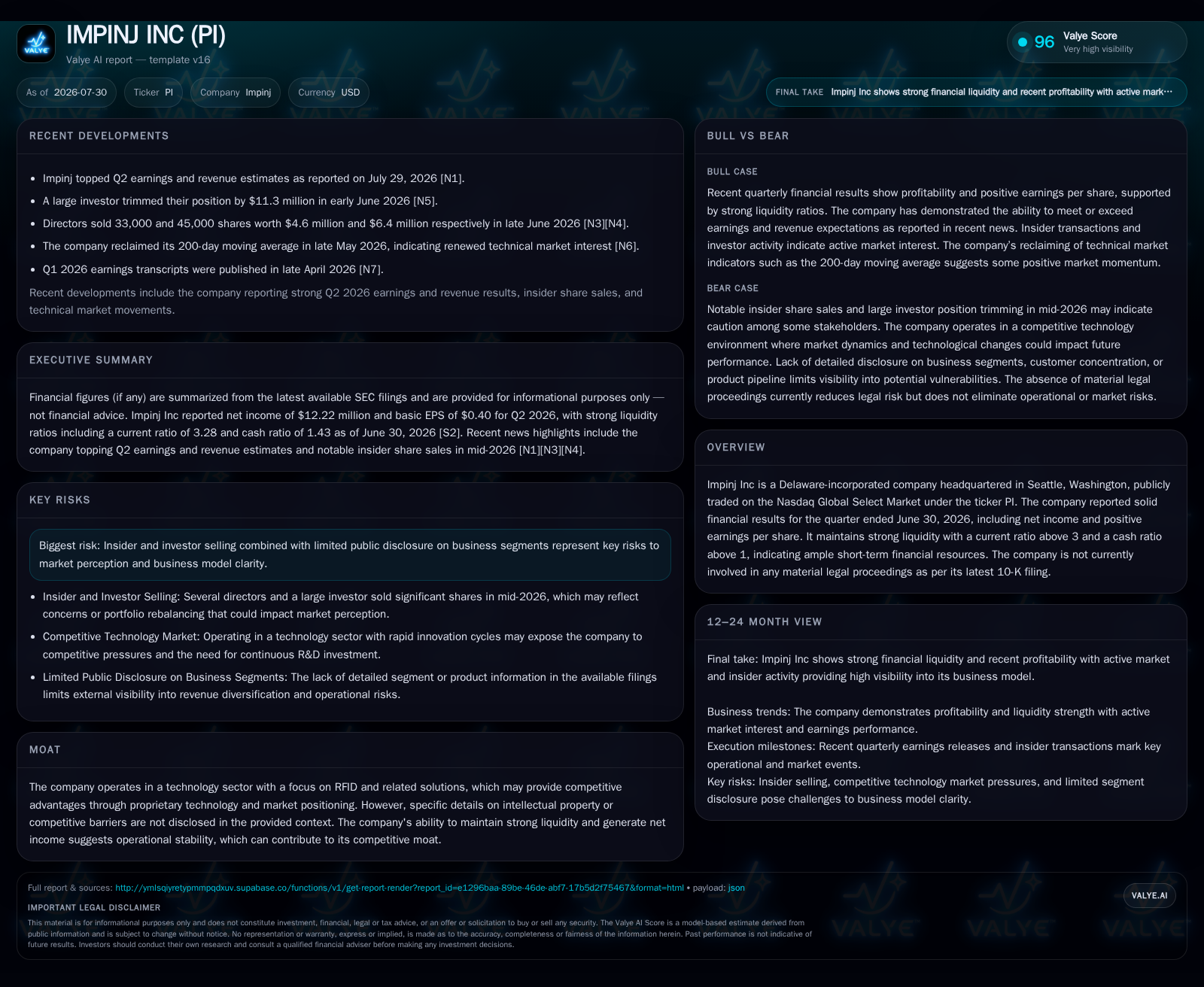
Impinj Inc delivered net income and positive earnings per share in the quarter ended June 30, 2026, signaling improved execution amid the dynamic RFID and IoT hardware environment. The company maintains a strong liquidity position with a current ratio above 3, providing buffer against supply chain and geopolitical uncertainties that could impact product availability and demand. Core revenue drivers stem from endpoint ICs, RFID tags, readers, and proprietary technology licensing, underpinning competitive differentiation through innovation and integration. However, insider selling activity and pricing pressures from commoditized tags represent notable risks alongside customer concentration concerns.
Q2 2026 Performance Highlights Confirm Operating Stability during Sector Volatility
Impinj Inc reported net income for the quarter ended June 30, 2026, marking a noteworthy advancement given historical oscillations between profitability and losses within the RFID hardware sector. This improvement indicates operational execution gains as the company navigates ongoing market headwinds [S2][S3]. A managing highlight is the company’s robust liquidity profile with a current ratio of approximately 3.28 at quarter-end and cash plus equivalents totaling around $38 million, positioning Impinj to withstand short-term disruptions and invest in growth initiatives [F1]. These liquidity metrics are especially relevant considering disclosed geopolitical factors that could affect semiconductor component supplies — a critical input for their RFID endpoints — thereby challenging production capacity or order fulfillment [S2].
Additionally, conversion options embedded in outstanding senior notes mature starting February 2027 provide potential capital structure flexibility over the medium term though they introduce conversion-related expense components impacting net income composition in some periods [S2]
Core Business Model Anchored by Proprietary RFID Semiconductor Technology and Licensing Revenue
The company’s revenue architecture revolves around three core elements: design and sale of endpoint integrated circuits (ICs), RFID tags/readers as physical hardware units deployed across industrial sectors, and licensing of proprietary technology essential to industry-standard RAIN RFID protocols [S1][S2]. This composition reflects a vertical integration within the RFID value chain—from semiconductor chip design through system-level deployment. Such integration offers differentiation against pure-play tag manufacturers or reader assemblers who lack proprietary silicon capabilities.
Licensing revenue is derived from patented technologies underpinning both Impinj products and third-party implementations under their patent portfolio. While detailed revenue segmentation is not publicly granular, this licensing stream represents an important margin enhancer given recurring nature tied to usage volumes rather than unit shipments alone [S1]. Maintaining elevated research & development spending at nearly half of operating expenses underscores management’s commitment to continuous innovation vital to sustain average selling price (ASP) premiums in a commoditizing tag marketplace [S1].
Embedded solutions integrating both hardware components with software-enabled device management further increase switching costs for customers deploying complex asset tracking or supply chain visibility systems—factors bolstering customer retention across retail, logistics, manufacturing, and healthcare verticals.
Competitive Landscape: Differentiation Through R&D and Customer Integration in a Fragmented Market
Within the RFID ecosystem where players range from Zebra Technologies specializing in comprehensive supply chain hardware/software solutions to Avery Dennison focusing heavily on tagging substrates, Impinj occupies a distinctive niche emphasizing semiconductor-level innovation backed by system integration capabilities. The company’s substantial R&D investments grant it technological leverage over more commoditized rivals such as Alien Technology who primarily manufacture tags or readers without integrated circuits.
Customer concentration remains notable as large enterprise clients represent significant revenue shares—a factor that constrains pricing power when those customers exert leverage especially amid broader economic fluctuations or supply shortages [S1][F1]. The company’s ability to diversify its clientele while expanding licensing partnerships will be crucial to mitigate margin sensitivity common to highly concentrated industrial technology suppliers.
Identified Growth Drivers Centered on IoT Expansion and Regulatory-Driven Adoption Dynamics
A core secular growth premise derives from accelerating adoption of RFID-enabled IoT applications across industrial automation, retail inventory management, logistics tracking, and healthcare asset control. Expanding e-commerce operations heighten demand for enhanced supply chain visibility solutions reliant on reliable RFID endpoints capable of seamless wireless connectivity.
Regulatory imperatives mandating product serialization, anti-counterfeiting measures, or safety traceability further stimulate market uptake beyond organic customer demand. Cloud-based analytics platforms amplifying data captured from embedded RFID systems drive additional service revenue opportunities connected to Impinj products [S1]. The interplay of these factors suggests sustained incremental volume growth potential in unit shipments of tags/readers alongside associated firmware/software subscriptions.
Emerging Constraints: Supply Chain, Insider Selling, and Pricing Pressures on Commoditized Tags
Supply chain vulnerabilities remain an acute concern as geopolitical tensions disrupt global semiconductor manufacturing networks impacting availability of silicon wafers essential for IC fabrication. These conditions impose production bottlenecks potentially constraining order backlogs or delaying deployments despite underlying demand strength [S2]
Concurrently, recent insider selling activity including director-level share disposals exceeding tens of millions USD introduces negative market perception risks about internal confidence levels, prompting scrutiny on governance or strategic outlook despite absence of disclosed fundamental deterioration [N3][N4]. This behavioral signal requires careful monitoring to distinguish routine portfolio rebalancing from emerging sentiment shifts.
Monitoring order backlog volumes relative to inventory turnovers could signal either approaching fulfillment delays or easing supply constraints.
Expansion of licensing agreements beyond existing partners would serve as a meaningful validation of the company’s IP moat sustainability. Successful launch or enhancement of next-generation RFID ICs embedding advanced features would underscore R&D efficiency translating into commercial advantage.
On the financing front, movement toward reducing net leverage—currently at approximately $209 million considering total debt less cash—and management's handling of convertible note maturities starting in early 2027 will inform capital structure flexibility assessments vital for funding ongoing innovation cycles without undue dilution or refinancing risk.
Financial Profile Discussion
Impinj’s balance sheet strength is underscored by a current ratio exceeding 3 (current assets approximately $305 million vs current liabilities near $93 million), evidencing resilient working capital buffers supportive of operational scaling in spite of external shocks [F1]. Cash equivalents amounting to roughly $38 million provide immediate liquidity enhancing agility.
Total debt aggregates approximately $247 million dominated by convertible senior notes with staggered maturities—$57 million due in May 2027 (2021 Notes) and $190 million maturing September 2029 (2025 Notes) permitting structured refinancing pathways if capital markets conditions remain favorable [F1][S2]. Interest expense remains modest relative to revenues due to low coupon rates.
No material contingent liabilities exist per latest filings with patent infringement litigations settled amicably via cross-licensing agreements extending through circa 2034 with primary competitor NXP Semiconductors—a resolution that mitigates legal uncertainty while generating ongoing royalty streams enhancing recurring revenue quality [S22][S26]
Overall, this financial footing effectively supports continued investment in R&D while maintaining adequate runway against unpredictable supply chain or macroeconomic disruptions. However, leverage levels warrant attentive governance given episodic profitability history common among high-growth semiconductor-reliant industrial hardware firms.
This analysis is based solely on publicly available filings as per SEC records dated July 29, 2026 ([S1],[S2],[S3]) combined with verified news sources ([N1],[N3],[N4]) and companyfacts financial data ([F1]). It does not constitute investment advice nor endorses any trading decision.
Disclaimer: This is research-only, informational analysis and not investment advice. It may include AI-generated interpretation and general industry context. Always verify important details using primary sources.

Comments