
Beta Bionics Advances Automated Insulin Delivery with New Clinical and Regulatory Milestones
Q2 2026 updates reveal progress in commercialization, regulatory challenges, and new device development shaping Beta Bionics' growth trajectory.
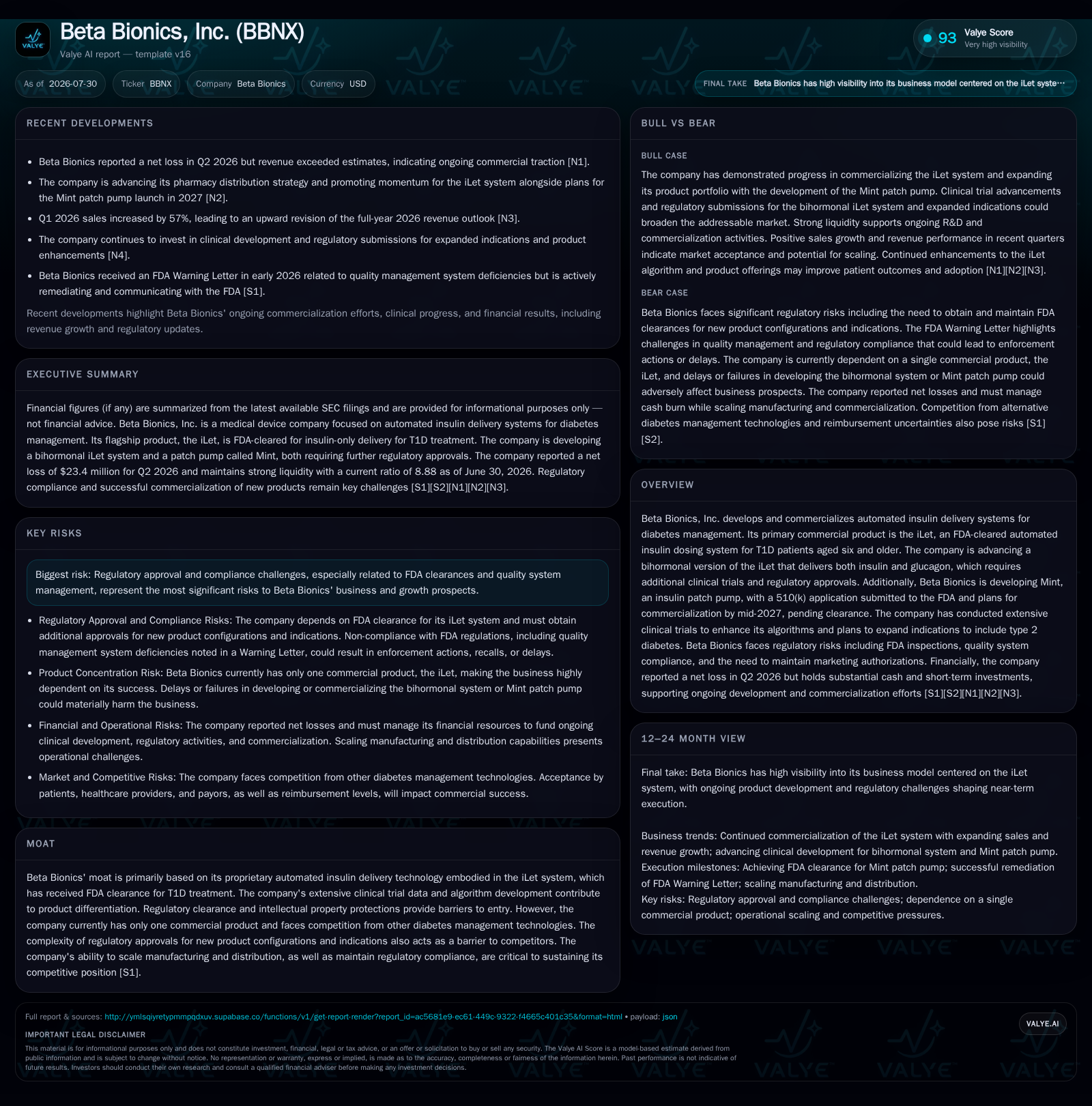
Beta Bionics reported second quarter 2026 results showcasing revenue growth driven by its FDA-cleared iLet automated insulin delivery system for type 1 diabetes, despite operating losses typical of early commercial-stage medical device companies. The company advances regulatory filings for a bihormonal iLet platform and the Mint patch pump, signaling product pipeline expansion but faces notable FDA quality management compliance risks that could affect timelines. Beta Bionics remains reliant on a narrow product portfolio, with ongoing clinical trials and pending approvals critical to broadening patient indications and generating recurring consumable revenues. Manufacturing scale-up and regulatory scrutiny will be key operational watchpoints in the near term.
Quarterly Operational Highlights Tighten Commercial Execution Focus
This operational profile underscores Beta Bionics’ transition from development to commercialization phase where pacing revenue gains against heavy research spending and infrastructure buildout is expected. Key performance signals include patient uptake rates evidenced by new device placements, clinician endorsements of algorithm efficacy (e.g., time-in-range improvements), and manufacturing throughput advancing toward capacity targets.
Navigating FDA Approvals and Platform Expansion Challenges
Beyond the single-hormone iLet device currently marketed, Beta Bionics faces complex regulatory pathways for its planned bifurcation into a bihormonal platform delivering both insulin and glucagon [S1]. This system necessitates multiple regulatory clearances: a New Drug Application (NDA) for glucagon drug approval concurrent with separate 510(k) submissions covering hardware infusion pumps and updated dual hormone algorithms. These multiple layers mean protracted clinical trial enrollment targeting both T1D and type 2 diabetes (T2D) cohorts to validate effectiveness before expanded labeling can be achieved [S1].
Separately, the Mint patch pump submitted its 510(k) application earlier in 2026 aiming for FDA clearance to enable full commercialization by mid-2027 [S1][S17]. Timing uncertainties remain given standard FDA review durations plus additional inspections verifying manufacturing site readiness. Notably, Beta Bionics recently received an FDA Warning Letter stemming from deficiencies cited during a June 2025 plant inspection relating to quality management system breaches [S21][S28]. While the letter does not currently inhibit manufacturing or sales activities, unresolved compliance issues pose downside risks to ongoing regulatory approvals or potential product recalls if corrective plans do not satisfy FDA scrutiny promptly.
This regulatory environment accentuates how adherence to quality system management (QMSR) protocols is vital across the company's value chain — from supplier qualification through production controls — to mitigate enforcement actions such as consent decrees or suspension of marketing clearances that would deleteriously impact commercial momentum.
Business Model Vulnerabilities Centered on Single Product Dependency
Beta Bionics' business model currently hinges materially on the iLet system. This concentration limits both revenue diversification and operating leverage until additional products like the bihormonal iLet variant or Mint patch pump enter commercial phases [S1][S2]. The monetization structure is initially device-driven sales; however, sustainable financial improvement depends on developing recurring revenues derived from consumables—such as infusion sets or sensors—and periodic software updates enhancing algorithm performance.
Currently, Beta Bionics lacks material contributions from software licensing or services typical for peers who integrate CGM data bundles or cloud-based analytics into their offerings. The absence of these recurring elements restrains margin expansion potential in the medium term until broader patient adoption facilitates ecosystem lock-in. Sensitivity remains high around execution cadence: any delay or failure in regulatory clearances risks elongating cash burn periods without offsetting product revenue gains.
Competitive Forces Shaping Beta Bionics’ Market Differentiation Strategy
Within the automated insulin delivery ecosystem, competitors such as Medtronic dominate with established scale manufacturing combined with extensive sales channels, while Tandem Diabetes Care emphasizes software integration enabling upstream CGM collaborations notably with Dexcom—the leader in continuous glucose monitoring technology. Meanwhile, Insulet Corporation champions the patch pump format similar to Mint's target market segment.
Beta Bionics differentiates itself primarily via proprietary algorithms embedded within the iLet platform that optimize insulin dosing by learning individual patient responses demonstrated through robust clinical trials—a moat erected through intellectual property protection tightly linked to outcomes like improved glycemic control time-in-range metrics [S1]. However, sustaining this competitive advantage hinges not solely on algorithmic sophistication but on capacity to scale manufacturing reliably and navigate intricate regulatory demands faster than peers.
The emerging bihormonal approach offering dual-hormone delivery represents an innovation frontier addressing hypoglycemia mitigation more effectively than current single hormone devices but introduces complexity due to additional NDA process for glucagon. Success here could define a technological leap altering payer willingness to reimburse higher-cost integrated devices.
'Unlocking' Growth: Device Pipeline and Emerging Indications as Future Demand Catalysts
Beta Bionics’ pipeline presents multiple levers for growth beyond incremental sales of its existing iLet product. Chief among them is the bihormonal version promising enhanced metabolic control through simultaneous insulin-glucagon administration subject to completion of ongoing clinical trials [S1]. Achieving dual algorithm clearance across T1D and expanding into T2D patient populations would notably enlarge addressable markets given the higher prevalence of type 2 diabetes globally fostering structural demand tailwinds.
Simultaneously, the Mint patch pump embodies strategic diversification targeting customers desiring minimally invasive alternatives favored for convenience compared to traditional tubing-based pumps [S17]. The anticipated mid-2027 commercialization window positions Mint as a near-term catalyst contingent upon timely FDA clearance and successful production scale-up phases.
These initiatives depend heavily on executing complex enrollments in pivotal studies confirming safety-efficacy profiles—benchmarks essential for investor confidence and payer formulary acceptance underpinning durable uptake curves.
'Guardrails' Against Risks: Regulatory, Manufacturing & Adoption Watchpoints
Risks outlined in Beta Bionics' Risk Factors sections emphasize recurrent themes including exposure to potential setbacks from FDA enforcement actions triggered by quality system non-compliance observed during recent facility inspections [S20][S21]. While remediation efforts are under way, lingering uncertainty about FDA satisfaction levels tempers near-term visibility around manufacturing continuity especially critical ahead of Mint launch preparations.
Manufacturing scale-up bottlenecks remain tangible constraints given complexity inherent in producing integrated AID systems at volumes needed for meaningful market penetration—mirroring challenges faced historically by peers Medtronic and Tandem upon rapid expansion phases. Supply chain disruptions or supplier regulatory non-compliance could compound delays adversely affecting customer fulfillment timelines.
Additionally, market adoption dynamics hinge on successfully navigating reimbursement frameworks which often lag behind innovative medical devices requiring extensive payer education alongside clinician training programs—particularly acute when seeking expanded indications into T2D segments different from initial pediatric/adult T1D targets [S1]. These factors contribute collectively toward extension in sales cycles potentially limiting near-term volume acceleration.
'What Comes Next' in Clinical Data Readouts and Commercial Scale-Up Milestones
Looking forward, key upcoming value inflections include Phase completion readouts supporting submission dossiers for bihormonal system components—insulin-glucagon dual delivery pump plus dual algorithm clearance—as well as anticipated feedback cycles related to Mint’s pending 510(k) review scheduled for late 2026/early 2027 horizon [S1][S17]. Monitoring enrollment statistics alongside any FDA guidance or inspectional outcomes will provide early signals regarding acceleration versus delay risks impacting projected launch timelines.
Commercially, early scaling indicators such as batch yields meeting quality specs, customer referral velocity post-iLet deployments, reimbursement authorization progress across major payors, and consumable refill rate trends represent tangible measures shaping growth sustainability narratives over rolling quarters.
Financial Profile Discussion: Cash Position Supports R&D but Commercial Scaling Pressure Looms
As of June 30, 2026, Beta Bionics held cash and equivalents totaling approximately $44.3 million with a robust current ratio near 8.9x reflecting strong short-term liquidity cushioning ongoing operations [F1]. Nonetheless, cash flow remains pressured by persistent operating losses stemming from elevated R&D expenses directed toward both refinement of existing products and advancement of pipeline devices alongside manufacturing investments [S2][N1].
The company thus confronts capital intensity inherent in scaling medical device firms crossing thresholds from innovation phase into commercial stalwarts. Sustaining capital discipline while balancing urgent funding needs for clinical programs will be crucial given still nascent levels of recurring revenues tied to consumables—a margin-enhancing lever material only once broader user bases establish steady purchase patterns.
In sum, Beta Bionics navigates classic early commercial-stage financial challenges compounded by demanding regulatory environments but possesses promising technology platforms whose future milestones offer inflection points contingent upon rigorous execution across product development, quality compliance, manufacturing ramp-up, and market acceptance domains.
Disclaimer: This analysis is based solely on publicly available information including recent SEC filings and does not constitute investment advice or research views. Prospective stakeholders should consult professional advisors before making decisions related to Beta Bionics or its securities.
Disclaimer: This is research-only, informational analysis and not investment advice. It may include AI-generated interpretation and general industry context. Always verify important details using primary sources.

Comments