
Adobe Strengthens Market Reach with Semrush Acquisition and Subscription Growth
Adobe's Q2 2026 report highlights the integration of Semrush and strong subscription revenue expansion, reinforcing its leadership in SaaS infrastructure for creative and marketing solutions.
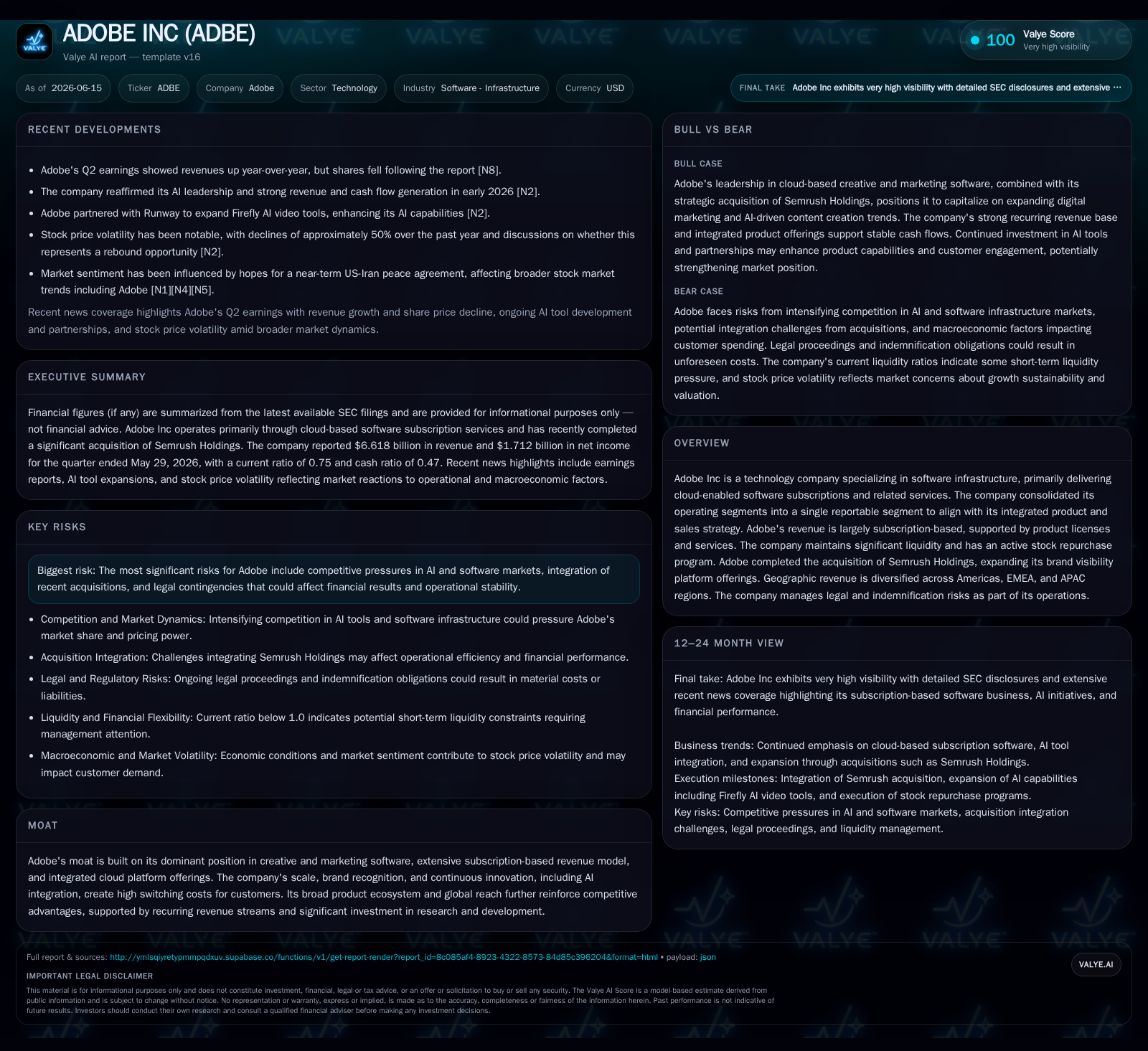
Adobe completed its acquisition of Semrush in April 2026 for $1.87 billion, adding a brand visibility platform to its portfolio and broadening its marketing software capabilities. The Q2 FY2026 filing shows subscription revenue rising markedly year-over-year to $6.4 billion, supported by high customer retention and recurring revenue strength. Adobe operates as a unified business segment focused on integrated cloud software delivery with significant investments in R&D to maintain innovation and competitive moat. Legal risks from prior DOJ litigation have been settled, reducing near-term uncertainty while competition intensifies in AI-enabled marketing and creative SaaS sectors. Liquidity remains robust with $4.9 billion cash and manageable net debt post-acquisition.
Q2 2026 Operating Highlights: Semrush Acquisition Boosts Marketing Platform Capabilities
Adobe's latest quarterly filing reported completion of the Semrush Holdings acquisition on April 28, 2026 for approximately $1.87 billion primarily in cash [S2]. This strategic move expands Adobe’s reach into brand visibility and digital marketing analytics, adding search engine optimization (SEO), generative engine optimization, and agentic search optimization solutions to its portfolio. The integration of Semrush commenced immediately post-closing, with financial results included from the acquisition date onward [S2]. This acquisition diversifies Adobe’s marketing offering beyond traditional creative tools and digital experience platforms.
Recurring Revenue Model: Subscription Growth Drives Top-Line Momentum
Adobe’s core business model centers on cloud-enabled subscription licenses for its creative, marketing, and document cloud products [S1]. Subscription revenue is the primary growth engine due to predictable annual recurring revenue (ARR) streams backed by multi-year contracts and high net revenue retention (NRR). The company achieved double-digit subscription revenue growth on a Y/Y basis this quarter despite macroeconomic uncertainties [S2]. Retention benchmarks implied by consistent ARR expansion indicate relatively low churn rates driven by high switching costs anchored in product depth and integration.
Complementing subscriptions are professional services that aid onboarding, customization, and integration, which support customer lifetime value (LTV) enhancement though represent a smaller margin pool [S1]. Cross-selling within Adobe’s broad software ecosystem leverages multi-product adoption incentives via unified sales strategies following segment consolidation into one reportable unit [S1], [S2].
Business Model Dynamics: Integrated Cloud Platform Powering Customer Stickiness
Since Q1 FY2026, Adobe consolidated formerly segmented reporting units—Digital Media, Digital Experience, Publishing & Advertising—into one single operating segment [S1], [S2]. This structural change aligns with management’s focus on delivering an integrated suite combining creative production tools with customer journey analytics and marketing automation under one cloud platform umbrella.
High switching costs arise from deeply embedded workflows across Adobe products coupled with proprietary integration APIs enabling enterprise customers to tailor solutions end-to-end [S1]. The acquisition of Semrush adds capabilities targeting search marketing workflows that enhance ecosystem stickiness further.
Research & Development expenses remain extensive as a percentage of revenue (roughly mid-teens range), underscoring Adobe’s emphasis on innovation including development of AI-powered creative features and advanced analytics tools [S2], [S1]. Continuous investment aims to counter competitive pressures from emergent SaaS platforms targeting niche verticals or emerging tech like Figma for design collaboration.
Competitive Positioning: Adobe amid Enterprise SaaS Giants and Marketing Analytics Providers
Adobe occupies a distinctive position straddling world-leading creative software infrastructure alongside expanding marketing software capabilities. In contrast to generalist enterprise SaaS providers like Salesforce or Microsoft, Adobe maintains specialized offerings with deep domain expertise combined into one cloud solution stack.
The Semrush acquisition marks an important step into digital marketing analytics territory where competitors include platforms such as HubSpot or standalone SEO tools. Yet Adobe’s scale advantage coupled with integrated data insights from content creation through campaign execution provide differentiation difficult to replicate by pure-play competitors [S1]. This breadth supports pricing power despite intensifying AI-related competitive dynamics across software categories.
Growth Catalysts: Innovation, AI Integration, and Geographic Expansion Perspectives
Persistent R&D spending fuels feature enhancements embedding AI/ML technologies that automate creative workflows and optimize marketing decision-making at scale [S2], [S1]. Given accelerating enterprise digital transformation trends favoring cloud-native SaaS adoption, Adobe benefits from secular tailwinds supporting ARR growth.
Geographically, Adobe maintains balanced exposure across Americas, Europe/Middle East/Africa (EMEA), and Asia-Pacific (APAC) regions mitigating localized economic volatilities while capturing growth opportunities in emerging markets via tailored offerings and channel partnerships [S1]. Cross-selling synergies leveraging Semrush's footprint enhance global marketer engagement.
Strategic acquisitions remain core to extending product scope and entering adjacencies faster than organic paths allow. Forward-looking statements emphasize pipeline technology investments intended to reinforce competitive moat through integrated platform experiences.
Risks to Monitor: Legal Settlements, Competitive Intensity, and Acquisition Integration
A material legal uncertainty settled during the past six months was the DOJ lawsuit concerning allegations around subscription disclosure practices violating the Restore Online Shoppers’ Confidence Act (ROSCA) filed in mid-2024 [S4], [S5]. The settlement concluded in early 2026 alleviating this litigation risk overhang but illustrates susceptibility to regulatory scrutiny common amongst subscription-based SaaS providers.
Competitive pressures remain elevated especially regarding pricing strategies amid growing AI capabilities across both creative design tools and marketing analytics software markets. Integration complexity following the large Semrush transaction is another potential execution constraint requiring close monitoring given platform overlaps and cultural harmonization needs.
Additional risks typical for multinational SaaS firms include dependency on major cloud infrastructure providers for uptime reliability plus evolving data privacy regulations impacting customer data management practices.
What to Watch: Forward Guidance, Customer Metrics & Integration Progress
Investors should track metrics providing visibility into future recurring revenue stability such as subscription renewal rates, net new ARR bookings beyond Semrush synergies, customer churn adjustments post-integration phase, and any shifts in geographic revenue mix indicating regional demand variations [S3]
Management commentary around progress integrating Semrush’s product set will be critical in assessing realization of anticipated cross-selling opportunities plus cost rationalization potential within sales channels.
Updates on evolving AI feature deployments will signal continued innovation pipeline vitality important for sustaining long-term market leadership.
Financial Overview: Liquidity, Debt Profile, and Capital Allocation Priorities
As of May 29, 2026 quarter-end, Adobe held approximately $4.9 billion in cash and cash equivalents against total debt near $6.15 billion recorded at February 27, 2026, resulting in net debt of about $1.23 billion—reflective of funding part of the recent acquisition using cash reserves alongside existing debt facilities [F1], [S2].
Operating cash flow generation remained robust supporting ongoing R&D investments without liquidity strain while stock repurchases continue under active authorization programs evidencing shareholder return focus alongside growth spending priorities [S2]
Capital expenditures remain moderate relative to operating cash flows consistent with SaaS model economics requiring negligible physical assets but sustained investment into cloud infrastructure partnerships.
This analysis references facts drawn directly from Adobe Inc.’s most recent SEC filings through June 15, 2026 ([S1], [S2], [S3], [F1]) emphasizing how recent strategic actions including the Semrush acquisition combine with foundational subscription economics to shape ongoing operational performance amidst sector-specific growth drivers and risks typical for large-scale SaaS infrastructure providers.
Disclaimer: This is research-only, informational analysis and not investment advice. It may include AI-generated interpretation and general industry context. Always verify important details using primary sources.

Comments