
Helio Corporation’s Strategic Capital Move to Support Space Hardware Expansion
Helio’s Q2 2026 filing reveals critical financing efforts underpinning growth in specialized space-qualified hardware and systems engineering for government and commercial aerospace sectors.
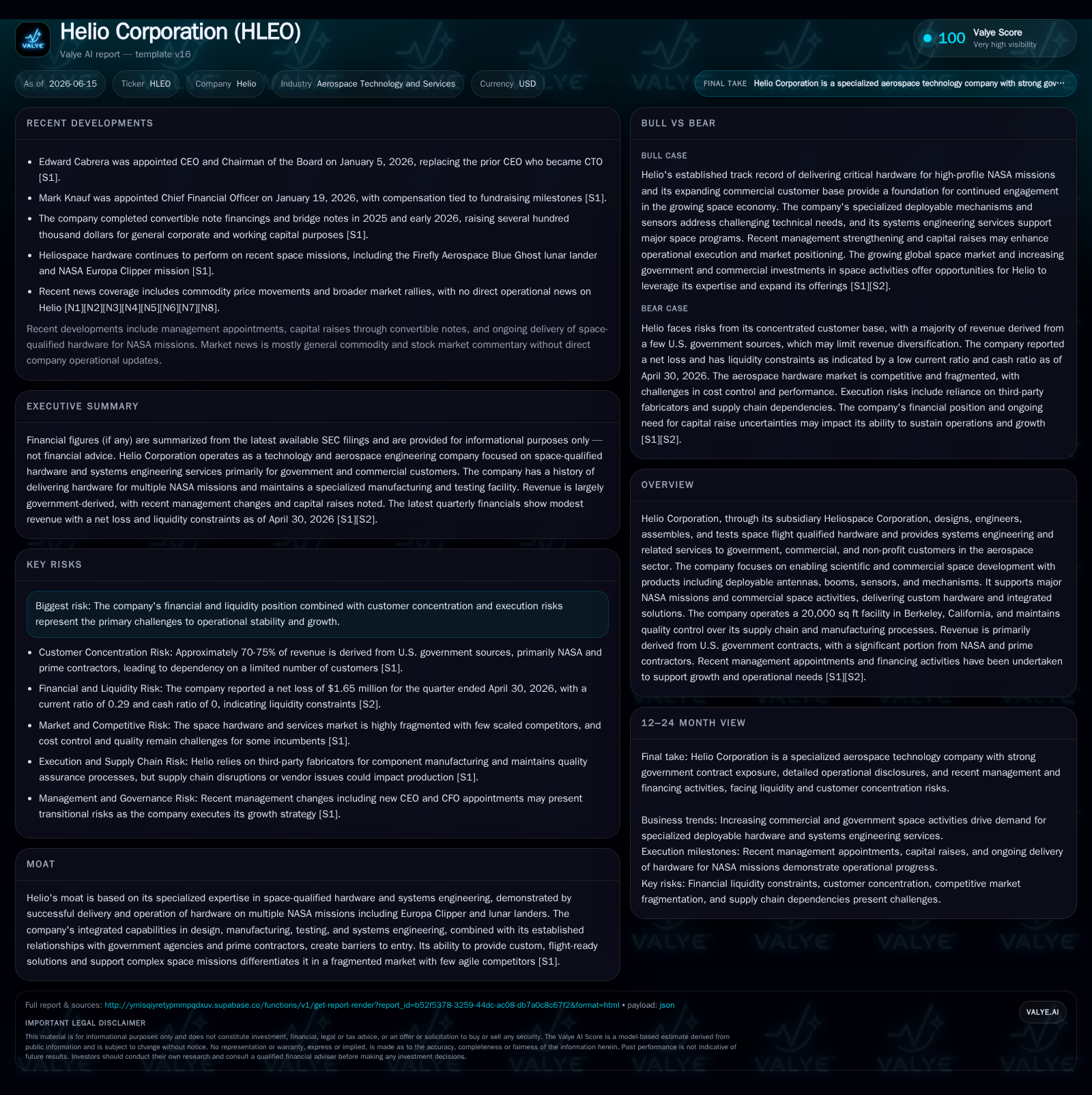
In its latest 10-Q filing dated June 15, 2026, Helio Corporation disclosed ongoing negotiations for bridge financing aimed at repaying promissory notes and funding operational initiatives, including R&D expansion and manufacturing improvements. The company’s business centers on delivering custom space-qualified hardware and integrated engineering services primarily under government contracts with milestone billing revenue recognition. While driving growth through participation in major NASA missions and emerging commercial space markets, Helio faces significant liquidity constraints and concentrated customer risk requiring substantial additional capital. Monitoring milestone achievement and financing outcomes will be key near-term indicators of execution.
Recent Quarterly Operating Update: Financing and Operational Initiatives
Helio Corporation’s June 15, 2026 10-Q filing reveals the company is actively negotiating bridge financing facilities intended to repay existing promissory notes and support key operational objectives. Specifically, these capital infusions are slated to fund expansions in R&D capabilities, bolstering sales, marketing, business development activities, facility infrastructure enhancements, manufacturing process improvements, as well as general corporate needs including working capital [S2]. This capital-intensive aerospace firm underscores the necessity of substantial additional funding to execute its near- and medium-term strategic plans.
A crucial element informing Helio’s revenue timeline is the milestone billing framework employed across its government contracts. Work In Progress (WIP) accounting captures incurred costs for jobs where specified contractual milestones remain uncompleted; revenues are recognized only upon achievement of discrete performance obligations that yield identifiable customer benefits independently from other contract phases [S2]. This dependency on milestone achievement delays revenue recognition relative to cash outlays for complex project executions.
Business Model: Delivering Custom Space-Qualified Hardware and Engineering Solutions
Helio’s business model centers around designing, manufacturing, assembling, and testing space-qualified flight hardware alongside providing integrated systems engineering services tailored principally for NASA missions and other U.S. government clients. Its portfolio spans deployable antennas, mechanical booms, sensors, precision mechanisms, and mission-specific payloads that require stringent spaceflight certification due to the harsh conditions of space operations.
Target customers pay via milestone-based contracts that may be time & materials or purchase orders but always depend on clear performance metrics aligned with project phases. This results in revenue driven by volume of milestones achieved rather than purely product shipments or service hours alone.
The company leverages a vertically integrated approach — combining design expertise with flight hardware assembly/testing skills — facilitating turnkey solutions that serve unique mission requirements. This integration differentiates Helio from competitors who typically specialize more narrowly at either system integration or component manufacturing stages [S1].
Industry Structure: Government Contract Dependence and Competitive Context
Operating primarily in the midstream segment of aerospace value chains, Helio acts as both a tier-1 supplier to prime contractors like NASA contractors and direct contractor to agencies themselves. The sector features few large players such as Lockheed Martin or Ball Aerospace dominating with extensive scale yet faces fragmentation at specialized hardware niches due to technical complexity and certification barriers that limit new entrants.
Helio occupies a focused niche delivering customized aerospace instruments combined with systems engineering services—a blend uncommon among specialist competitors who usually lack full integration or prime-scale government relationships. However, this concentration on government clients translates into high customer concentration risk typical in the sector. Milestone billing patterns linked to government budgeting cycles create elongated cash conversion periods demanding disciplined working capital management [S1]
Growth Drivers: Expanding Space Missions and Technology Innovations
Expansion in global space exploration programs fuels demand for Helio’s offerings. The increased frequency of lunar landers, Mars sample returns, CubeSat constellations like SunRISE, and other NASA science initiatives generate recurring opportunities for deploying smart payloads designed by Helio’s team.
Moreover, the emergence of commercial projects such as Blue Origin’s lunar landers broadens prospective markets beyond traditional government contractors. Helio is investing in advanced deployable systems including flight qualified release mechanisms and modular antenna designs targeting scalable commercial sales under NASA commercialization programs [S1,S23]
Longer-term ventures into Space Based Solar Power (SBSP) exemplify ambition to pioneer integrated space infrastructure solutions expected to tap multi-trillion-dollar energy markets by mid-century. This positions Helio at the forefront of mission lifecycle innovation from hardware design through mission formulation supporting increasingly sophisticated space applications.
Risks and Constraints: Customer Concentration and Capital Intensity Challenges
Helio carries significant exposure to revenue concentration via limited government customers representing the bulk of contracts. Delays or budgetary cuts at these agencies could materially disrupt revenue streams given billing tied closely to milestone progression.
The removal of conversion options during note amendments signals renegotiation pressures intended to push imminent maturities outward but likely increases refinancing risk.
Given operating losses sustained from high overhead on research-expense intensive product development cycles coupled with elongated payment terms typical in aerospace contracts, recurring financing rounds appear necessary just to maintain operations within working capital limits.
What to Watch Next: Financing Milestones and Revenue Booking Signals
Key upcoming catalysts include successful closure of bridge financing deals targeted to retire costly promissory notes while freeing resources for expanding production capacity amidst rising order backlog reported earlier this year [S2]. Furthermore, monitoring the achievement rate of scheduled project milestones will offer leading indicators around revenue recognition acceleration potential given their integral role in converting WIP into booked income.
These notes carry interest rates ranging from 9.75% to 12.00% and mature mostly within the next two fiscal years [S2]. Cash and cash equivalents remain minimal at about $7,305 as of October 31, 2025 [F1]. Current assets total approximately $940,410 against current liabilities of about $3,259,418, resulting in a current ratio near 0.29 [F1]. This reflects a net debt position near $723,195 [F1] and underscores a challenging liquidity stance.
Management emphasizes ongoing fundraising necessity explicitly warning no assurance exists regarding completion or terms favorable enough for sustainable operations beyond one year horizon absent substantial external capital inflows [S2]. This financial profile typifies early-stage specialized aerospace manufacturers where capital intensity matches industry norms but magnifies risks without broader equity market access or prime contractor-backed long-term backlog commitments.
This analysis synthesizes publicly filed SEC disclosures through June 15th, 2026 without making investment research views or forecasts beyond documented evidence.
Financial position in context
As of 2026-04-30, companyfacts shows $730,500 of total debt [F1]. Companyfacts also indicates net debt of roughly $723,195 for the latest available period [F1]. Current assets of $940,410 and current liabilities of approximately $3.26 million imply a current ratio near 0.29x for 2026-04-30 [F1].
Disclaimer: This is research-only, informational analysis and not investment advice. It may include AI-generated interpretation and general industry context. Always verify important details using primary sources.

Comments