
Powerfleet Advances Unified AIoT Platform with Acquisition-Driven Scale
Powerfleet’s latest quarter showcases progress in scaling its unified AIoT platform amid integration and leverage challenges shaping its growth trajectory.
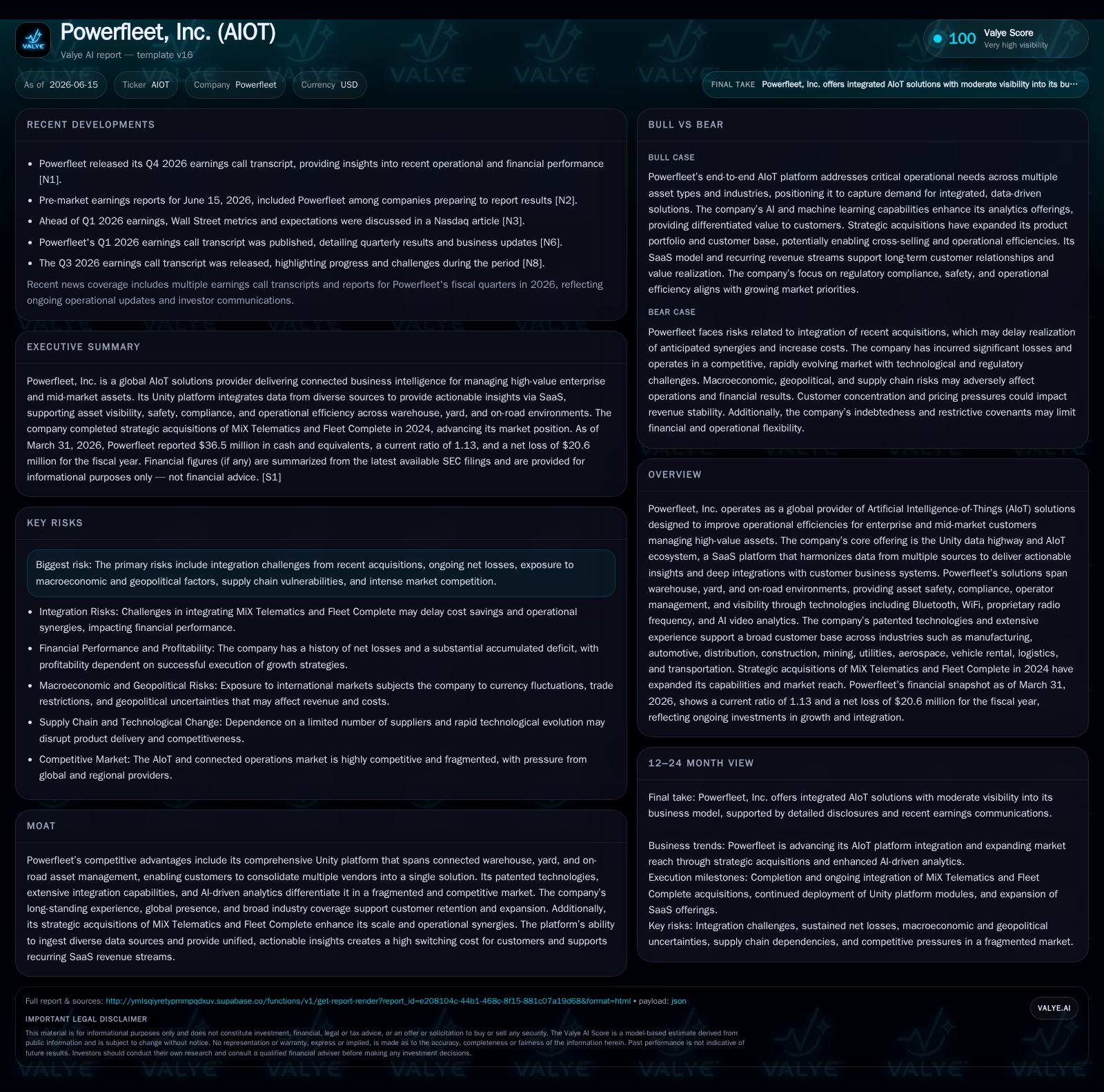
In its latest quarterly filing, Powerfleet highlighted operational gains driven by acquisitions of MiX Telematics and Fleet Complete that expanded its global footprint and customer reach. The company’s Unity AIoT platform integrates multi-source data across warehouse, yard, and on-road assets to deliver actionable insights via a SaaS model complemented by hardware sales and professional services. While the broad platform and patented technologies create high switching costs and support recurring revenue growth, integration complexities, elevated debt levels, and competitive pressures represent key near-term constraints. Monitoring recurring revenue trajectory, net retention, and successful integration milestones will be central to assessing Powerfleet’s path to sustainable profitability.
Latest Quarterly Operating Update Highlights Scale Gains Amid Integration Work
Powerfleet’s 10-Q filing for Q3 FY2026 dated February 9 reveals tangible progress in leveraging acquisitions that materially enhanced scale and market presence [S2]. The integrations of MiX Telematics and Fleet Complete have expanded the company's global operational footprint to markets including South Africa, Canada, Europe, and Latin America [S1]. These transactions have grown the customer base to over 50,000 enterprises spanning multiple industries yet introduce complexity around harmonizing systems and processes [S22].
Operationally, Powerfleet continues building out its device attachment rates—a key SaaS KPI reflecting how many IoT devices are deployed per customer—which supports higher average revenue per user by consolidating asset management functions onto the Unity platform [S2], [N1]. However, as noted in risk disclosures and MD&A commentary [S1], these integration activities are a dual-edge sword: they create opportunities for cross-selling and operational synergies but also cause near-term inefficiencies such as fragmented legacy systems running in parallel and delayed realization of cost savings.
Supporting this strategic thrust is the company’s recently furnished earnings call material reinforcing commitment to drive platform-based solutions over point products through enhanced AI capabilities and unified data ingestion [N1], [S3]. This incremental scale is central to Powerfleet’s ability to offer holistic asset intelligence rather than fragmented telematics or standalone device management prevalent among competitors.
Powerfleet’s AIoT Unity Platform: Business Model and Product Quality Assessment
Powerfleet built its business model around the Unity data highway—an AIoT SaaS platform that ingests heterogeneous data streams from IoT devices using Bluetooth®, WiFi, proprietary radio frequency communication technologies—and applies AI video analytics for safety-critical environments [S1]. The software provides enterprise-wide visibility bridging warehouse operations (e.g., forklifts, man-lifts), yard management (e.g., ground support equipment at airports), through to on-road heavy trucks, trailers, rental cars, and automotive OEM fleets [S25].
Revenue derives primarily from recurring subscriptions granting access to Unity’s software ecosystem combined with hardware device sales tailored for rugged operating conditions plus professional services including system implementation and ongoing consulting [S1]. This business mix ensures predictable recurring revenue driven by high device attachment rates complemented by one-time or periodic hardware sales to enable connectivity.
The platform’s patented sensor designs and battery management technology support differentiated performance in harsh environments. Coupled with advanced AI-enabled analytics delivering actionable KPIs on asset utilization, operator behavior, safety compliance monitoring including pedestrian proximity alerts via video safety modules—these capabilities reinforce value propositions across verticals like manufacturing, logistics, construction, utilities, aerospace, vehicle rental fleets and transportation [S25]. The ability to consolidate multiple legacy suppliers into one unified platform creates switching costs maintaining net retention.
Competitive Positioning in Industrial AIoT: Unified Platform versus Fragmented Solutions
Powerfleet operates in a fragmented Industrial IoT landscape where many competitors specialize narrowly either in on-road telematics or isolated asset tracking solutions. By spanning warehouse-to-road with a single integrated ecosystem backed by over 35 patents and decades of IoT expertise [S1], Powerfleet strategically positions itself as a platform provider enabling customers to consolidate disparate asset management vendors.
Competitors mentioned in filings include Geotab, Samsara (IOT peer), Karooooo, Verizon Connect among others—all with sizable operations but often focused on specific segments such as fleet telematics or video safety in isolation rather than full-spectrum unity [S27]. This breadth underpins Powerfleet’s moat through embedded integrations with customers’ ERP systems, transportation management platforms (TMS), yard management systems (YMS), labor/timecard tools plus SaaS analytics layered atop ingested data streams [S7],[S10].
The extensive partner ecosystem coupled with open APIs further strengthens switching barriers fostering long-term contracts evidenced by growing annual recurring revenue compositions although exact ARR figures remain undisclosed publicly [N1], [S3]. Pricing power benefits from demonstrable ROI typically realized within 12 months post-deployment which supports uptake despite competitive pressure noted as a market risk due to new entrants and technologically evolving rivals [S9].
Growth Drivers: Acquisitions, SaaS Expansion, and Industry Tailwinds
Powerfleet’s growth engine is powered significantly by leveraging scale from the MiX Telematics combination completed in April 2024 and the Fleet Complete acquisition finalized shortly thereafter. These deals expanded both geographic reach—important given international government procurement patterns—and enriched product portfolios covering connected warehouse operations uniquely juxtaposed to many on-road focused peers [S23], [N1].
Broadly rising enterprise demands for visibility into mixed-asset environments fuel adoption: customers seek end-to-end operational transparency from facility-level forklifts through transport fleets ensuring safety compliance under increasingly stringent regulations while driving sustainability improvements through emissions monitoring embedded in connected vehicles.
Furthermore, a macro shift is underway favoring unified AIoT platforms integrating machine learning analytics across multiple asset classes over siloed point solutions—this drives higher device attachment rates per customer as organizations replace legacy manual processes or piecemeal software stacks. Regulatory rules such as hours-of-service monitoring combined with new video safety mandates amplify demand for integrated solutions embedding AI video analytics plus real-time compliance reporting features increasing stickiness.
Powerfleet acknowledges ongoing business transformation activities create inefficiencies like multiple parallel ERP/CRM systems internally disrupting billing accuracy and risking temporary control deficiencies impacting financial reporting integrity [S22]. Failure or delays here could limit synergy realization delaying margin expansion.
From a financial perspective the company carries substantial leverage with total debt approximating $236.5 million against $36.5 million cash at March quarter-end yielding net debt near $200 million; current ratio stands at 1.13 indicating modest near-term liquidity cushion [F1]. Covenants attached to credit agreements constrain operational flexibility limiting ability to incur additional debt or execute transactions without lender consent; interest rate exposure persists due to floating benchmarks linked credit facilities raising financing costs if interest rates rise further [S17], [S4].
This debt profile requires careful cash flow management as operating losses continue (-$20.6 million net loss latest quarter despite positive operating income) highlighting burn concerns even amidst revenue growth pressure making sustained path to profitability uncertain absent execution gains or cost control improvements [F1]
Competitive forces are acute given fragmented market composition attracting deep-pocketed incumbents with broader technology stacks; pricing pressure plus rapid technological evolution require continuous innovation investment raising capital intensity risks compounded by supply chain instability affecting component availability for IoT hardware production globally [S9]. Lastly geopolitical volatility introduces foreign exchange exposure as international sales form meaningful revenue portions exposing results to currency fluctuations or trade restrictions.
What to Watch Next: Upcoming Milestones, Guidance Signals, Execution Markers
Operational KPIs such as Net Retention Rate reflecting customer expansion within installed base alongside Device Attachment Rates measuring penetration depth remain pivotal. Additional progress markers comprise deployment ramp-up of AI video safety solutions into existing accounts demonstrating technical leadership extending product moats. Effective integration allowing unification of corporate functions yielding streamlined internal controls would alleviate current risk points.
Strategic depth beyond core geographies—especially emerging markets where regulation is tightening—will show whether international expansions convert into sustainable revenue addition amid complex compliance landscapes including radio spectrum licensing regimes outlined in filings [S26],[S8]. Adjusting go-to-market strategies shortening sales cycles while supporting long-term contract renewals involving multi-vendor consolidation scenarios will also provide valuable insight.
Financial Profile: Capital Structure and Operating Income Status
As of March 31 fiscal quarter-end 2026 Powerfleet reported cash & equivalents of approximately $36.5 million against total debt near $236.5 million leaving net debt roughly $200 million—a considerable leverage burden relative to scale that imposes financing cost pressures amid rising interest rates environment according to disclosed credit facilities agreements [F1],[S17]. Current ratio stood at about 1.13 providing modest working capital coverage though tight liquidity buffers remain [F1].
Operating income was reported positive at nearly $19.6 million reflecting improving core business unit earnings; however net losses persisted at about -$20.5 million primarily due to non-operating expenses linked to interest charges amortization of intangible assets arising from recent acquisitions consistent with transformational phase dynamics [F1],[N1].
It does not constitute investment advice but aims for rigorous operational insight grounded solely on evidentiary sources.*
Disclaimer: This is research-only, informational analysis and not investment advice. It may include AI-generated interpretation and general industry context. Always verify important details using primary sources.

Comments