
Core Laboratories’ Resilience Hinges on Technical Expertise Amid Industry and Regulatory Shifts
Core Laboratories delivers specialized oilfield services anchored in reservoir characterization and production enhancement, navigating evolving market cycles and regulatory landscapes.
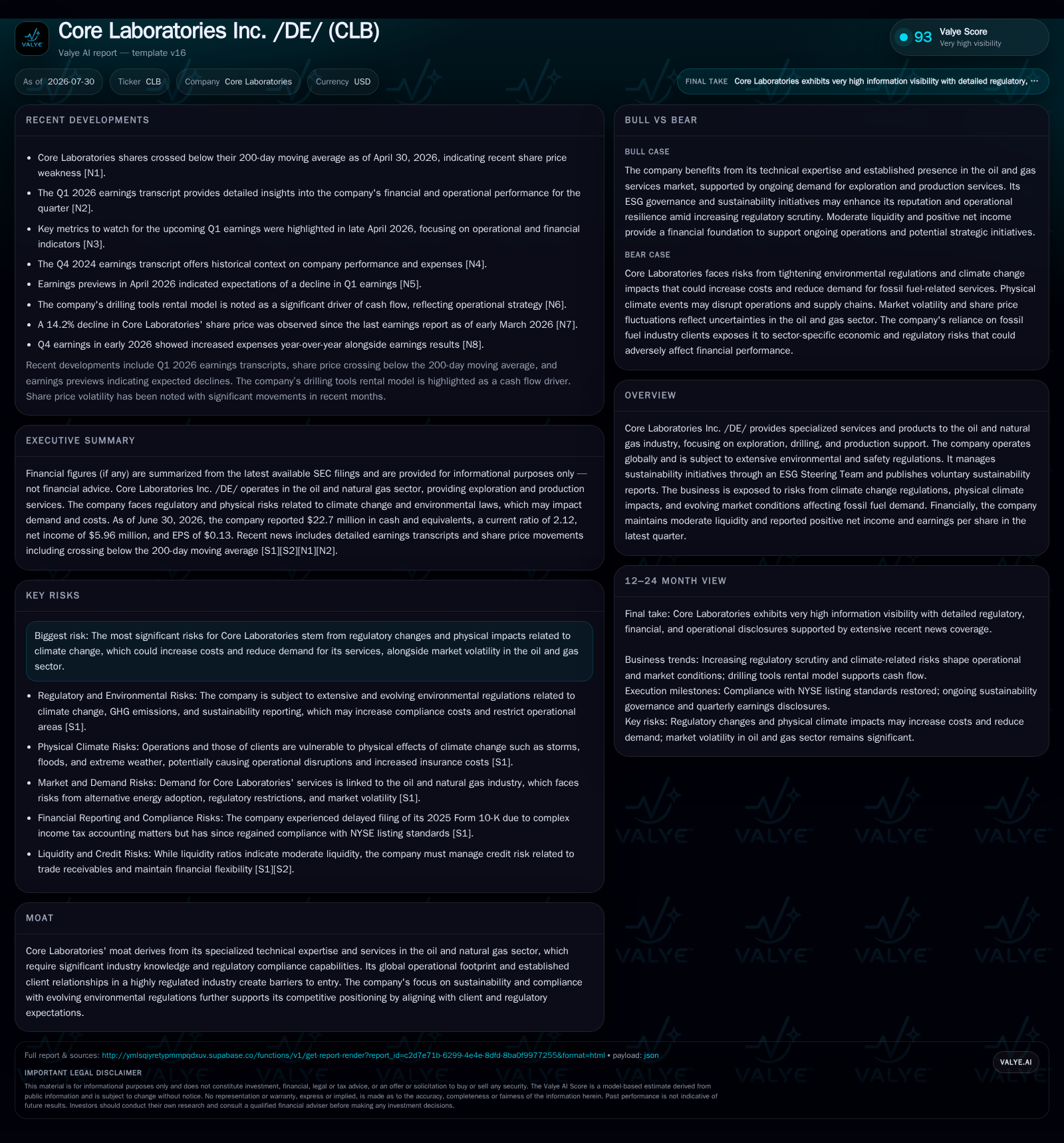
In Q2 2026, Core Laboratories sustained its operational momentum by leveraging its niche technical offerings in reservoir analysis and production enhancement for upstream oil and gas operators. The company’s business model depends heavily on sophisticated laboratory services and field diagnostics that support enhanced recovery and reservoir management, making it uniquely positioned but also exposed to upstream capital spending cyclicality and regulatory pressures from climate policy. Its global footprint enables geographic diversification, though demand remains tightly linked to oil and gas industry spending patterns. Financially, Core Labs maintains a moderate liquidity cushion and manageable debt levels, supporting its strategic initiatives despite volatility risks tied to commodity price fluctuations and environmental regulation changes.
Recent Operating Update
Core Laboratories’ Q2 2026 filing shows continued operational stability despite industry headwinds that often characterize the oilfield services sector [S2]. The company's second-quarter earnings surpassed estimates signaling sustained client demand for their core reservoir description and production enhancement solutions tailored for upstream operators [N1]. This latest update follows annual disclosures emphasizing that demand drivers remain closely linked to the capex outlook within oil exploration, drilling, and production activities [S1], where volatility persists due to fluctuating commodity prices.
Business Model Description
Core Laboratories operates as a highly specialized provider of proprietary technical services primarily targeting upstream oil and natural gas companies. It offers two main operating segments: Reservoir Description (laboratory-based evaluation of rock properties, fluids sampling, petrophysics) and Production Enhancement (well completions diagnostics, stimulation effectiveness assessment, enhanced oil recovery techniques) [S14]. Revenue is generated through project or service contracts where clients pay for advanced data analytics, core analysis, well logging results interpretation, formation evaluation, and implementation support that optimize hydrocarbon recovery.
The company’s monetization relies on capturing value across the upstream lifecycle — from initial reservoir characterization supporting field development planning to continuous production optimization in mature fields. Proprietary technologies and patented equipment enhance margins by differentiating Core Labs from commoditized laboratory service providers [S1]. Additionally, Core Labs supports emerging energy transition projects with service lines evaluating carbon capture storage sites and geothermal resources, signaling strategic adaptation to evolving market demands.
Revenue streams comprise ongoing service contracts plus equipment sales aligned with analytical needs [S18]. Laboratory throughput rates and turnaround times materially influence client satisfaction and renewal rates. Geographic revenue attribution is primarily based on service performance location rather than client domicile exposure; roughly two-thirds of revenue derives outside the U.S., reflecting the global nature of oilfield operations
Industry Structure and Competitive Position
The oilfield services industry is marked by intense sensitivity to upstream drilling rig counts, operator capital programs, and regulatory frameworks governing environmental compliance. Core Labs occupies a niche within the broader services ecosystem alongside peers such as Schlumberger (integrated services), Halliburton (drilling/completions focus), Baker Hughes (equipment/technology), Weatherford International (well construction), and TechnipFMC (subsea technologies).
Core Laboratories’ moat is centered on technical expertise requiring extensive domain knowledge in reservoir geology, petrophysics, fluid chemistry analysis, combined with compliance capabilities to meet stringent health, safety, environment (HSE) standards across many jurisdictions. This specialization creates high switching costs for clients reliant on consistent data integrity for critical field development decisions.
Moreover, expanding ESG initiatives in the sector drive rising expectations for environmental stewardship among clients. Core Lab’s established ESG Steering Team manages sustainability reporting aligned with international standards — essential as customers face accelerated regulatory scrutiny linked to carbon emissions caps or fossil fuel production restrictions [S1]. This approach supports client retention in a transitioning energy economy but also adds potential cost pressures via compliance investments.
Growth Drivers
Growth fundamentally ties to upstream capital investment cycles yet is enhanced by increased reservoir complexity requiring advanced technical inputs. Key drivers include:
- Rising global demand for oil and gas supporting exploration budgets outside mature basins.
- Advances in measurement science enabling more precise reservoir characterization and well intervention strategies.
- Expansion into emerging markets with maturing hydrocarbon sectors.
- Regulatory incentives encouraging enhanced recovery techniques over new drilling.
- Growing need for support services related to carbon capture utilization & storage (CCUS) projects.
- Incremental penetration in geothermal or mining resource evaluations linked to energy transition [S1]
Sales velocity depends on maintaining strong laboratory throughput metrics while expanding service contracts in both established geographies like the U.S., Middle East, North Sea, Canada, Brazil as well as newer fronts. Cross-selling between segments strengthens client relationships by encompassing full lifecycle reservoir management solutions.
Risks and Watchpoints
However promising its technical niche might be, Core Labs faces multiple inherent risks:
- Commodity price downturns constrain E&P spending leading to reduced rig counts lowering service contract volume.
- Regulatory tightening on GHG emissions may restrict exploration zones or add compliance costs potentially suppressing fossil fuel output growth [S1].
- Operational impacts from physical climate events like severe weather could disrupt client activity or company facilities.
- Geopolitical instability in key producing countries injects uncertainty into project execution timelines.
- Customer concentration risk exists as top-tier international oil companies dominate contract awards; delays or cancellations materially affect revenues.
- Technological obsolescence risk requires sustained R&D investment to remain competitively differentiated.
- Currency fluctuations impose translation effects given multinational operations without current hedging activities [S1].
Mitigating these risks depends on adaptive capacity toward evolving client priorities including environmental compliance integration and leveraging digital innovation pipelines capturing deeper subsurface insights.
What to Watch Next
Future catalysts will hinge on:
- Published quarterly backlog trends indicating robustness of contracted service volumes.
- Changes in upstream rig count utilization globally providing early signals of capex momentum shifts.
- New product or technology deployments enhancing analytical capabilities or operational efficiency.
- ESG compliance costs impacting margin dynamics or prompting portfolio diversification announcements.
- Capital allocation updates addressing share repurchase pacing or dividend strategies reflecting financial flexibility.
- Legal/regulatory developments impacting operating jurisdictions especially those influencing fossil fuel extraction feasibility [S3][N1]
Continued monitoring of working capital management including accounts receivable collection efficiencies will also inform cash flow sustainability amid cyclical demand patterns.
Financial Profile Discussion
As of June 30, 2026 balance sheet metrics exhibit moderate financial leverage with approximately $22.7 million cash & equivalents against total debt near $114 million yielding net debt around $91 million; this level indicates manageable obligations within operating cash flow generation capacity [F1]. The firm’s current ratio stands at a healthy 2.12 providing liquidity buffer for short-term liabilities totaling about $101 million versus current assets near $214 million [F1].
Capital expenditure runs roughly mid-to-high tens of millions annually supporting technology upgrades required for lab operations plus global field offices infrastructure renewal [S25][S26]. Dividend distributions remain nominal at $0.01 per share per quarter reflecting conservative cash deployment balanced with share repurchase activities modestly reducing outstanding shares over time [S11][N3].
It integrates sector-standard KPIs reflective of upstream oilfield service dynamics contextualized within regulatory evolution around climate norms. No forward-looking or investment advice is offered.*
Disclaimer: This is research-only, informational analysis and not investment advice. It may include AI-generated interpretation and general industry context. Always verify important details using primary sources.

Comments