
Fortinet’s Q2 Results Showcase Resilient SASE Growth in a Competitive Cybersecurity Market
Fortinet reported solid Q2 performance driven by strong demand for its integrated cybersecurity platform, particularly SASE firewall adoption, offsetting industry-wide pricing pressures.
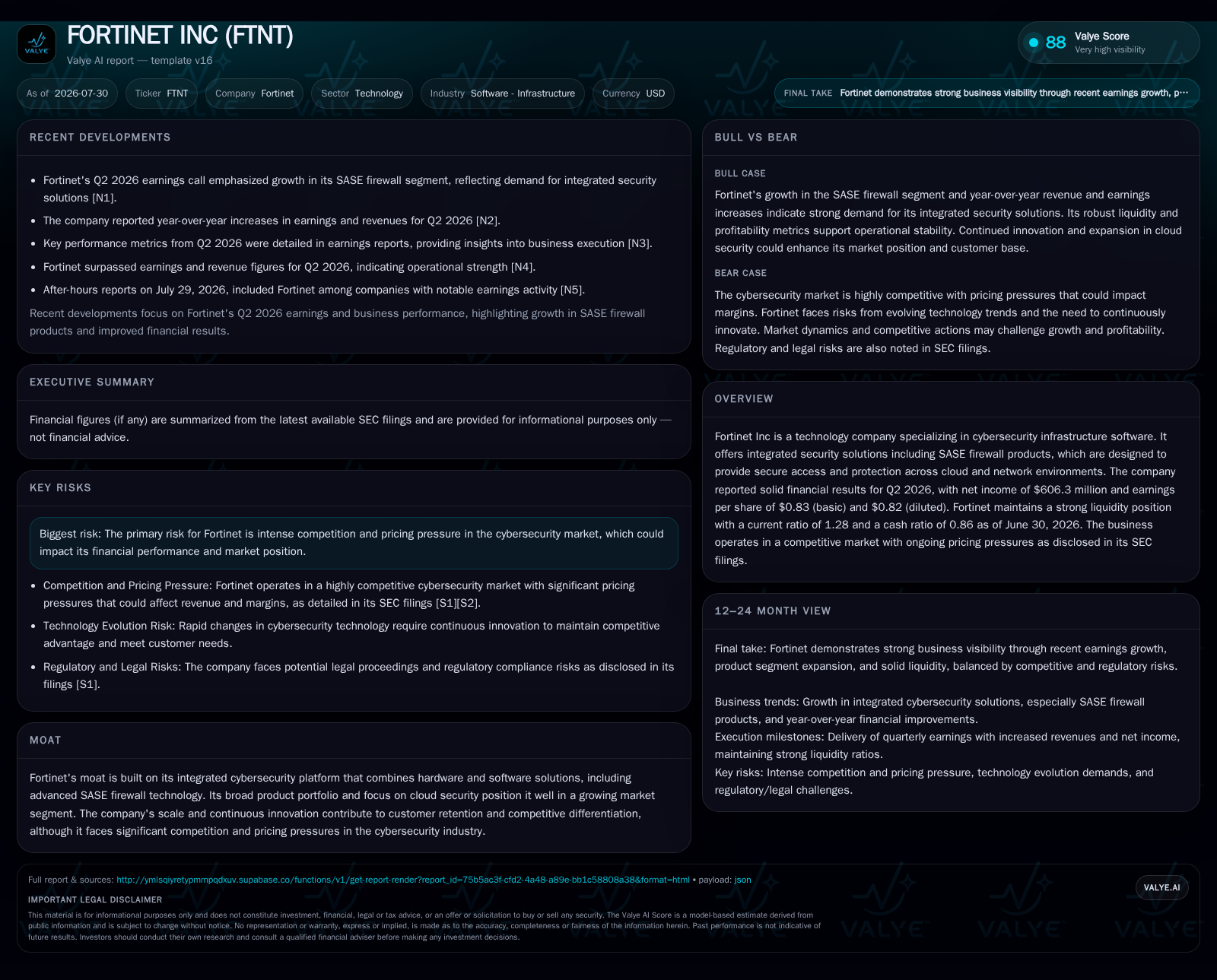
In Q2 2026, Fortinet delivered net income of $606.3 million and earned $0.83 per basic share, supported by continued growth in subscription licensing tied to its Secure Access Service Edge (SASE) firewall products. Despite ongoing pricing pressures typical in the competitive cybersecurity infrastructure software space, Fortinet's diversified revenue mix—including hardware appliances and managed security services—helps sustain recurring revenue strength and customer retention. The company maintains a robust liquidity position with a current ratio of 1.28 and net cash exceeding $2.4 billion as of quarter-end, supporting stable operations amid evolving market dynamics. Near-term growth hinges on expanding cloud security adoption, regulatory cybersecurity mandates, and increasing demand for integrated network-edge protection solutions.
Q2 Operating Update: Sustained SASE Growth Amid Pricing Challenges
Fortinet’s second quarter ended June 30, 2026, showcased operational resilience as the company reported net income of $606.3 million alongside basic earnings per share of $0.83 and diluted EPS of $0.82 [S2], [S3]. This solid profitability underscores effective cost management despite an environment marked by aggressive competition in cybersecurity infrastructure software and hardware. Management highlighted robust demand for its Secure Access Service Edge (SASE) firewall products as a key contributor to recurring revenue growth during the quarter [N3], which aligns with the broader industry shift toward integrated edge-to-cloud security.
These results come during continued pricing pressures typical for network hardware security appliance providers competing against peers such as Palo Alto Networks and Check Point Software Technologies. Fortinet addressed these headwinds through strategic product mix enhancements emphasizing subscription licensing alongside its hardware sales base [S2]. The liquidity backdrop remains strong with a current ratio of 1.28, current assets totaling approximately $6.21 billion against current liabilities near $4.84 billion as of June-end 2026, powered by $2.93 billion in cash reserves versus just $500 million in total debt—yielding a net cash position of roughly $2.43 billion that enhances balance sheet flexibility amidst challenging industry conditions [F1].
Fortinet’s Integrated Cybersecurity Portfolio Fuels Recurring Revenue Strength
Fortinet operates within a business model archetype common to cybersecurity infrastructure vendors that combines subscription-based licensing with hardware appliance revenue streams complemented by managed security services contracts [S1]. Its comprehensive cybersecurity platform integrates physical firewall hardware with software-as-a-service (SaaS) components delivering network security, cloud security including SASE capabilities, endpoint protection, intrusion prevention systems (IPS), and threat intelligence orchestration.
This model generates Annual Recurring Revenue (ARR) predominantly through subscription licensing attached to its software offerings; customers typically pay recurring fees that scale with user volumes or network usage metrics embedded within long-term contracts known for high net revenue retention rates when compared across the sector [S1], [N3]. Simultaneously, hardware appliance sales provide strategic revenue injections but possess thinner margins due to component costs and supply chain risks.
Managed security services further diversify revenue sources by offering value-added continuous monitoring and incident response capabilities—leveraging Fortinet's integrated platform to enhance stickiness with enterprise customers who increasingly demand unified control planes bridging on-premises networks and cloud environments.
This hybrid approach supports sustained customer retention even as pricing pressures intensify because clients often prefer consolidated platform vendors to reduce complexity amid growing compliance mandates and rising cyberattack sophistication.
Cybersecurity Industry Dynamics Impacting Competitive Positioning
Within the broader cybersecurity infrastructure landscape—which also includes entities like Cisco Systems integrating network hardware security with enterprise IT infrastructure—Fortinet faces intense rivalry rooted mainly in technology differentiation and pricing strategies rather than geographic or channel exclusivity alone [S1]. The market dynamics drive constant innovation cycles as players race to embed advanced capabilities such as zero-trust enforcement within their SASE architecture offerings.
Price compression has become more acute due to overlapping features among competitors’ platforms coupled with commoditization risks inherent in hardware appliances sourced partly from constrained semiconductor supply chains—a factor that impacts cost bases across the segment [N3]. However, Fortinet’s scale allows continued investment into R&D aimed at seamless integration of cloud-native security functions while preserving robust on-premises firewall performance.
Regulatory complexity also raises barriers for newer entrants unable to match compliance certifications or global service footprints demanded by large enterprise or government customers. These elements collectively offer Fortinet a moat centered on breadth of portfolio blended with trusted long-term relationships.
Expansion Drivers: Cloud Adoption, Remote Work & Regulatory Demand for SASE Solutions
Structural growth tailwinds remain firmly aligned with Fortinet's strategic focus areas. Increasing hybrid IT environments propelled by cloud migrations boost demand for scalable networking firewalls embedded within SASE frameworks that deliver secure access regardless of user location—a pattern reinforced by persistent remote workforce expansion post-pandemic era [S1], [N3].
Additionally, rising frequency and complexity of cyberattacks are compelling enterprises to adopt layered defense approaches featuring endpoint protection tightly orchestrated with network-level firewalls deploying real-time threat intelligence feeds—a capability integral to Fortinet’s platform design.
More stringent regulatory mandates globally force companies to prioritize cybersecurity measures demonstrably reducing risk exposure via integrated monitoring tools compliant with data privacy norms such as GDPR or CCPA equivalents.
Meanwhile growth in Internet-of-Things (IoT) connected devices expands attack surfaces necessitating scalable security architectures that bridge traditional data centers and public clouds—areas where Fortinet’s combined hardware/software strategy finds direct applicability.
Risk Factors: Price Compression, Customer Retention, and Supply Chain Sensitivities
Despite evident strengths, risks documented in recent filings caution about margin headwinds originating from escalating competition-induced price erosion especially visible in core firewall product lines where commoditization risks loom large [S2], [S1]. Maintaining net revenue retention rates will be pivotal given alternatives available to customers including emerging cloud-native-only security vendors.
Supply chain volatility remains an execution risk primarily impacting hardware appliance availability—delays or costs spikes here could constrain license renewals or new contract closures if prospective customers defer investments.
Moreover continuous innovation is non-negotiable; failure to keep pace technologically could erode competitive positioning especially against specialized SaaS-focused rivals pushing aggressive go-to-market tactics targeting mid-market enterprise segments.
Additional potential challenges involve integration of acquired technologies or adapting rapidly evolving threat landscapes into coherent product roadmaps consistent with evolving customer security policies.
"What to Watch" — Guidance, Retention Rates, Product Mix Evolution, and Innovation Delivery
Stakeholders should closely track sequential quarterly disclosures regarding Annual Recurring Revenue expansions which provide advance signals on underlying subscription license momentum—a critical barometer amid fluctuating macroeconomic IT spend climates [S2]. Additionally observing changes in product/service revenue segmentation can reveal shifts toward cloud-centric offerings versus traditional appliance sales informing margin trajectory expectations.
Net revenue retention trends will indicate effectiveness of upselling existing customers through expanded usage or additional modules within Fortinet’s ecosystem—metrics management commentary at earnings calls have implicitly emphasized around new SASE firewall pipeline growth prospects underscoring healthy customer demand profiles despite external pressures [N5]
Innovative product launches integrating AI-enhanced threat detection or multi-cloud orchestration capabilities constitute vital milestones affecting competitive stance relative to peers; progress here could widen moat durability over coming cycles.
Financial Profile Discussion: Liquidity, Debt Position & Margin Pressure Analysis
Fortinet’s balance sheet presents considerable strength supporting strategic investments amid competitive market conditions. As of June 30, 2026, cash and equivalents totaled approximately $2.93 billion while total debt stood modestly at around $500 million yielding a net cash position close to $2.43 billion—a liquidity buffer reinforcing operational flexibility and capital allocation optionality during margin headwinds induced by price competition effects [F1]
The current ratio at quarter-end was 1.28 indicating sound short-term asset coverage over liabilities facilitating resilience against working capital fluctuations often characteristic in SaaS-subscription heavy models combined with hardware turnover cycles.
Operational margin trends reportedly absorbed some adverse impacts from price reductions particularly linked to firewall appliances; however this was partially offset by higher-margin recurring subscription revenue growth demonstrating defensive margin profile characteristics typical across well-managed integrated cybersecurity platforms incorporating both SaaS licensing and physical appliances.
Leverage levels remain conservative relative to many technology infrastructure providers ensuring capacity to invest continuously into R&D without compromising financial stability relevant for sustaining long-term competitive positioning.
This analysis synthesizes publicly filed SEC disclosures as of July 30, 2026 ([S1], [S2], [S3]) combined with validated financial snapshot data ([F1]) and supplemented by recent earnings call insights ([N3], [N5]). Commentary respects the complexity inherent to dynamic cybersecurity markets without conjecturing beyond available evidence.
Disclaimer: This is research-only, informational analysis and not investment advice. It may include AI-generated interpretation and general industry context. Always verify important details using primary sources.

Comments