
Baxter International Faces Operational Challenges Amid Product Recalls and Supply Constraints
Recent quarterly results highlight a sales and earnings beat despite margin pressure tied to regulatory recalls and supply chain disruptions.
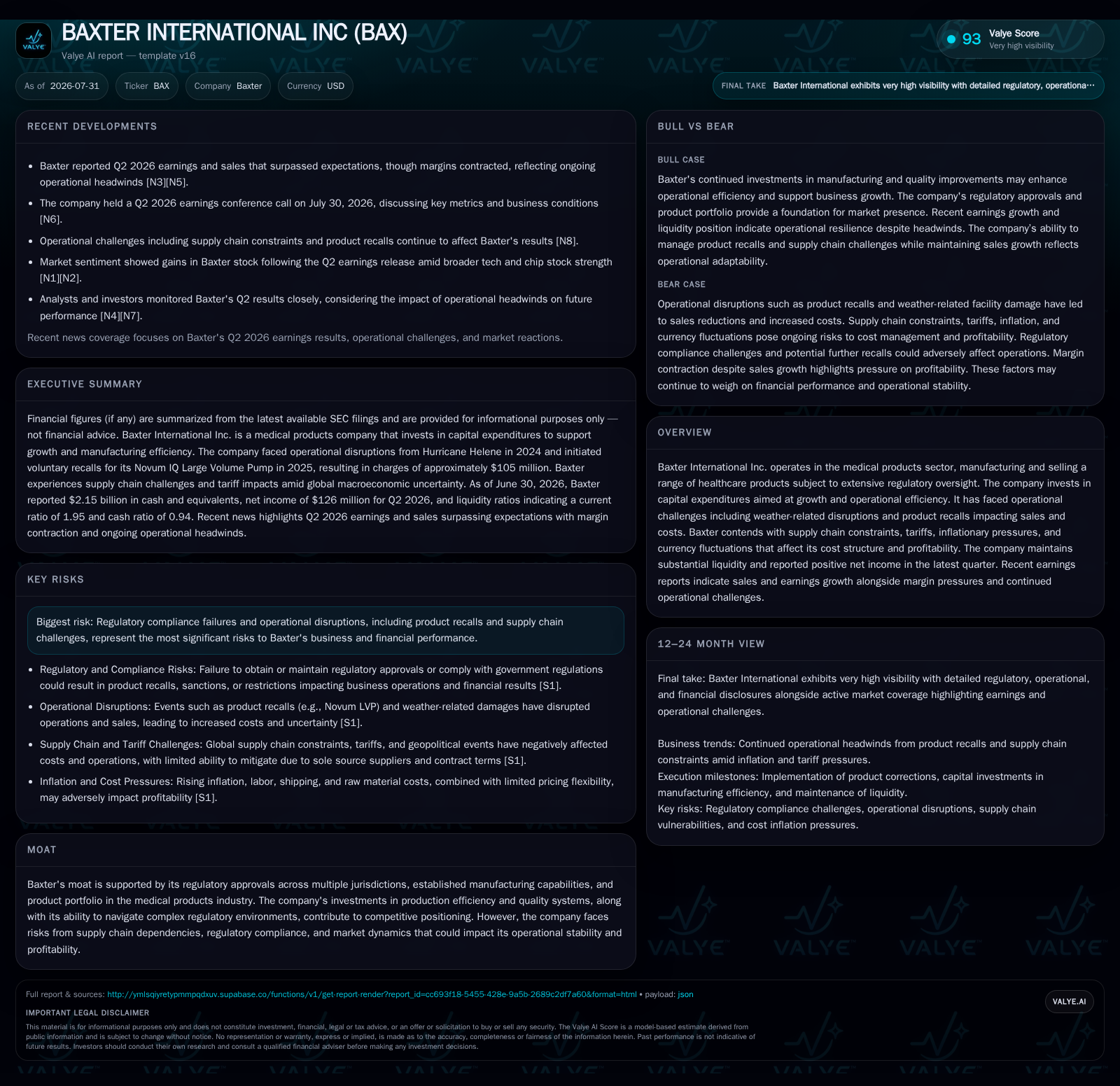
Baxter International's latest quarterly filing reveals sales growth supported by strong demand for its intravenous (IV) solutions and infusion systems, partially offset by margin contraction due to product recalls and inflationary cost pressures. The company's voluntary recall of its Novum IQ large volume pump (LVP) has disrupted sales in that product line, with remediation estimated at $105 million during 2025. Baxter continues investing in capital expenditures focused on expanding manufacturing capacity and improving quality systems to support future growth. Industry-wide supply chain constraints and currency fluctuations pose ongoing risks, while the company's broad product portfolio and regulatory approvals support a defensible competitive position. Monitoring recall remediation progress and supply chain recovery will be critical near-term performance drivers.
Recent Operating Update
Baxter International's Q2 2026 filings detail continued revenue momentum despite significant operating headwinds stemming from product recalls and supply chain issues. The company reported sales exceeding estimates, driven by sustained demand for intravenous (IV) solutions, infusion systems, and connected care products [S2][N3]. However, these top-line gains came alongside compressed gross margins attributed primarily to inflationary cost pressures, tariffs on imported materials, currency volatility, and expenses related to the ongoing Novum IQ large volume pump (LVP) recall [S2].
The Novum IQ LVP recall remains a critical constraint: Baxter voluntarily halted shipments of this key infusion pump in the US and Canada starting July 2025 following FDA Class I classification for under-infusion risks discovered during extended standby or bolus delivery modes [S1]. The recall necessitated extensive corrective actions including software updates requiring regulatory clearance as well as physical returns or exchanges of affected units. The company has already recognized approximately $105 million in charges through 2025 associated with expected sales reductions, remediation costs, inventory write-downs, and contract asset impairments related to this correction program [S1]. While Baxter’s Spectrum IQ pump serves as an alternative offering during this disruption, the absence of Novum IQ LVP availability in major markets depresses potential sales volume over an uncertain timeframe.
Complementing these operational challenges is the company's restructuring of its segment reporting begun in early 2026, where Pharmaceuticals were integrated into the Medical Products & Therapies segment. This change aligns resource allocation more closely with business realities and reflects a strategic shift towards emphasizing its core infusion therapies and advanced surgical products alongside connected care technologies under Healthcare Systems & Technologies [S5][S6]. This reorganization aids investors in better assessing performance drivers across Baxter’s portfolio moving forward.
Business Model Overview
Baxter’s business revolves around designing, manufacturing, marketing, and servicing a broad array of medical products integral to hospital and clinical settings. Its core revenue streams are derived from sterile IV solutions, infusion pumps/systems including administration sets, parenteral nutrition therapies providing sustenance intravenously to patients unable to eat normally, surgical hemostats used to control bleeding during operations, respiratory devices for breathing assistance, and an expanding suite of connected care solutions like smart beds and patient monitoring systems [S1]
Revenue is primarily transactional through direct sales channels serving hospitals, clinics, home health providers, and ancillary healthcare service organizations worldwide. Consumable product sales such as IV bags represent recurring revenue driven by volume usage tied to patient populations requiring fluid therapy or nutrition. Capital equipment components like infusion pumps depend heavily on installed base growth as well as replacement cycles. This mix creates variability influenced by healthcare infrastructure investment trends along with regulatory approvals enabling new product introductions or expanded indications.
Margins are sensitive not only to raw material costs but also operational efficiency factors such as manufacturing capacity utilization rates and quality system effectiveness—both critical given stringent FDA oversight governing Baxter’s products which frequently undergo audits or post-market surveillance due to their life-critical use. Service contracts accompanying some capital equipment provide modest annuity-like cash flow but are secondary compared to product volumes.
The company's capital expenditure program exemplifies this focus: in 2025 Baxter invested $513 million targeting expanded production capacity (notably for IV solutions) while enhancing quality control systems responding to both internal goals and external regulatory demands [S1]
Industry Structure and Competitive Position
Operating within the medical products industry characterized by high regulatory scrutiny—particularly FDA compliance—the barriers to entry remain formidable largely due to lengthy product development cycles paired with need for rigorous clinical validation. Regulatory approval timelines directly impact launch feasibility for innovation-driven revenue growth while constant vigilance is required against product liability or recall incidents.
Baxter sits among established peers such as Medtronic (strong in infusion pumps), Becton Dickinson (leader in IV consumables), Stryker (surgical equipment), 3M Healthcare (medical consumables), and Boston Scientific (device innovation). Each peer balances capital-intensive manufacturing with regulatory compliance demands; however Baxter’s combination of sterile fluids plus connected care represents a differentiated breadth that integrates consumable revenues with technology-enabled care platforms.
This diversification supports customer stickiness via ecosystem integration—hospitals rely on full suites of Baxter’s infusion components aligned with monitoring devices—and helps mitigate pricing pressures typical within commoditized medical supplies segments. Nonetheless, the company must continuously invest in R&D (~4-5% of sales historically) alongside capital expenditures ensuring capacity keeps pace with market demand amid evolving clinical protocols.
Key KPIs reflecting competitive health include manufacturing capacity utilization (signaling ability to meet orders without bottlenecks), frequency/severity of recalls impacting customer trust, new FDA approvals driving incremental revenues, installed base growth reflecting expanded hospital adoption rates of capital equipment plus associated consumables—and operating margins reflecting pricing power versus inflationary input costs.
Growth Drivers
Long-term demographic trends anchor sustained demand: aging populations globally increase chronic disease prevalence necessitating hospital interventions reliant on Baxter’s IV fluids, parenteral nutrition therapies, surgical hemostats for complex procedures, respiratory care devices for pulmonary ailments, all serving growing patient volumes.
Technological innovation fuels next wave growth too: development of advanced infusion pumps integrating AI-guided dosage controls or wireless connectivity dovetails with broader adoption of remote patient monitoring solutions critical amid healthcare digitization pushes. Emerging market expansion adds an additional avenue where expanding healthcare infrastructure lifts unit volumes for both capital device adoption and consumable usage.
Strategic acquisitions or partnerships targeting specialty injectables or novel surgical sealants can also deepen product portfolios enhancing cross-selling opportunities within existing client bases.
Each growth vector requires successful navigation through regulatory landscapes ensuring timely approvals while scaling up manufacturing capabilities without compromising stringent quality compliance—tasks that underpin Baxter’s ongoing investment priorities.
Risks and Watchpoints
Regulatory compliance failures remain paramount risk factors given prior Class I FDA recalls seen with Novum IQ LVP pumps coupled with potential litigation exposure stemming from product liability suits such as ethylene oxide sterilant allegations faced historically [S25][S26]. Recalls not only precipitate direct remediation costs—as evident from the $105 million reserve—but also dampen customer confidence slowing adoption rates or triggering customer switching which impacts top-line trends.
Supply chain fragility amplifies vulnerability: prior hurricane-related disruptions at key manufacturing sites delayed output leading customers towards conservation efforts reducing demand primarily for IV fluids—a core volume driver—and inflation-induced tariff increases impose margin compression pressures further exacerbated by currency fluctuations impacting global cost structures [S1]
Capital intensity mandates disciplined execution in spending initiatives; overshooting capex without commensurate demand would pressure free cash flow generation complicating leverage reduction efforts amid total debt above $9 billion at year-end 2025 with net debt around $7.3 billion after accounting for cash balances near $2.15 billion as of June 30, 2026 [F1]. Maintaining investment-grade credit metrics while funding innovation pipelines remains critical.
Monitoring how quickly Baxter can resolve outstanding product issues—including completing software corrections subject to regulatory clearance—and restore full sales operations for recalled lines will serve as key near-term operational signals.
What To Watch Next
Upcoming milestones include progress updates on Novum IQ LVP corrective actions including timeline announcements around lifting shipment holds; subsequent quarters’ margin trends indicating if inflationary cost pressures or tariff impacts ease; organic sales trends reflecting recovery post-weather emergent disruptions; operating metric disclosures detailing manufacturing capacity utilization improvements linked to recent capex spend; any new FDA approvals broadening therapy indications or launching novel infused products; shifts in segment profitability given reporting changes consolidating pharmaceuticals; management commentary on supply chain normalization outlooks; plus any legal developments related to ongoing litigation or regulatory inquiries.
Investor focus will gravitate toward EBITDA margin stabilization demonstrating leverage over input costs alongside measured deleveraging progress consistent with stated liquidity preservation strategies.
Financial Profile Discussion
As of June 30, 2026, Baxter held approximately $2.15 billion in cash and equivalents against current liabilities near $3.59 billion maintaining a healthy current ratio of roughly 1.95 indicating reasonable short-term liquidity coverage [F1]. Total debt stood at about $9.49 billion at year-end 2025 reflecting elevated leverage levels mitigated somewhat by sizable cash reserves yielding net debt around $7.34 billion [F1].
Maintaining a balanced approach between investing aggressively in capacity/quality improvements while managing debt maturities constitutes core financial stewardship going forward particularly given macroeconomic uncertainties influencing interest rates or currency translation effects impacting global operations.
This analysis synthesizes reported Q2 filings along with annual context for Baxter International Inc., articulating recent operational developments within industry dynamics without issuing investment research views.
Disclaimer: This is research-only, informational analysis and not investment advice. It may include AI-generated interpretation and general industry context. Always verify important details using primary sources.

Comments