
Hasbro's Brand Power and Digital Pivot Fuel Second Quarter Beat
Hasbro's Q2 results highlight digital gaming growth and flagship IP strength amid ongoing margin pressures from tariffs and litigation.
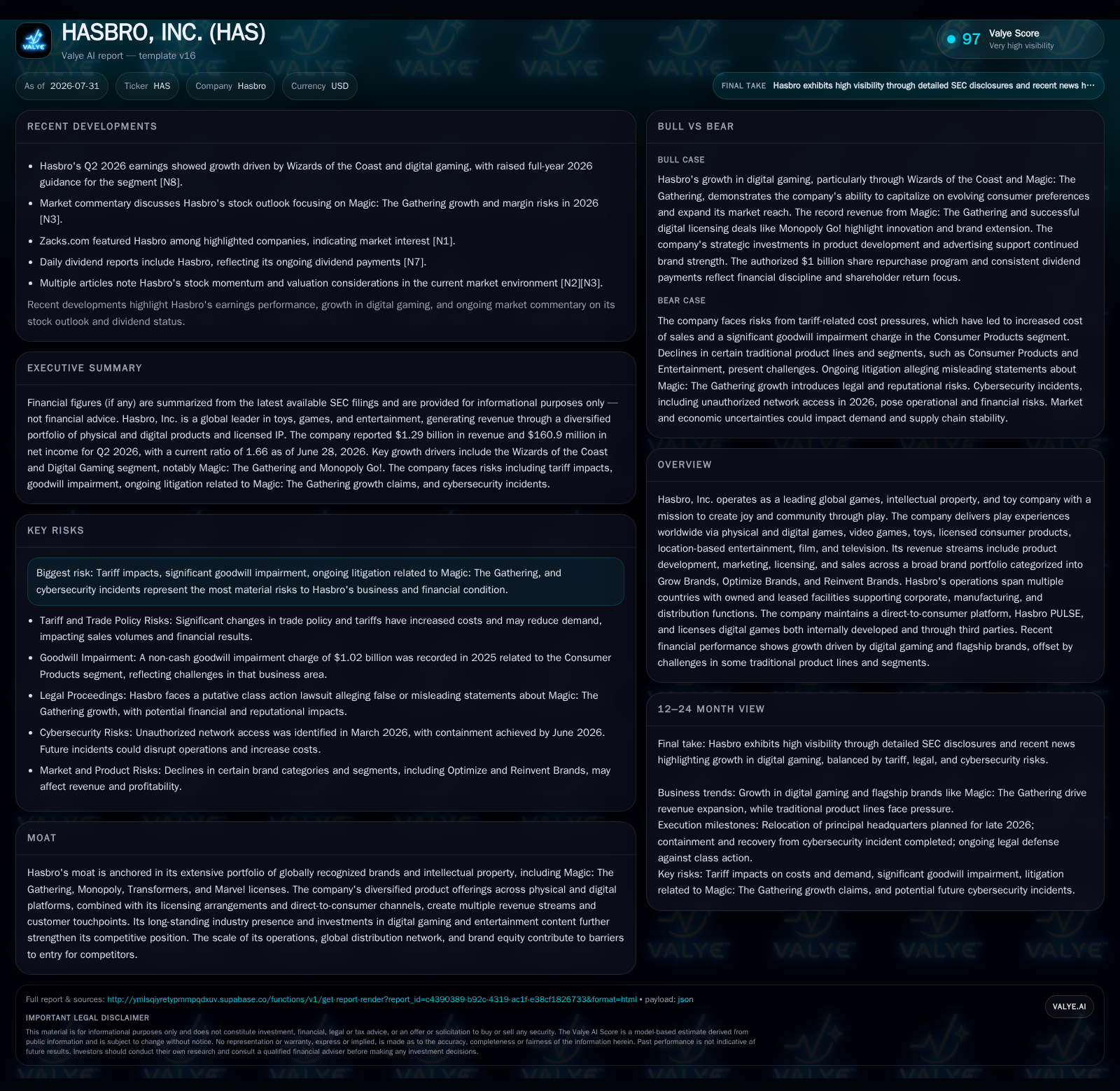
In its latest quarterly filing dated July 30, 2026, Hasbro reported an earnings beat driven largely by growth in its digital gaming segment and strong performance from flagship brands like Magic: The Gathering. However, the company continues to face cost headwinds stemming from tariffs, supply chain inflation, and litigation risks notably related to Magic IP. Hasbro’s multi-channel approach combines revenue from physical products, licensing royalties, and entertainment content, enabling diversified monetization of its extensive intellectual property portfolio. Looking ahead, near-term watchpoints include leadership transition at Wizards of the Coast and execution on new product launches alongside margin recovery efforts.
Q2 Results Highlight Digital Growth Offset by Margin Pressures
Hasbro’s July 30, 2026 quarterly report unveiled a notable earnings beat primarily driven by growth in its digital gaming segment under the Wizards of the Coast umbrella. Contributing materially were rising sales from Magic: The Gathering ("Magic") card sets complemented by broader digital game offerings that include licensed third-party developers [S2][N3]. This surge in digital user engagement reflects management’s successful strategy to expand beyond traditional tabletop formats into interactive entertainment landscapes where monetization can be more recurring and scale less constrained by physical production.
Despite top-line strength, cost pressures persist. Tariffs implemented since prior years continue to inflate cost of sales materially — recognized at approximately $44.9 million in 2025 — while inflationary wage increases and supply chain complexities add further margin headwinds [S1][N2]. These factors contributed to a contraction in gross margin percentage during the quarter, underscoring ongoing operational challenges even as revenue growth accelerates.
Monetizing a Diverse Brand Portfolio Through Multiple Revenue Streams
Hasbro operates a multi-faceted business model structured around its expansive intellectual property portfolio segmented into Grow Brands (flagship franchises like Magic), Optimize Brands, and Reinvent Brands reflecting various lifecycle stages [S1]. Revenue generation is diversified across physical toy manufacturing, digital gaming (both internally developed and licensed), consumer products licensing agreements generating royalty income, as well as entertainment content leveraging brand extensions into film, television, and live events.
The Wizards of the Coast segment illustrates this integration well — Magic drives direct product sales complemented by licensing arrangements with third-party digital game developers who generate additional royalties meanwhile engaging consumers through events and media content that deepen brand loyalty [S1][F1]. Additionally, Hasbro’s proprietary direct-to-consumer platform Hasbro PULSE plays a key role in capturing higher-margin sales by bypassing wholesale channels and fostering closer consumer relationships through exclusive product offerings.
Manufacturing is predominantly outsourced with Hasbro focusing its internal efforts on product design, marketing spend allocation, IP management, and distribution network optimization — essential capabilities for sustaining innovation pipelines and demand generation in an increasingly competitive environment [S1].
Positioning in the Competitive Toy and Gaming Industry
Against peers like Mattel and LEGO Group that have robust traditional toy portfolios enhanced by entertainment content integration, Hasbro distinguishes itself through its significant emphasis on digital game development embedded within an acknowledged tier-one IP framework. Compared with digitally native companies such as Activision Blizzard or Nintendo that lead interactive entertainment revenues but lack broad physical toy lines, Hasbro occupies a hybrid niche blending physical-digital omni-channel presence.
This positioning affords resilience via multiple revenue levers but also exposes Hasbro to competitive risks inherent in rapidly evolving gaming marketplaces where consumer preferences shift quickly toward novel formats or experiences often pioneered by technology-first firms [S1]. Operationally, managing supply chain complexity has become industry-wide stress point intensified by geopolitical factors impacting tariff regimes — challenges shared with other diversified toy companies including Spin Master and Funko Inc.
Growth Catalysts in Digital Transformation and DTC Expansion
Key structural growth drivers for Hasbro lie in accelerating digital gaming revenue streams spearheaded by the Wizards of the Coast segment’s focus on enhancing user engagement metrics such as active player counts and digital downloads [S2]. Coupled with innovative product launches leveraging popular licensed IPs—like Marvel or Transformers—these enable brand extensions that capture new consumer segments while reinforcing core franchise loyalty.
Expansion of direct-to-consumer sales channels via Hasbro PULSE not only increases gross margins but also creates valuable consumer data feedback loops facilitating better demand forecasting and tailored marketing spend efficiency [S1]. Emerging market penetration also represents potential upside as middle-class demographics grow demand for branded toys/games calibrated to local tastes
Moreover, cross-media entertainment content development connected to Hasbro-owned properties forms synergistic catalysts for product refresh cycles complementing traditional retail sell-through rates alongside newer streaming video initiatives.
Risks Surrounding Litigation, Tariffs, and Cybersecurity
Hasbro continues to confront material legal proceedings related primarily to allegations involving Magic: The Gathering’s growth disclosures which could impact investor confidence if outcomes are uncertain or adverse settlements occur. Management is actively defending these claims though anticipates difficulty estimating loss ranges at this stage [S1]
Tariff impacts on cost structure maintain prominence as a risk case; although mitigated somewhat via supply chain diversification efforts, exposure remains given global trade tensions affecting raw materials sourcing internationally. Inflationary pressures remain broadly persistent impacting labor costs across contract manufacturers.
Additionally, cybersecurity concerns raised in the latest filings highlight vulnerabilities related not only to internal systems but also risks introduced via third-party manufacturers handling sensitive information. Increasing sophistication of cyber attacks presents operational continuity threats with potential delayed shipments or compromised proprietary data [S2]. These operational risk factors underline the importance of ongoing investment into IT security infrastructure alongside physical supply safeguards.
Near-Term Milestones And Watchpoints Leadership And Product Campaigns
A significant near-term event is the announced transition arrangement for John Hight—the President of Wizards of the Coast—who will remain through early September 2026 transitioning responsibilities via advisory services through mid-next year [S3]. This leadership change is critical given Hight's involvement in shaping franchise strategies around Magic growth initiatives; his succession could influence tactical priorities or innovation pacing at the division level
Upcoming product launch success rates for new expansions within flagship brands will serve as key demand markers validating Hasbro’s ongoing investment logic in design/marketing spend. Tournament turnouts for Magic events combined with early indicators from expansions’ retail sell-through will provide insight into momentum sustainability beyond Q2 momentum.
Market watchers should monitor any updated guidance or commentary in subsequent earnings releases indicating progress on margin recovery programs addressing tariff-driven cost inflation.
Financial Profile Discussion Liquidity Leverage And Capital Allocation Context
As of 2026-06-28, Hasbro maintains a current ratio of approximately 1.66, reflecting adequate short-term liquidity capacity covering current liabilities of $1.72 billion against current assets of about $2.85 billion supporting normal working capital needs [F1]. Total debt stands near $3.56 billion, dominated by long-term obligations maturing over several years offering manageable refinancing timelines without immediate pressure [F1].
Net debt after cash balances is about $2.38 billion, positioning leverage within ranges customary for diversified consumer goods companies balancing operating income volatility against strategic capital deployment flexibility [F1]
Monitoring operating profit margins alongside free cash flow conversion rates will be crucial for assessing capital allocation effectiveness going forward.
This document does not constitute investment advice or research views but provides detailed domain-focused insights consistent with buy-side analyst standards.
Disclaimer: This is research-only, informational analysis and not investment advice. It may include AI-generated interpretation and general industry context. Always verify important details using primary sources.

Comments