
AMC Networks Navigates Content Licensing and Debt Refinancing Amid Streaming Rights Transitions
AMC Networks manages transitions in key streaming rights while reshaping its debt profile and cost structure in a changing media landscape.
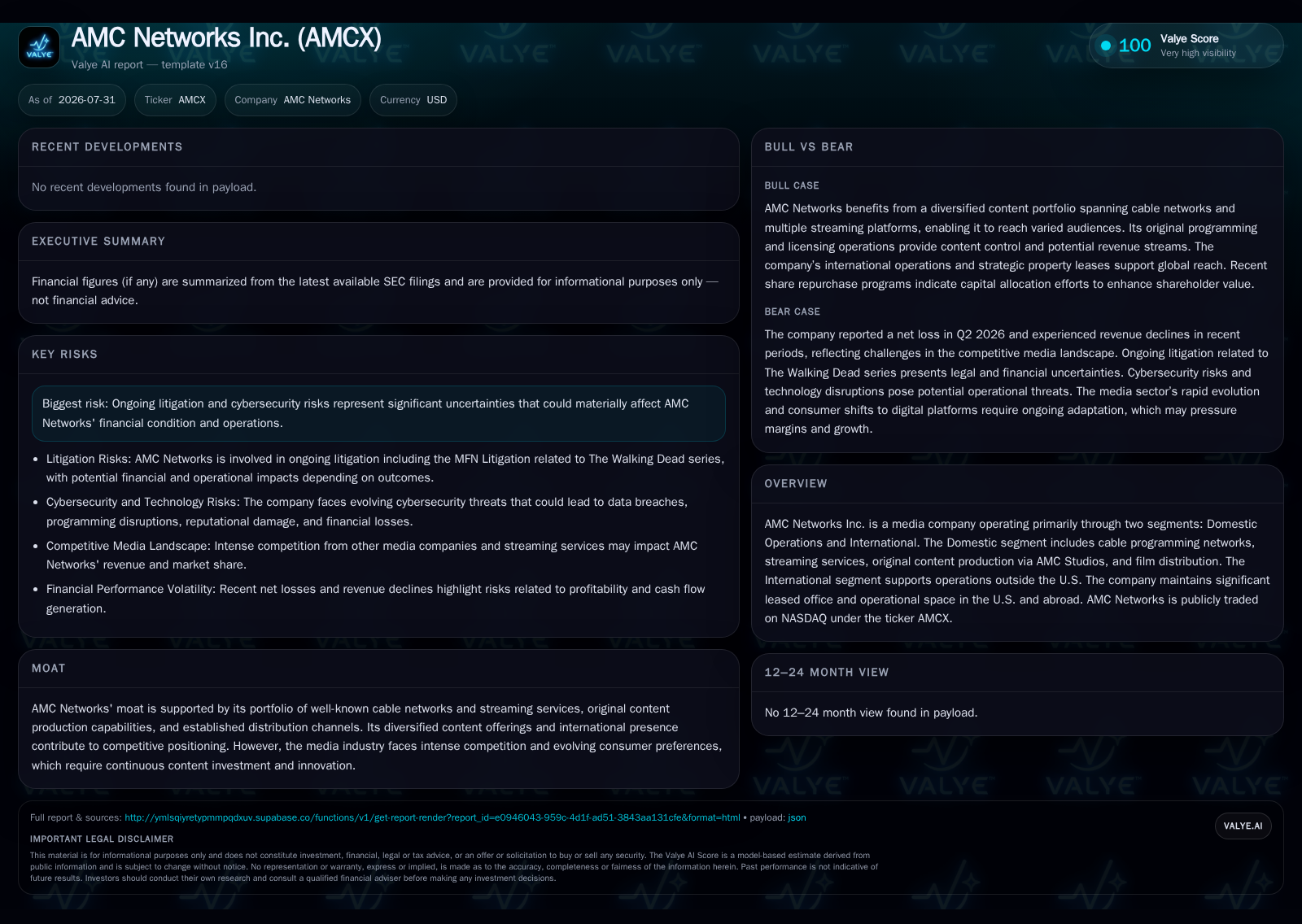
In its latest quarterly filing, AMC Networks detailed significant operating developments including the renewal of U.S. streaming licenses for The Walking Dead franchise starting in 2026-27, which underscores the strategic importance of proprietary content in its subscription and advertising revenue model [S2]. Concurrently, AMC reshaped its capital structure by refinancing significant debt portions, extending maturities with higher-yield notes due 2032, reducing credit facility exposure, and repurchasing shares under an accelerated program [S4], [S6]. These moves come amid ongoing industry challenges of high content costs, evolving consumer preferences, and intense streaming competition, making content licensing duration and subscriber engagement key growth factors. AMC’s dual-segment operations focused on domestic cable networks, streaming services, and international distribution position it for international expansion yet expose it to steady restructuring efforts and legal risks [S1].
Recent Operating Update
In its Q2 2026 report filed July 30, AMC Networks highlighted critical shifts in key licensing agreements that impact long-term revenue predictability. Notably, AMC secured co-exclusive licenses for U.S. streaming rights to The Walking Dead franchise commencing January 6, 2027 for the main series with additional Walking Dead Universe titles following at staggered intervals throughout 2026 [S2]. This rollout timing reflects a deliberate sequencing aligned with current license expirations across territories. For AMC's streaming platforms—where subscription revenue hinges heavily on exclusive content—the renewal preserves access to marquee intellectual property that fuels viewership engagement and monetization through ads and subscriptions.
On the financial front, AMC executed a strategic debt restructuring through an exchange offer initiated in February 2026 swapping $875 million of maturing 10.25% Senior Secured Notes due 2029 for new notes carrying a higher coupon of 10.50%, but extending maturity out to 2032 [S2]. Additionally, the company fully repaid its revolving credit facility balance alongside the Term Loan A Facility balance of approximately $80 million by mid-2026 [S2], effectively trimming short-term liquidity commitments.
Q2 performance reflected the cost impacts of these financing maneuvers marked by increased interest expense ($42.7 million) contributing to an operating income decline to $15.9 million compared to $64.5 million a year earlier [S13]. Net loss attributable to shareholders was ($21.9) million versus net income previously as subscriber volume pressures combined with restructuring charges (notably $1.3 million in Q2 tied largely to international workforce reductions) weighed on margins [S13], [S16]. This reinforces a persistent theme across media peers where balancing high fixed content costs against fluctuating advertiser budgets remains challenging.
Business Model Analysis
AMC Networks operates fundamentally as a vertically integrated content creator and multi-platform distributor within both Domestic Operations—including flagship cable programming networks (e.g., AMC, BBC America), direct-to-consumer streaming services (AMC+), original film production via AMC Studios—and International segments serving global markets through localized distribution channels [S1]. Revenue is generated through multiple streams: subscription fees from consumer-paid streaming services provide recurring base income; advertising sales across cable channels monetize viewership ratings; licensing deals for content syndication deliver upfront payments or royalties; and original programming investments aim to build proprietary intellectual property that differentiates offerings and reduces reliance on third-party acquisitions.
Content licensing terms materially affect revenue timing and visibility; for example, AMC’s staggered renewals for popular series permit granular scheduling of release windows critical for subscriber retention strategies tied to exclusive premieres on owned platforms [S2]. The company’s approach combines maintaining legacy cable distribution agreements—which still represent significant cash flow—with expanding digital-first initiatives reflecting broader industry shift.
Cost structure centers around content production costs (original series/film creation), amortization of program rights acquired externally, advertising sales teams’ operational funding, plus technology infrastructure supporting digital distribution [S16]. Restructuring programs notably target employee cost efficiency improvements internationally as part of ongoing margin optimization plans impacting operating expenses reported each quarter
Industry Structure and Competitive Position
Operating within the converging fields of traditional cable network operators (peers like ViacomCBS/Paramount Global), diversified media conglomerates with premium content portfolios (Disney), pure-play streaming platforms (Netflix), and film studios with direct consumer access (Warner Bros. Discovery), AMC holds a hybrid position leveraging legacy relationships while investing into future-proofed digital channels.
The competitive battleground focuses intensely on proprietary content ownership/licensing duration plus platform technological capabilities supporting seamless user experiences. High-quality originals such as The Walking Dead act as stickier assets driving subscriber acquisition and retention against heightened churn risks typical across saturated streaming markets. International expansion presents both opportunity—by broadening geographic footprint especially via localized language offerings—and risk related to regulatory variability or slower monetization ramps outside core U.S. markets.
Cybersecurity threats pose operational continuity hazards given the reliance on digital distribution infrastructure vulnerable to attacks affecting service availability or data integrity.
Content costs represent a structural margin pressure point as market rates for talent and production escalate industry-wide forcing constant evaluation between investing for competitive advantage versus cost containment. Subscriber churn remains susceptible to competitor offerings with deeper pockets or broader libraries pulling viewers away.
Advancements in technology adoption supporting multi-device compatibility or enhanced user interfaces could provide incremental competitive advantage warranting close monitoring as well.
Financial Profile Discussion
As of June 30, 2026, AMC Networks reported cash & equivalents of approximately $464 million against total debt nearing $1.74 billion net of unamortized discounts translating into net debt above $1.27 billion highlighting continued leverage usage typical in capital-intensive media enterprises focused on profitable growth via scale economies and intellectual property ownership consolidation [F1], [S2]. The company maintains a current ratio near 1.76 indicating adequate short-term liquidity coverage against current liabilities roughly $717 million balanced by sizeable current assets [$1.26 billion] predominantly receivables linked to subscription billing and advertising contracts [F1].
Interest coverage weakened visibly during H1 due primarily to refinancing-related expenses plus increased coupon rates embedded in new senior notes; however, lengthened maturities improve medium-term liquidity risk profiles while enabling capital expenditure commitments required for original programming development continuing at multi-hundred-million dollar levels annually evidenced by amortization spikes in program rights expense alongside steady depreciation charges supporting technology assets [S13], [S24].
AMC’s measured approach toward voluntary prepaying term loans alongside retiring revolving credit lines signals prudent balance-sheet risk management relative to volatile cash flow generation inherent in media companies balancing cyclical advertising sales against relatively fixed content amortization schedules.
This analysis synthesizes recent SEC filings up through July 30, 2026 without investment research views or projections. All financial figures are cited directly from reported filings ensuring factual accuracy while interpreting operating changes within broader media industry dynamics.
Disclaimer: This is research-only, informational analysis and not investment advice. It may include AI-generated interpretation and general industry context. Always verify important details using primary sources.

Comments