
SAIA Battles Pricing Pressures and Claims Volatility in Q2 2026
SAIA’s latest quarter exposes margin headwinds from pricing constraints and variable claims expenses amid competitive freight transport market dynamics.
In Q2 2026, SAIA faced significant operating challenges characterized by downward pricing pressures and volatile claims-related expenses that compressed margins. The company’s less-than-truckload (LTL) revenue model remains resilient through shipment volume growth and network expansion, but profit leverage is limited by rising insurance costs and labor-driven capacity constraints. Industry-wide fuel surcharge difficulties and labor availability issues further shape SAIA’s cost structure and operational efficiency. The firm’s sizable liquidity buffer provides strategic flexibility as it navigates these pressures within a highly competitive LTL freight environment.
Q2 Pressure Points: Pricing Squeeze Meets Claims Expense Swing
Saia Inc.'s second quarter of 2026 financial disclosures reveal a challenging operating environment dominated by downward pricing pressures exacerbated by difficulties in fuel surcharge implementation. The company explicitly noted adverse impacts on its revenue per shipment driven by intense competition across its service regions combined with external industry-wide factors beyond their control [S2]. This squeeze on pricing power arrived alongside increased volatility in insurance claims expenses encompassing personal injury, cargo loss, group health plan claims, and other employment-related liabilities. Such claims frequency and severity swings have translated into heightened variability in the operating ratio (operating expenses over operating revenues), placing pressure on SAIA’s margins [S2].
The confluence of these factors establishes a margin risk profile where revenue gains from shipment volume expansions are partially offset by rising unit costs and unpredictable claims charges. The company's acknowledgment that claims expenses represent an ongoing source of earnings volatility underscores the operational challenge common within the transportation and logistics sector, where cargo loss and injury claims can spike unexpectedly due to accident or environmental factors.
LTL Freight Transportation Economics Underpinning SAIA’s Revenue Model
SAIA operates primarily as a less-than-truckload (LTL) freight carrier—a segment characterized by transporting relatively smaller shipments consolidated across multiple customers. In this model, revenue largely stems from the total shipment volume multiplied by average revenue per shipment, which itself depends on weight-based pricing (revenue per hundredweight), average shipment length, and additional surcharges such as fuel adjustments [F1], [S2].
The company reported steady top-line figures indicative of sustained demand for its freight services despite pricing headwinds [F1]. However, in tightly contested LTL markets where major players such as Old Dominion Freight Line and FedEx Freight similarly operate, pricing discipline is difficult to maintain as customers often negotiate aggressively based on service coverage and reliability.
The industry standard KPIs—capacity utilization (load factor), operating ratio, claims ratio—serve as barometers for operational health; SAIA's report highlights these variables require close monitoring due to influences from labor market tightness and claims cost fluctuations [S2]. Successful management of fleet utilization directly affects fixed-cost absorption rates critical for profitability leverage.
Service Geography Expansion: Growth Potential Meets Operational Complexity
Strategic efforts to expand service geography feature prominently in SAIA's growth plans, aiming to increase network density which typically drives incremental freight volume through improved transit times and broader market access [S2]. Such expansion is essential for scaling economies but introduces operational complexity. Expanded routes necessitate recruitment of additional drivers and dock workers—whose availability presently is constrained—and investments in terminal infrastructure [S2].
This scaling dynamic imposes upward pressure on operating expenses even as it enables revenue growth potential through new customer acquisition or deeper penetration within existing markets. The company flagged execution risks associated with the pace of expansion which could cap margin improvement if matched by disproportionate cost escalation.
Pricing Dynamics Shaped by Competition, Fuel Surcharges, and Customer Mix
SAIA operates within an intensely competitive freight market where price elasticity among commercial shippers limits easy rate increases [S2]. Fuel surcharges have historically offered a partial pass-through mechanism to help offset volatile diesel prices; however, recent filings emphasize challenges connected with fuel surcharge recovery due to customer pushback or regulatory scrutiny [S2], diluting this protective buffer.
Price pressure extends beyond spot-rate negotiations into contract renewals where long-term customers seek stable or reduced freight costs amid economic uncertainty. The mix shift between expedited versus standard shipments also influences realized yield per shipment. Industry peers like Old Dominion Freight Line face similar constraints differentiating tariff structures while battling comparable cost headwinds.
Labor Market Constraints Determine Capacity, Cost Structure, and Delivery Reliability
A critical structural constraint shaping SAIA's operations is the tight supply of qualified labor—including drivers who must meet rigorous licensing requirements and dock workers skilled in efficiently handling freight loads—to maintain high fleet utilization rates [S2]. Labor shortages lead to capacity bottlenecks that increase marginal operating costs through overtime pay or reliance on leased equipment firms.
These workforce dynamics also have a direct bearing on on-time delivery performance; delays reduce customer satisfaction potentially impacting retention metrics. Rising wage inflation trends contribute further cost pressures reflecting broader labor market tightness observed industry-wide.
Claims Expense Volatility: Insurance Costs as an Earnings Wildcard
Insurance claims represent a notably volatile expense category for SAIA, driven by cargo damage or loss incidents and liability claims linked to personnel injuries or accidents [S2]. Fluctuations in claim frequency or severity translate into swings in the claims ratio (claims cost relative to revenue) that materially affect operating ratios quarter-to-quarter.
Given the capital-intensive nature of freight transport—with significant exposure to third-party liability—the predictability of insurance premiums or self-insurance reserves remains limited. Management openly states this risk contributes to irregular margin outcomes creating budgeting challenges uncommon in more stable-service sectors.
Strategic Risks Beyond Quarterly Metrics: Regulatory Compliance & Market Cyclicality
The company identifies numerous ongoing risk factors that extend beyond immediate quarterly results including escalating regulatory compliance costs—ranging from safety regulations for drivers’ hours-of-service restrictions to environmental emission standards—and infrastructure constraints limiting highway capacity [S27]. Periodic economic downturns slow overall freight volumes impacting revenue flows cyclically.
Additional risks surround cybersecurity vulnerabilities tied to operational technology disruptions or ransomware attacks—a growing concern among logistics operators reliant on digital platforms for tracking shipments and managing dispatching systems [S2]. These risks cumulatively compound margin compression possibilities if not proactively managed.
Leading Indicators Ahead: On-Time Delivery Rates & Shipment Volumes To Track
Industry practice emphasizes monitoring key performance indicators such as shipment volume growth trajectories alongside average revenue per shipment as direct measures of demand strength. On-time delivery rates signal logistic efficiency crucial for customer retention while operating ratio fluctuations reflect cost control effectiveness.
Although SAIA does not disclose granular KPI data quantitatively in the latest filings beyond qualitative commentary,[N1] market commentary suggests tracking upcoming quarterly performance on these metrics will provide insight into whether price pressures can be managed without eroding service quality intensely enough to impact volumes negatively.
Financial Profile Discussion: Liquidity Cushion Supports Capital Strategy Despite Covenant Vigilance
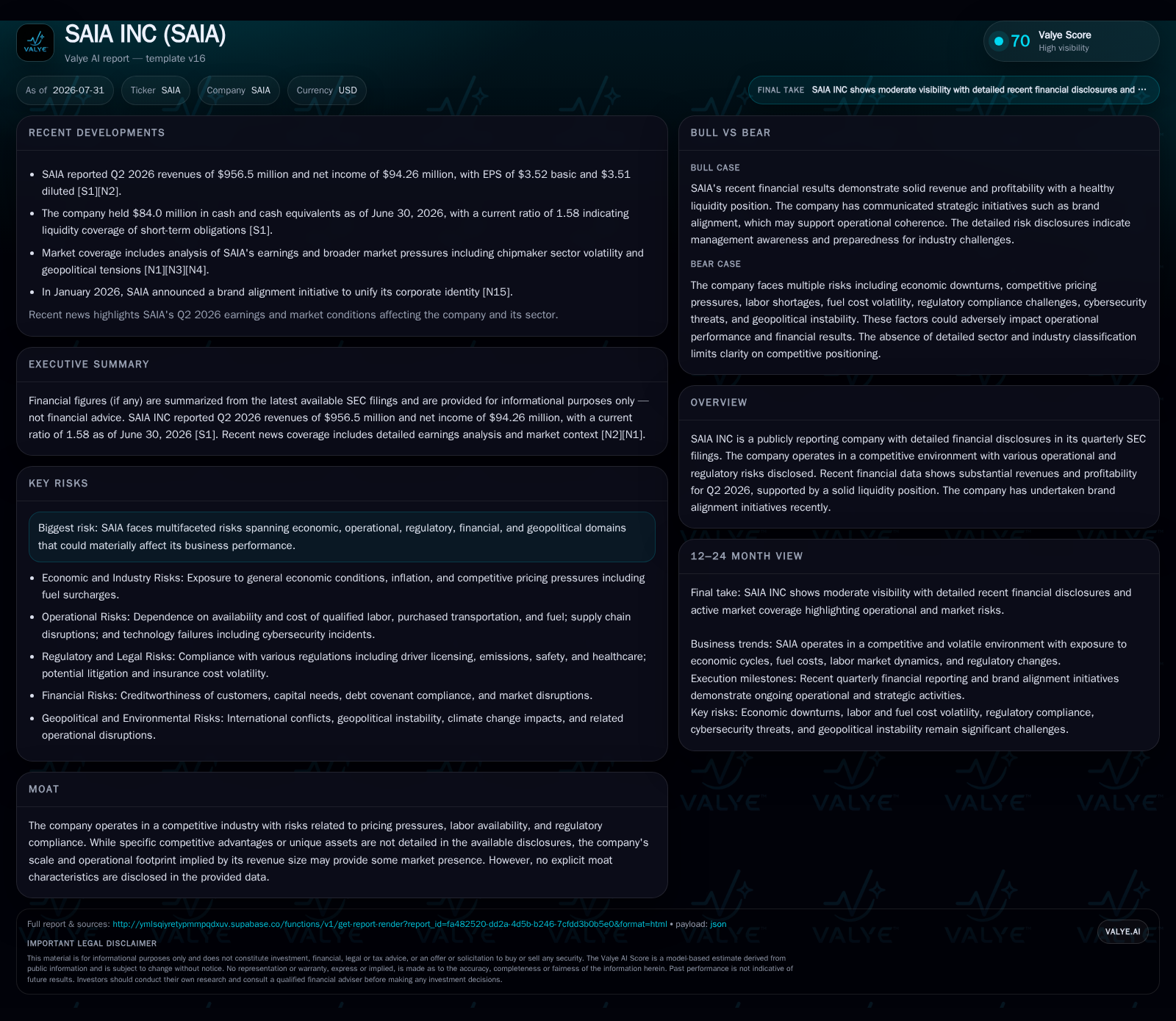
As of June 30, 2026, SAIA held approximately $84 million in cash and equivalents against $100 million in total debt, resulting in a net debt position near $16 million [F1]. The company’s current ratio stood at 1.58, indicating a sufficient near-term liquidity buffer [F1].
Despite this balance sheet position supporting strategic flexibility for network investment or unforeseen claim payouts, filings caution about the possibility of covenant breaches under stressed scenarios reflecting sensitivity to earnings volatility primarily from pricing pressures and escalating insurance costs [S2]. Maintaining disciplined capital allocation alongside prudent risk management remains essential as SAIA maneuvers through this challenging phase.
This analysis incorporates only publicly filed information up through July 30, 2026. It reflects no proprietary inside knowledge nor offers any investment advice but rather contextualizes SAIA Inc.’s current operational realities within broader transportation sector dynamics.
Disclaimer: This is research-only, informational analysis and not investment advice. It may include AI-generated interpretation and general industry context. Always verify important details using primary sources.

Comments