
Northern Trust Boosts Earnings as Assets Under Management Expand Amid Interest Rate Tailwinds
Northern Trust’s Q2 2026 results demonstrate robust earnings growth driven by a favorable interest rate environment and expanding assets under management, reinforcing its diversified wealth and fiduciary services model.
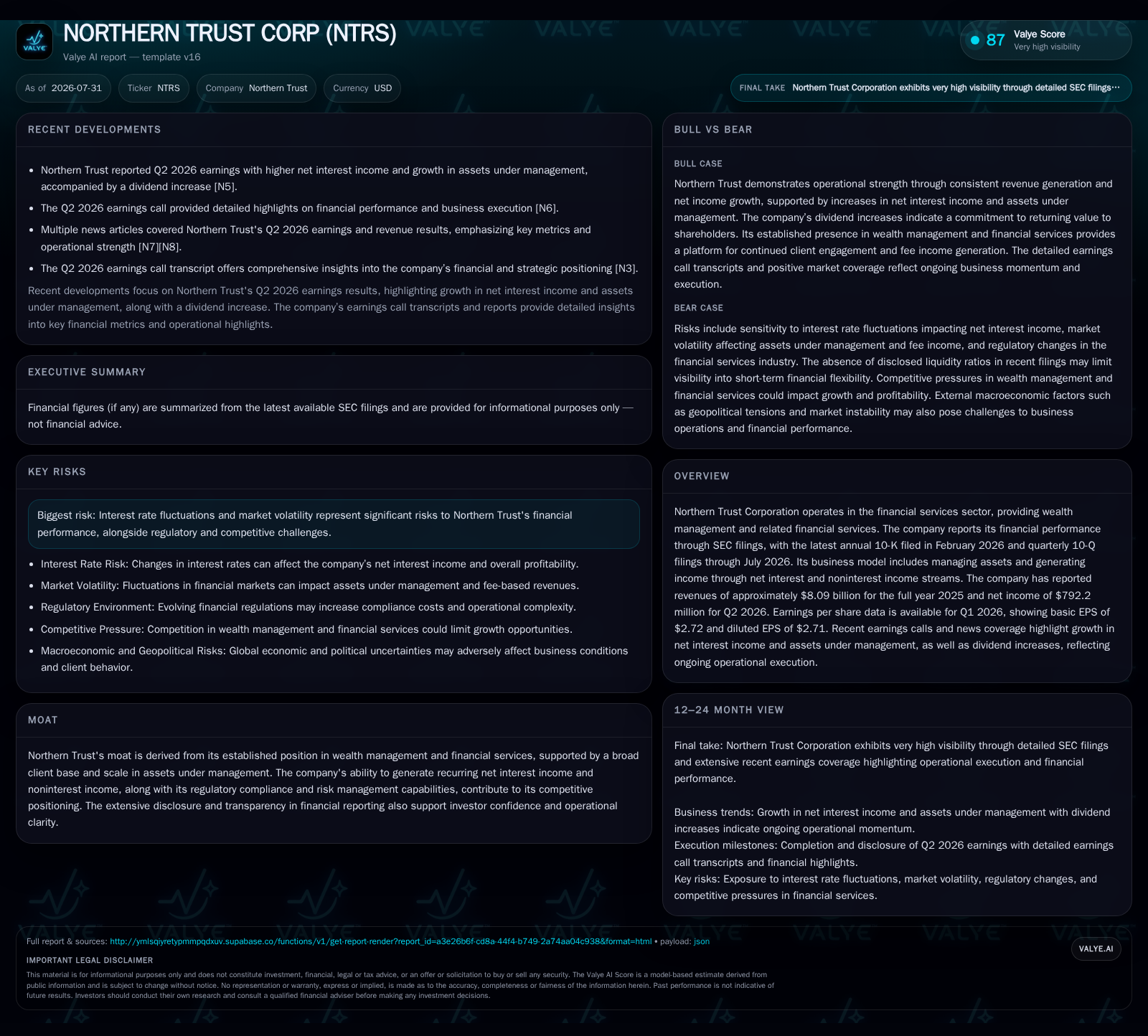
In its latest quarterly filing, Northern Trust Corporation reported a net income of $792.2 million for Q2 2026, reflecting strong net interest income growth supported by rising interest rates and steady expansion in assets under management (AUM). The company’s dual revenue streams—net interest income from lending and deposits alongside fee-based income from wealth management and custody services—have together fortified its earnings resilience amid market volatility. Compared to peers like State Street and BNY Mellon, Northern Trust maintains competitive positioning through diversified fee income and operational discipline. Key risks remain tied to interest rate fluctuations, market volatility, and regulatory pressures, with upcoming quarters set to reveal traction on client retention and expense management.
Q2 Operating Update: Earnings Lifted by Rising Net Interest Income and AUM Growth
Northern Trust’s Q2 2026 earnings reporting revealed a net income of $792.2 million fueled primarily by a notable increase in net interest income (NII) aligned with the prevailing upward trend in interest rates [S2]. This quarter’s financial performance marks a continuation of the company’s ability to capitalize on a favorable rate environment that enhances spread-based earnings from its lending portfolios and deposit bases. Simultaneously, the firm’s assets under management maintained an upward trajectory, directly supporting fee-generating activities including custody services and fiduciary advisory segments [N1]. These combined factors indicate a strong operating leverage effect wherein growing AUM not only raises top-line fee revenue but also feeds into broader balance-sheet efficiencies.
The rise in NII is particularly critical given Northern Trust’s historical reliance on this stream as a foundational revenue pillar alongside noninterest income sources. The synergy between rising rates driving margin expansion and gradual pickup in market volumes suggests durable earnings quality over the medium term [S2]. Recent investor communications highlighted confidence with a dividend increase declaration following the quarter ([N3]), underscoring management’s positive stance on capital deployment backed by sustained profitability.
Layered Revenue Streams: How Net Interest Income and Fee Income Complement Each Other at Northern Trust
Northern Trust operates a bifurcated business model that strategically captures value from both net interest income arising from traditional banking operations—lending activities balanced by deposit funding—and fee income earned primarily through wealth management, custody, fiduciary services, and trust offerings [S1],[S2]. This dual-source construct cushions the firm against isolated shocks; when fee-based revenues linked to assets under management fluctuate due to market volatility or asset flows, net interest income provides countervailing stability driven by the company’s asset-liability management capabilities.
The firm’s stewardship of client assets across institutional investors, high-net-worth individuals, and corporations not only generates recurring fee income but also reinforces client stickiness via fiduciary duties and trust relationships. This contributes positively to client retention metrics often cited in the industry as predictors of long-term revenue quality [S1]. Furthermore, Northern Trust’s effective utilization of client segmentation enables tailored pricing power balancing competitive pressures with valued service differentiation.
While fees represent a significant portion of total revenue—anchored by scale in AUM—they tend to exhibit variability sensitive to market conditions. Net interest margin expansion during periods of rising rates thus amplifies overall profitability potential. This complementary relationship aligns with observed industry patterns where successful custodians maintain diversified revenue portfolios rather than singular dependence on transactional commissions or spread compression [S2],[N1].
Competitive Landscape: Northern Trust’s Position Against State Street and BNY Mellon Custodian Peers
Within the wealth management and custodial services sector, Northern Trust competes alongside major players such as State Street Corporation and BNY Mellon. These peers operate comparable business models that blend asset servicing with fiduciary responsibilities while navigating similar regulatory frameworks. Though exact rankings vary regionally and segmentally, Northern Trust distinguishes itself through focused client segmentation emphasizing ultra-high-net-worth clientele as well as large institutional mandates that demand bespoke trust solutions.
When benchmarking scale metrics such as AUM growth trajectories versus these custodians, Northern Trust sustains competitive momentum but faces persistent pressure on operating margins stemming from elevated compliance costs and investments in technology platforms necessary for digital transformation [N7]. Fee diversification remains a differentiator; while traditional wealth managers may concentrate predominantly on advisory fees or asset management contracts, Northern Trust leverages its custodian bank heritage to integrate treasury functions enhancing cross-selling potential.
Operational efficiency measured via cost-to-income ratio is closely watched by peers; Northern Trust endeavors to optimize this ratio by deploying automation across routine processes while carefully managing headcount growth to maintain service levels without disproportionate expense escalation [S1]. Sustained success relative to peers will hinge on maintaining this balance amid intensifying competition from fintech entrants disrupting some traditional custody functions.
Growth Drivers: Market Dynamics Fueling Asset Expansion and Fee Diversification
Macro-level drivers underpinning Northern Trust’s growth include rising global wealth accumulation trends prompted by demographic shifts favoring aging populations requiring retirement planning alongside expanding institutional allocations emphasizing risk-adjusted returns. These secular forces drive incremental net new asset inflows forming the core base for recurring fee revenues [S1],[N1]. Further supporting growth is the company’s strategic enhancement of digital advisory platforms facilitating richer client interaction that can lead to deeper penetration of customized fiduciary products.
Cross-selling opportunities within existing relationships also augment wallet share; banking products such as lending or deposit accounts bundled with trust services enhance revenue per client beyond standalone custody fees [N3]. Favorable interest rate environments strengthen this dynamic by improving net interest margin performance that supplements fee base growth economically
Northern Trust has noted increased adoption of technology-enabled investment solutions as pivotal in capturing younger wealth segments whose preferences lean toward digitally accessible services without sacrificing personalized guidance—this innovation aligns well with industry shifts observed broadly across global wealth managers aiming for multigenerational client retention strategies [N1]
Risks to Monitor: Interest Rate Fluctuations, Market Volatility, and Regulatory Pressures Ahead
Despite robust recent performance drivers, several inherent risks place downward pressure on Northern Trust's outlook. Interest rate volatility constitutes a double-edged sword; while rising rates currently bolster NII expansion, abrupt rate cuts or flattening yield curves could compress margins rapidly given reliance on spread earnings [S2]. Market volatility likewise impacts AUM valuations affecting fee income stability since custody fees often scale proportionally with managed assets' value rather than fixed contractual amounts.
Regulatory compliance represents another significant weight on operating expenses due to intensified supervisory scrutiny post-global financial crisis emphasizing fiduciary accountability, data privacy requirements, anti-money laundering controls, among others [S1]. These compliance costs are largely fixed or semi-fixed overheads contributing negatively to operating leverage especially when organic revenue growth slows.
Competition from emerging fintech disruptors offering streamlined asset servicing or robo-advisory alternatives challenges established pricing models potentially eroding traditional fee pools incrementally. Operational risks connected with cybersecurity threats also pose material reputational hazards capable of undermining client trust fundamental to Northern Trust’s fiduciary franchise [N1],[S1],[S2].
Key Signals Ahead: What to Watch for in Upcoming Quarters on Client Activity and Operating Efficiency
Looking forward into successive quarters following Q2 2026 results, several critical indicators will illuminate Northern Trust’s trajectory. Foremost among these are the pace of net new asset inflows which serve as proxies for competitive positioning effectiveness amid complex market environments. Stability or growth here correlates strongly with sustained fee revenue gains [S2],[N3].
Monitoring shifts in fee income mix—such as proportionate growth in fiduciary versus pure custody fees—and changes in renewal or retention rates will provide early signals around client loyalty amid intensifying alternatives available in the marketplace. Likewise important is movement in the cost-to-income ratio reflecting operational efficiency; improvements here would suggest successful scaling of investments in automation or platform rationalization offsetting compliance-driven expense inflation.
Additional attention should be paid to disclosed EPS momentum benchmarks given their linkage directly back to core profitability drivers highlighting how well incremental revenues translate into bottom-line benefits post overhead absorption. Dividend sustainability further echoes confidence levels embedded within guidance updates provided through quarterly calls or subsequent filings ([N3]) reinforcing financial discipline vis-à-vis capital return frameworks.
Brief Financial Profile Discussion: Profitability, Margins, and Capital Framework Supporting Operations
Return on equity metrics historically registering at moderate double-digit levels indicate balanced returns reflecting steady reinvestment coupled with shareholder distributions consistent with recent dividend increases noted publicly ([N3]). Operating expense vigilance remains central given ongoing investments in regulatory compliance infrastructure combined with technology upgrades aimed at long-term competitiveness ([S1]).
Overall financial strength facilitates continued execution against growth ambitions encompassing organic expansion via enhanced digital capabilities alongside selective partnerships or acquisitions designed to augment product breadth without diluting capital efficiency significantly.
This analysis synthesizes the latest data points provided by Northern Trust Corporation's SEC filings through July 2026 integrated with recent news commentary reflecting evolving market context while anchoring interpretation firmly within wealth management and custodial financial services sector norms without conjecture beyond reported evidence.
Disclosure: This article does not constitute investment advice but is intended solely for informational purposes based on public filings and industry knowledge.
Disclaimer: This is research-only, informational analysis and not investment advice. It may include AI-generated interpretation and general industry context. Always verify important details using primary sources.

Comments