
Martin Marietta Expands Footprint Amid Shipment Growth and Margin Pressures
Q2 2026 shows shipment gains driven by acquisitions but margin compression from acquisition accounting and cost pressures.
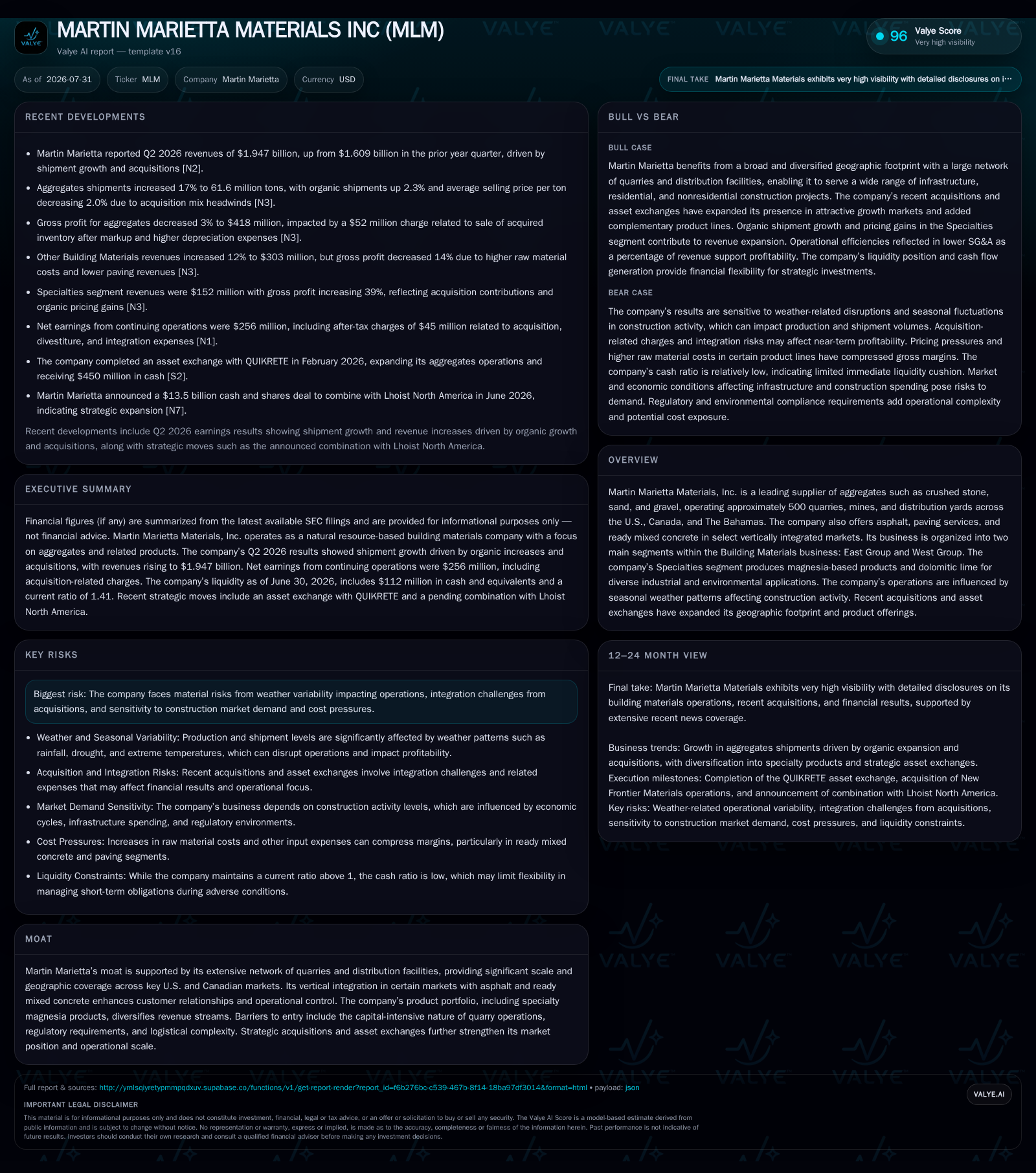
Martin Marietta Materials reported aggregate shipment growth for Q2 2026 fueled by organic gains and contributions from recent acquisitions, including QUIKRETE and New Frontier Materials. However, average selling prices per ton declined slightly due to geographic and acquisition mix headwinds. Gross profit margins compressed, reflecting a notable charge related to the sale of acquired inventory at fair market value, along with elevated depletion and amortization expenses. The company's Building Materials business segments were reorganized post-QUIKRETE transaction, and the Specialties segment marked strong profitability growth supported by pricing and acquisition synergies. Amid pending Lhoist North America acquisition, financial covenant amendments provide leverage flexibility, though integration and macroeconomic risks remain notable.
Recent Operating Update: Growth with Margin Headwinds
In its Q2 2026 filing dated July 30, Martin Marietta Materials delivered above-consensus shipment volumes with aggregate shipments increasing 15% year-over-year for the first six months ended June 30 [S2]. This growth was driven by a mixture of organic shipment gains (4.3%) alongside full-quarter contributions from the QUIKRETE Holdings asset exchange closed in February 2026 and partial-quarter contributions following the May acquisition of New Frontier Materials (NFM) [S19], [S22]. However, average selling price (ASP) per ton fell modestly by about 1.3%, impacted primarily by the mix effect of acquisitions in lower ASP geographies as well as ongoing geographic shifts favoring Central and Western divisions where prices tend to be lower than corporate average [S22]. Importantly, organic ASP rose slightly offsetting some compositional pressures.
Despite volume growth, aggregate gross profit decreased roughly 3% for the six-month period. This contraction was largely attributable to a substantial $73 million charge reflecting the sale of acquired inventory marked up to fair market value under acquisition accounting rules, coupled with heightened depreciation, depletion, and amortization expenses stemming from recent asset additions [S29]. The discounting effect from acquisition accounting masks underlying operational profitability trends and will normalize over time as adjusted for these non-recurring items. Meanwhile, other Building Materials revenues advanced by approximately 7–12% across reporting periods but experienced gross profit declines (14% quarter-on-quarter) due primarily to elevated ready mixed concrete raw material costs alongside diminished paving job margins reflecting competitive pricing pressures or macroeconomic cost inflation [S14], [S16].
The Specialties segment stood out with robust performance showing a 39% gross profit increase on revenues of $152 million during Q2 2026 [S16]. This improvement was fostered by the July 2025 Premier Magnesia acquisition integration delivering synergy realization across magnesia-based products alongside solid organic pricing improvements. This diversification into specialty materials introduces higher-margin revenue streams that reduce cyclicality inherent in traditional heavy materials.
Business Model Specifics: Aggregates-Centric with Strategic Vertical Integration
Martin Marietta's core business model rests on vertical integration of aggregates production—comprising crushed stone, sand, and gravel—through a network of approx. 500 quarries, mines, and distribution yards concentrated in strategic U.S., Canadian, and Caribbean markets [S1], [S19]. The company monetizes primarily through volume shipments billed on a per-ton basis to contractors engaged in infrastructure, residential, commercial construction as well as agricultural and environmental uses. Revenue moves with aggregate shipment volumes influenced heavily by seasonal weather patterns—spring through fall being peak construction seasons—and pricing dynamics tied to local market conditions.
Beyond upstream aggregate extraction, the firm competes downstream in select geographically focused markets with ready mixed concrete plants, asphalt production facilities, and paving services units creating bundled offerings that lock-in customer relationships via integrated supply chains [S19], [S26]. These vertical integration efforts mitigate competitive pressure from pure-play aggregates producers while improving operational efficiencies like logistics coordination across production and delivery.
Recent strategic asset moves—most notably acquiring QUIKRETE operations producing roughly 20 million tons annually alongside asphalt/paving assets in British Columbia while divesting non-core cement plants—demonstrate management's focus on concentrating resources in higher-growth or margin-enhancing segments aligned with targeted geographic clusters [S19], [S2]. This repositioning also prompts the resegmentation into East Group (East + Southwest divisions) and West Group (Central + West divisions) reporting structures designed to better manage regional market dynamics [S12].
Industry Context & Competitive Positioning
Martin Marietta operates within the capital-intensive building materials sector characterized by high fixed costs associated with quarry development, equipment depreciation (depletion expense), regulatory permitting hurdles, substantial logistics infrastructure needs (truck/rail/barge transport), and sensitivity to construction spending cycles. Peer companies such as Vulcan Materials Company or Lehigh Hanson similarly focus on aggregated quarry portfolios complemented by selective vertical integrations into asphalt or concrete.
The company's scale—with approximately half a thousand production sites distributed broadly across key U.S. states plus Canadian provinces—provides substantial geographic coverage enabling regional pricing power but also exposes it to microeconomic variations including weather disruptions—excess rainfall or drought conditions materially influence capacity utilization and shipment volumes each quarter [S1], [S26]. Martin Marietta’s moat is underpinned by this extensive logistics network supplemented by regulatory barriers restricting new entrant quarries potentially diluting market share.
Strategic acquisitions such as Premier Magnesia LLC enhance diversification into specialty minerals offering margin stability offsetting cyclical aggregates demand fluctuations [S16]. Nonetheless, company-wide operating margin compression observed recently highlights cost pressure sensitivities exacerbated by input price inflation particularly in raw materials used for ready mixed concrete production
Growth Drivers: Geographical Expansion & Vertical Diversification
The company's recent asset exchanges substantially expand its presence in attractive growth markets such as Virginia, Missouri, Kansas, British Columbia while augmenting product mix through incorporation of asphalt businesses [S19]. Such expansions increase critical mass enabling potential economies of scale in procurement and transport logistics reducing per-ton costs.
Vertical integration initiatives into paving services plus ready mixed concrete plants foster stable customer engagement via one-stop sourcing solutions rather than commodity-only sales elevating switching costs for clients seeking project efficiency.
Additionally, expanding specialty minerals lines through acquisitions reduces reliance on traditional aggregates cyclicality driven heavily by infrastructure government spending trends that can be volatile amid political budget uncertainties [N1], [N10]. Organic pricing power within specialty products evidences pricing levers beyond volume reliance shown in Specialty segment gross margins rising substantially Y/Y during Q2 2026 [S16].
Recent acquisitions present integration execution risk potentially affecting synergy capture timelines or operational disruptions leading to temporarily inflated costs demonstrated through acquisition accounting charges impacting reported profits at present [S29]. Given sizable upcoming Lhoist North America $13.5 billion transaction pending close subject to regulatory approvals creates further complexity requiring prudent management attention amid macroeconomic uncertainty [N1], [S23].
Cost inflation remains a persistent pressure point noted especially in ready mixed concrete raw materials which haven't fully stabilized leading to compressions in Building Materials gross margins despite revenue advances marking an area requiring ongoing monitoring from both procurement strategy and pricing standpoint.
Additionally, regulatory compliance costs involving environmental permits for quarry expansions or emissions controls imply capital intensity will continue limiting rapid capacity scaling constraining short-term supply responsiveness relative to demand spikes.
What To Watch Next
Market participants should track shipment volume trends especially organic tonnage performance relative to weather impact deviations; any sustained volume softness would signal economic headwinds compromising demand resilience.
Watch for margin recovery signals post-noncash acquisition charges normalization alongside continued execution integrating NFM footprint leveraging synergies centralizing logistics operations.
Progress updates on Lhoist North America merger approval timing plus debt financing execution will materially affect balance sheet health profiles determining longer-term capital allocation flexibility beyond purely operational metrics.
Monitoring shifts in contract mix between vertically integrated service offerings versus pure commodity aggregate sales could provide insights into evolving competitive positioning against major peers like Vulcan Materials or Lehigh Hanson.
Finally, management commentary during subsequent earnings calls addressing input cost pass-through capabilities within pricing frameworks will clarify margin sustainability prospects amid inflationary pressures observed globally.
Financial Profile Discussion
As of June 30, 2026, Martin Marietta held approximately $112 million in cash and equivalents against current liabilities around $1.74 billion, yielding a current ratio of about 1.41 indicating short-term liquidity adequacy supporting ongoing working capital needs [F1], [S2]. Total debt approximated $1.03 billion netting down to about $919 million net debt after subtracting cash balances signaling moderate leverage. The company was in compliance with its financial covenants as of June 30, 2026 [S2]. It refrains from projecting future financial results beyond documented data points or speculating on unstated commercial agreements or market shares. No investment research views are offered herein.
Disclaimer: This is research-only, informational analysis and not investment advice. It may include AI-generated interpretation and general industry context. Always verify important details using primary sources.

Comments