
TechnipFMC’s Q2 Execution Challenges Temper Margins Despite Revenue Strength
Recent cost estimate revisions in TechnipFMC’s Q2 2026 results highlight execution volatility amid robust revenue performance.
TechnipFMC reported solid revenue for Q2 2026, but project execution challenges manifested in unfavorable cost estimate revisions that weighed on gross profit margins. The company’s integrated subsea and surface services model drives sizeable backlog supported by offshore development activity, yet execution risk remains a persistent margin headwind. Geographic diversity cushions regional volatility, while forthcoming environmental accounting changes introduce additional complexity. Liquidity and capital structure are currently adequate to support the capital intensity of large EPC projects amidst cyclical oilfield spending.
Q2 Cost Estimate Revisions Reflect Execution Volatility in Complex Offshore Projects
TechnipFMC’s second quarter 2026 earnings revealed notable execution challenges reflected through net unfavorable cost estimate revisions impacting gross profit by approximately $17.2 million ($73.3 million unfavorable partially offset by $56.1 million favorable adjustments) [S2]. This reveals the persistent difficulty in accurately forecasting costs on highly technical, capital-intensive offshore engineering procurement and construction (EPC) contracts that form a core part of TechnipFMC’s integrated subsea and surface systems business model. While revenue growth remained strong, these cost overruns exerted pressure on margins, illustrating that project execution risk remains a crucial determinant of near-term profitability.
This dynamic is emblematic of the oilfield services industry where complex offshore projects—employing bespoke subsea systems and surface production equipment—necessitate tight control over engineering, installation timelines, and material costs to secure margin stability. TechnipFMC’s disclosure underscores an important operating marker: monitoring future cost estimate revisions and their impact on gross margins will be essential to assessing whether the company’s project delivery capabilities are improving or still vulnerable to overruns common in large-scale integrated deliveries.
Integrated Subsea and Surface Solutions Link Backlog Quality With Margin Pressure
TechnipFMC derives revenue predominantly through long-term contracts blending subsea infrastructure with surface facilities under an EPC framework [S1]. The company’s ability to provide end-to-end solutions positions it competitively vis-à-vis peers such as Schlumberger and McDermott International who also operate integrated service models covering field development phases from design to offshore installation.
However, this integrated delivery model intensifies exposure to execution risk; fixed-price contracts prevalent in the portfolio demand stringent cost control, whereas cost-plus contracts provide more margin flexibility but less pricing power [N5][S2]. The recent quarterly cost estimate revisions highlight how fluctuations in project-level costs materially affect operating income margins despite a strong aggregate contract backlog
TechnipFMC’s moat is supported by this technological integration—its combined subsea and surface expertise enhances customer retention and contract win potential—but remains constrained by the mixed quality of backlog impacted by evolving commodity prices, supply chain constraints, and labor market pressures.
Geographic Presence Balances Regional Risks Amid Cyclical Capex Fluctuations
TechnipFMC operates globally with significant presence across Latin America, Europe, Africa, North America, Asia Pacific, and the Middle East [S1]. Such geographic diversification serves both as a hedge against regional geopolitical instability and as exposure to different oil basin cycles driven by local capital expenditure rhythms.
This balance is critical given the upstream industry’s pronounced cyclicality tied directly to oil price swings which influence operator capex budgets for field development including offshore projects requiring advanced subsea systems.
TechnipFMC's established footprint in diverse basins allows it to capitalize on accelerating spending in regions benefiting from ongoing exploration or replacement infrastructure investments while offsetting declines elsewhere. Tracking revenue shifts by geography alongside new order intake provides vital insight into regional demand drivers amid a fluctuating economic landscape.
Growth Levers Tied to Offshore Exploration Recovery and Energy Transition Investments
Underlying TechnipFMC’s commercial momentum are growth opportunities connected to a rebound in offshore exploration and development activity globally. Expansions into liquefied natural gas (LNG) infrastructure construction also present new avenues for backlog expansion [S1][S2]
Projects such as Baleine Phase 3 exemplify the company's ability to secure high-profile offshore developments requiring complex integrated solutions combining subsea trees with surface production equipment—a strategic area underpinning future growth prospects [N5]
Increasing global energy demand alongside aging field infrastructure necessitates ongoing maintenance cycles supporting aftermarket businesses within TechnipFMC’s service portfolio. Additionally, burgeoning energy transition investments such as carbon capture projects potentially offer new contract scopes distinct from traditional hydrocarbon extraction services.
Execution Risks and Accounting Changes Pose Watchpoints for Profitability Stability
Despite encouraging backlog growth signals, TechnipFMC faces risks consistent with its sector: volatile oil prices dictate customer spending pace, geopolitical hotspots may disrupt schedules or increase costs, and project delays or cost overruns threaten profitability.
Adding complexity is the recently issued FASB Accounting Standards Update (ASU) 2026-02 concerning environmental credits and obligations effective from 2028 onward [S2]. This introduces more rigorous accounting standards around emerging environmental credit markets influencing certain contract accounting.
TechnipFMC is currently evaluating the impact of this ASU which may introduce future earnings variability or disclosure changes related to sustainability-linked project components or regulatory compliance costs. Monitoring management’s progress adapting financial reporting to these evolving rules will be informative on transparency levels amid rising ESG-related investor scrutiny.
Near-Term Milestones: Monitoring Contract Updates, Environmental Credit Accounting Impact
Investors and analysts should focus on incoming quarterly disclosures for signs of order intake acceleration or slippage especially linked to large EPC subsea-surface contracts which drive most revenue. Project completion timelines relative to original estimates serve as a tangible KPI reflecting improved execution discipline or lingering challenges.
Updates around the adoption impacts of ASU 2026-02 before its mandatory implementation will also be critical—we expect preliminary disclosures or management commentary illuminating potential margin effects or balance sheet changes resulting from environmental credit obligations within the next year.
Capital Structure Enables Flexible Funding But Requires Vigilance on Debt Maturity Profiles
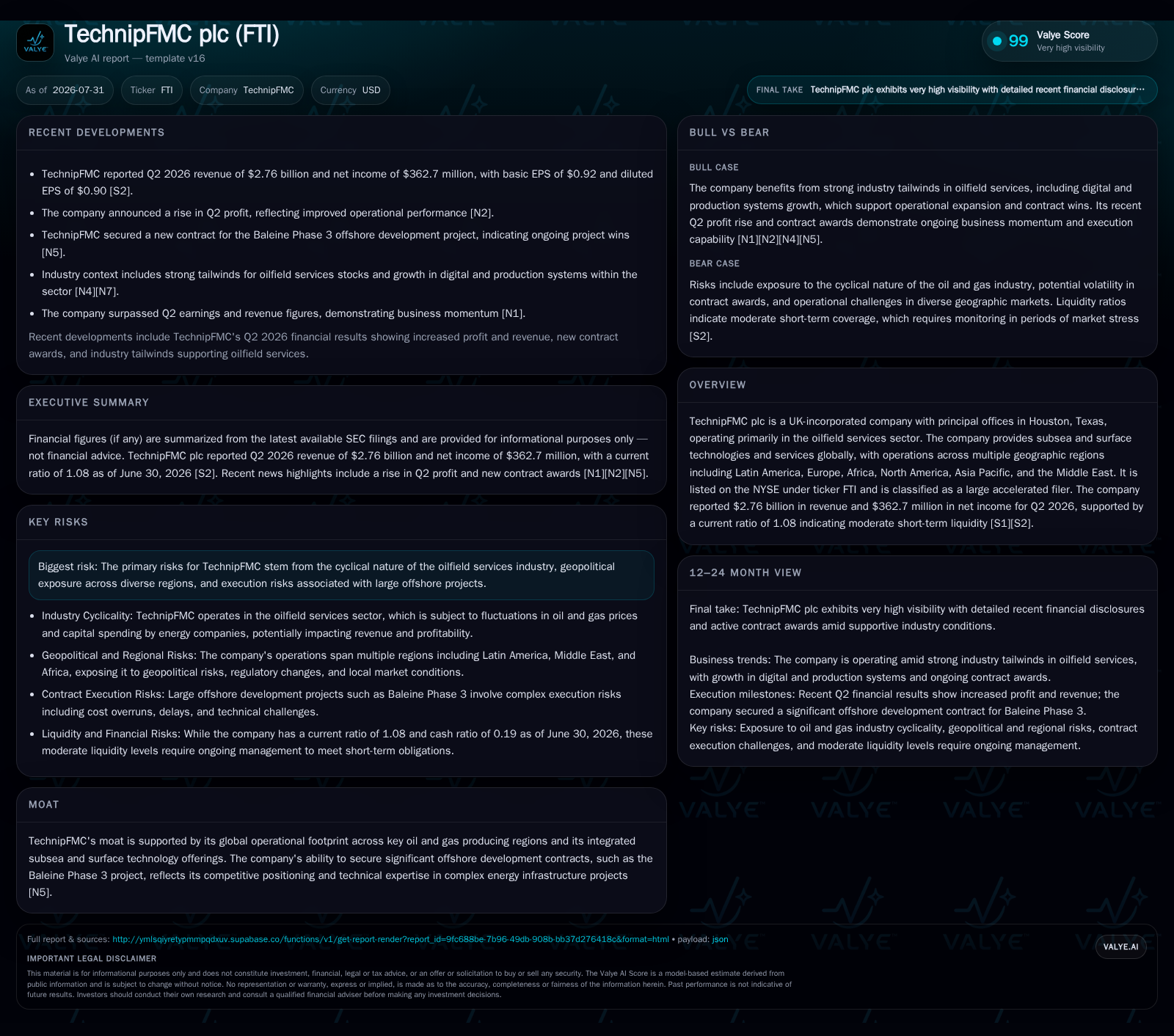
TechnipFMC maintains liquidity supported by cash balances nearing $992 million at quarter end June 30, 2026, alongside availability under an untapped $1.25 billion revolving credit facility [S2][F1]. Such resources are essential given the capital-intensive nature of offshore EPC projects characterized by long working capital cycles deriving from inventory build-up, subcontractor payments, and milestone-based customer billing.
Debt totaled approximately $402 million as of June 30, 2026, with a notable short-term portion of $115 million reflecting current maturities and highlighting near-term refinancing needs [S2]. This debt profile requires ongoing monitoring to manage rollover risks amid industry cyclicality and macroeconomic conditions.
Effective liquidity management paired with cautiously calibrated debt servicing capability is fundamental for TechnipFMC’s resilience as it scales backlog-driven operations during episodic upstream spending peaks.
Financial Profile Discussion
TechnipFMC reported Q2 2026 revenue of $2.76 billion complemented by net income of approximately $363 million indicating profitable core operations despite margin pressures from cost estimate adjustments [S2]. The current ratio remains moderate at 1.08 reflecting balanced short-term asset coverage against liabilities but points toward tightly managed working capital given industry capex demands [F1].
Operating cash flow generation is a key metric moving forward; historical trends suggest fluctuations due to project payment timing but sustaining positive OCF while funding new orders will validate capital efficiency improvements.
It highlights the interplay between operational execution risks intrinsic to integrated oilfield services providers like TechnipFMC and evolving financial/regulatory factors shaping near-term results transparency.
Disclaimer: This is research-only, informational analysis and not investment advice. It may include AI-generated interpretation and general industry context. Always verify important details using primary sources.

Comments