
DT Midstream’s Stable Firm-Contract Model Faces Concentration and Renewal Risks
DT Midstream’s Q2 2026 update highlights steady revenue from long-term contracts amid customer concentration and market dynamics.
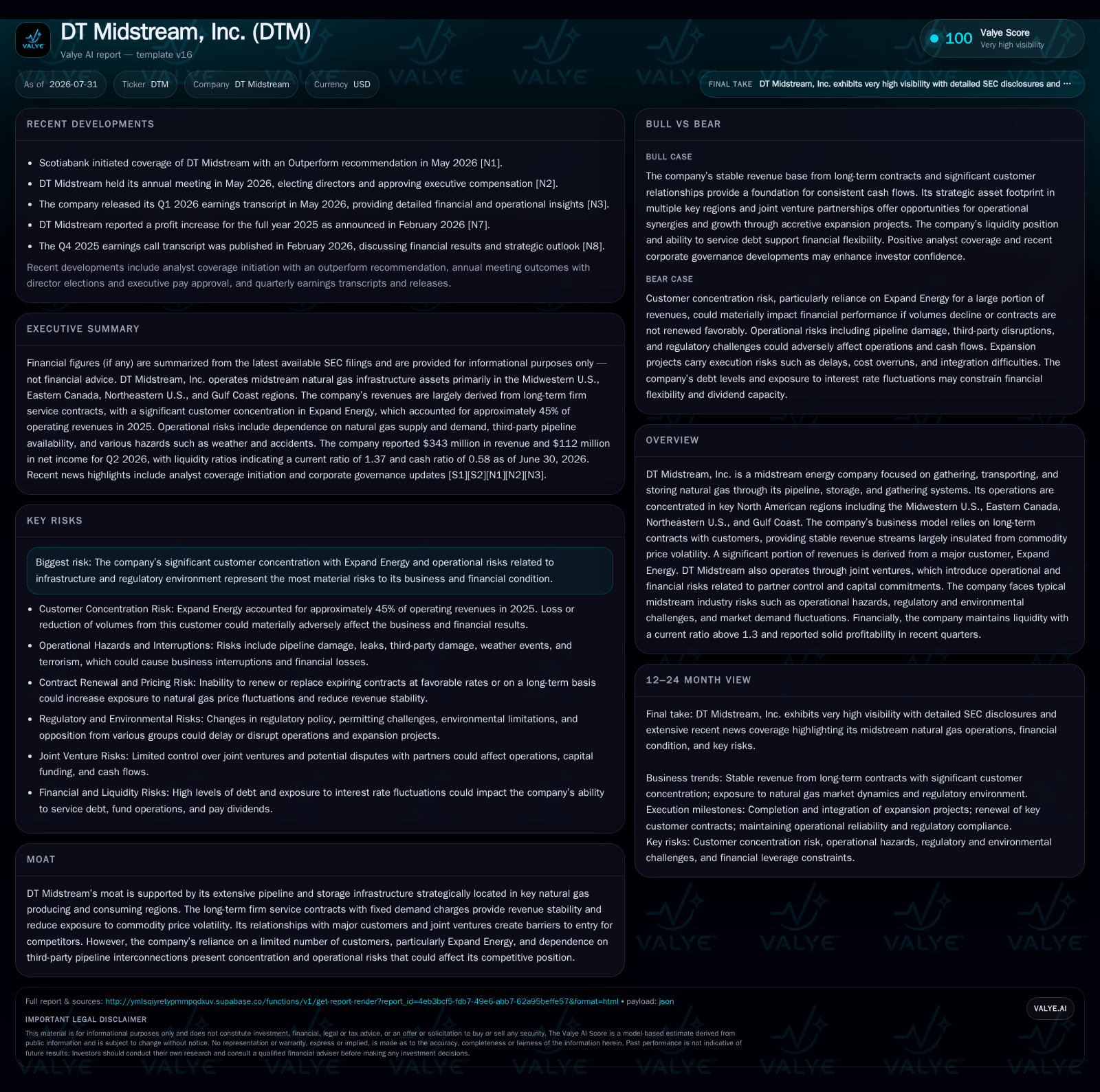
DT Midstream, Inc., a North American natural gas gathering, transportation, and storage operator, reported stable operating trends in its Q2 2026 10-Q. Its revenue base remains largely insulated from commodity price swings due to long-term firm service contracts emphasizing fixed demand charges. However, DT Midstream faces material risks from heavy reliance on a single major customer accounting for nearly half of revenues and from contract renewal uncertainties. The company’s financials show solid liquidity but substantial leverage typical of midstream peers. Growth prospects hinge on maintaining contracted volumes amid regional supply conditions and capturing new long-term contracts amid an evolving regulatory environment.
Recent Operating Update
Business Model Analysis
DT Midstream operates primarily as a pipeline-focused natural gas midstream infrastructure provider with activities spanning gathering systems, transportation pipelines, and storage facilities [S1]. Its geographic footprint covers vital energy corridors including the Midwest U.S., Eastern Canada, Northeastern U.S., and the Gulf Coast—a spread that strategically aligns it with both production basins and consumption markets.
The core revenue mechanic is fee-based income under long-term firm service contracts structured around fixed demand charges or minimum volume commitments (MVCs). These agreements insulate DT Midstream’s revenues from direct exposure to natural gas commodity prices because customers pay fees based predominantly on contracted capacity rather than fluctuating throughput volumes alone [S1]. Such contracts promote predictable cash flow generation critical for supporting the company’s operational costs and debt servicing.
The firm service model also includes deficiency fees for MVC shortfalls, bolstering revenue even when throughput dips temporarily [S1]. Nonetheless, contract expiration remains a vulnerability if renewals are not secured on comparable commercial terms. This dynamic places emphasis on contract backlog quality—a key KPI for midstream operators—though DT Midstream does not publicly disclose detailed backlog metrics
Joint ventures form part of DT Midstream’s operational profile as well. While these partnerships enable asset and capital sharing benefits that can accelerate system expansion or optimize connectivity with third-party pipelines, they entail risks related to partner governance and financial commitments that could impact overall returns [S1].
Industry Structure and Competitive Position
Midstream infrastructure companies like DT Midstream occupy the crucial link connecting upstream producers with downstream consumers including utilities and industrial users. Their value lies in reliable delivery capacity supported by extensive pipeline networks and storage assets that underpin market liquidity.
DT Midstream’s competitive moat is underpinned by its strategically positioned pipeline systems intersecting key natural gas plays and densely populated demand centers across North America [S1]. Long-term contracts serve as economic moats by limiting entry opportunities for competing pipelines unless new supply basins emerge or customer dynamics shift substantially.
However, the business is inherently capital intensive with substantial ongoing expenditures required to maintain system integrity and comply with evolving regulatory requirements relating to environmental permitting and safety standards. Competitors such as Enterprise Products Partners or Kinder Morgan benefit likewise from scale advantages; therefore DT Midstream must continually optimize maintenance efficiency and system reliability to sustain margin performance.
Customer concentration further influences competitive dynamics; losing or downsizing volumes from Expand Energy—the largest single customer—could disrupt revenue visibility significantly [S1]. As such, diversification efforts within contract portfolio or geographic scope carry strategic importance.
Growth Drivers
DT Midstream’s growth trajectory revolves around several foundational drivers:
- Regional Natural Gas Production Growth: Expansion in production within operating regions directly correlates with higher throughput volumes available for gathering and transport services.
- Long-Term Contract Awards: Securing additional firm service contracts—both for existing assets undersubscribed at present or greenfield expansions—enhances contracted capacity utilization.
- Infrastructure Expansions: Investments targeted at upgrading capacity or building new storage facilities can capture incremental market share or address supply-demand imbalances.
- Market Demand Trends: Growing adoption of natural gas as a relatively cleaner fossil fuel alternative amid environmental regulation supports steady demand for midstream services.
- Strategic Joint Ventures: Partnerships allowing shared project financing or access to otherwise inaccessible markets bolster asset utilization efficiently.
These factors combined drive improvements in KPIs such as contracted capacity utilization rates, throughput volume growth measured ordinarily in millions of cubic feet per day (MMcf/d), and operating margins that reflect efficient cost leverage over increasing volumes.
Risks and Watchpoints
Key risks shaping DT Midstream's profile include:
- Customer Concentration: Dependence on Expand Energy for roughly 45% of revenues concentrates credit risk. Any volume reduction or contract non-renewal from them holds material downside potential [S1].
- Contract Renewal Uncertainty: While firm service contracts offer protection from commodity volatility, failure to renew them at expiry or replacement under less favorable terms could expose cash flows to greater price sensitivity or volume variability.
- Regulatory & Environmental Compliance: Operations face stringent regulations under federal/state laws governing pipeline safety, environmental impact assessments, land use permits, and emissions controls. Noncompliance triggers financial penalties or forced curtailments impacting availability [S1].
- Operational Hazards: Infrastructure risks include leaks, ruptures, accidents leading to costly repairs or reputational harm.
- Third-party Pipeline Interconnection Dependence: Unavailability or limited access to other pipelines connecting customers impairs volume flow capabilities [S1].
- Financial Leverage & Interest Rate Exposure: With net debt approximating $3.18 billion against cash of $172 million as of mid-2026 ([F1]), interest expenses are sensitive to rate fluctuations affecting free cash flow generation for dividends or reinvestment.
These variables warrant continuous monitoring; sustained operational reliability metrics including downtime rates alongside adherence to MVCs would help mitigate adverse impacts.
What To Watch Next
Several upcoming indicators deserve close attention:
- Contract Renewal Announcements: Timely disclosure of negotiations especially concerning Expand Energy will shed light on future revenue stability.
- Throughput Volume Trends: Quarterly reporting of volume metrics would confirm usage patterns supporting firm service charge assumptions.
- Capital Expenditure Updates: Insights into expansion projects or maintenance capital provide visibility on infrastructure modernization prospects affecting system availability.
- Dividend Declarations: Consistent dividend payouts above $0.88 per share quarterly signal management confidence in underlying cash flows despite leverage.
- Regulatory Developments: Any changes in environmental policy impacting permitting timelines could influence project schedules.
- Joint Venture Activity: New partnership formations or modifications impacting operational control would influence financial contribution profiles.
Stability across these factors will validate DT Midstream’s entrenched business model relying on asset-backed contractual revenues amid evolving market dynamics.
Financial Profile Discussion
As of June 30, 2026, DT Midstream reported cash and equivalents totaling approximately $172 million alongside current assets of $409 million against current liabilities of $298 million, yielding a healthy current ratio near 1.37 indicative of short-term liquidity adequacy [F1]. Total debt stood at $3.35 billion resulting in net debt around $3.18 billion after factoring cash reserves [F1]. This leverage level is characteristic among midstream companies who typically employ significant debt financing secured by predictable fee-based cash flows under firm contracts.
Dividend policy continuity at recent quarterly levels implies management prioritizes shareholder returns balanced against prudent leverage management within capital allocation frameworks [S3]. Monitoring free cash flow generation versus capital expenditure needs will be essential going forward given cyclical nature of midstream capex requirements including regulatory compliance investments.
This analysis synthesizes recent quarterly operational disclosures combined with annual SEC filings to contextualize DT Midstream’s operational positioning within North American natural gas midstream infrastructure sector without offering investment research views or forecasts. Observers should watch contract renewal developments closely due to concentrated customer exposure while assessing emerging regulatory impacts on asset utilization potential.
Disclaimer: This is research-only, informational analysis and not investment advice. It may include AI-generated interpretation and general industry context. Always verify important details using primary sources.

Comments