
Spok Holdings Balances Legacy Paging Services with Growing Software Revenue amid Network Lease Costs
Spok Holdings reported a steady recurring revenue mix in Q2 2026, highlighting the ongoing transition in healthcare communication from legacy wireless messaging to integrated software solutions.
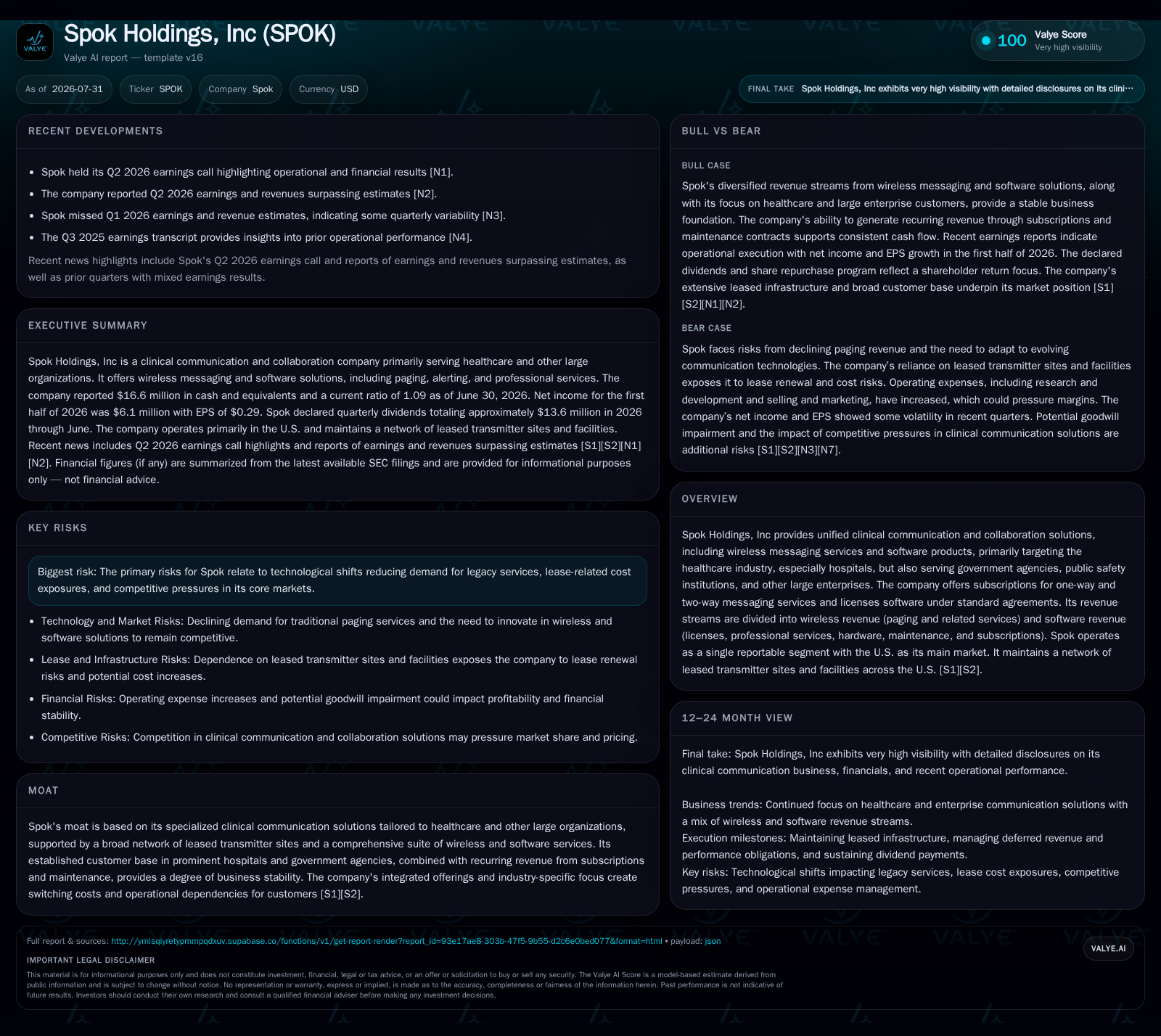
In its Q2 2026 filing, Spok Holdings reinforced a mixed revenue profile combining legacy paging services with expanding software licensing and subscription revenues primarily targeting healthcare providers. The company’s extensive network infrastructure of leased transmitter sites supports its wireless services but presents ongoing cost pressures. While recurring subscription revenue underpins business stability, risks include legacy technology obsolescence and lease expense volatility. Growth hinges on expanding software adoption and maintaining high customer retention amid competitive and regulatory demands.
Recent Operating Update and Why It Matters
Spok Holdings’ latest quarterly report for Q2 ending June 30, 2026, reiterates the company’s dual reliance on wireless paging services alongside its expanding software offerings [S2]. The disclosures emphasize the enduring role of Spok's nationwide network infrastructure—operating approximately 2,869 active transmitters across nearly 2,400 leased sites—as the backbone supporting its paging and two-way messaging services [S1]. This extensive network facilitates offerings primarily to U.S.-based hospitals and government entities requiring secure clinical communication.
Critically, Spok continues to generate wireless revenue mainly through recurring subscriptions charged on a periodic basis (monthly through annual), a model that covers one-way or two-way messaging capabilities tailored to customers' geographic coverage needs [S2]. Alongside this is software revenue derived from perpetual and term license fees, maintenance contracts typically spanning one to three years, professional services for implementation, and complementary hardware sales that enable integration with clinical workflows [S2].
The combined mix underscores that while legacy paging is still material, the company is progressively shifting toward higher-margin software solutions—a trend consistent with industry digital transformation pressures [S3]. The quarterly results also noted a declared dividend consistent with prior quarters ($0.3125 per share), implying stable cash flow generation from their recurring business model
Spok’s Business Model: Revenue Mechanics and Strategic Positioning
Spok’s business model centers on providing unified clinical communication solutions that include wireless messaging (notably paging) and software-driven collaboration tools. Customers—chiefly hospitals, healthcare systems, government agencies, and related public safety institutions—pay via subscriptions for continuous messaging access or license fees for software solutions that improve clinical alerting workflows [S1][S2].
Revenue grows by increasing subscriber base volume (devices/users), extending average contract length through renewal rates, upselling enhanced two-way messaging capabilities or additional service scope, and selling related hardware enabling interoperable communication platforms [S2]. Maintenance contracts offer predictable annual or multi-year recurring revenue, thus delivering margin stability compared with one-time hardware sales which are episodic
Strategically, Spok leverages deep integration within hospital IT systems, fostering stickiness due to operational dependency on reliable alerting systems compliant with HIPAA and patient-safety regulations. This creates switching costs bolstered by the specialized nature of transmitter site leasing arrangements underpinning wireless service delivery. However, this physical infrastructure dependence also exposes Spok to risks from escalating lease costs or potential alternative technology displacing paging services [S1].
Industry Structure and Competitive Landscape
Within healthcare IT communications—a sector focused on secure real-time clinical collaboration—Spok occupies the niche bridging wireless messaging with integrated software platforms. Peers such as Vocera Communications and TigerConnect prioritize cloud-native clinical communication platforms enhancing interoperability without legacy network constraints. These competitors often deliver more modern mobile apps supporting multi-channel messaging beyond traditional paging.
Spok’s substantial physical network infrastructure differentiates it but also places it at risk amid technological obsolescence trends. The company competes not only on product suite breadth but also on network uptime reliability essential for mission-critical hospital communications where downtime can compromise patient safety.
Furthermore, regulatory pressures around patient safety mandate rigorous compliance standards that favor established providers like Spok but open opportunities for newer entrants offering easier EHR integration or streamlined workflow tools. Leasing arrangements spanning thousands of transmitter locations elevate fixed cost structures unlike pure-software competitors reliant on cloud infrastructure.
Distinct Growth Drivers
Spok’s growth prospects hinge heavily on accelerating digital transformation trends in healthcare that increase demand for secure real-time communication platforms. Hospitals expanding IT budgets seek multi-modal messaging solutions combining traditional one-way paging with modern two-way secure messaging integrated into clinical alerting workflows.
The gradual shift away from purely legacy paging toward hybrid or full software-based communication models represents both opportunity and challenge. While wireless subscriptions remain steady owing to entrenched use cases (e.g., emergency alerts), growth possibilities lie in expanding software license bookings, professional implementation services utilization, and incremental hardware compatible with new communication protocols [S2]
Moreover, the public safety/government segment offers additional expansion avenues as these entities upgrade aging communication infrastructures requiring both reliability and compliance advantages inherent in Spok’s offerings. Finally, increasing regulatory emphasis on secure healthcare communication standards fuels demand for comprehensive platforms integrating alerting with EHRs and workflow orchestration.
Risks, Watchpoints, and Growth Constraints
Key risks persist around the pace of technological obsolescence reducing demand for legacy paging services foundational to much of Spok’s wireless revenue [S1]. If clients transition rapidly to alternate cloud-native platforms or mobile-first communication tools without significant network dependency, subscription attrition risk rises.
Lease costs connected to over 2,300 transmitter sites create exposure to fluctuating commercial real estate pricing or landlord contractual changes potentially squeezing operating margins [S1]. Maintaining high network uptime is essential; any outages may jeopardize contracts especially in highly regulated hospital environments.
Competitive risks abound given emergent clinical collaboration vendors emphasizing interoperability without infrastructure lease burdens—pressuring pricing power across Spok’s offerings. Additionally, long sales cycles typical in healthcare IT procurements coupled with uncertain renewal timing require vigilance in subscription renewal rates as primary retention KPIs.
Cybersecurity and HIPAA compliance pose ongoing threats broadly within healthcare IT communications; any data breaches would erode trust significantly given the sensitivity of clinical alerts handled by Spok’s platforms.
What To Watch Next
Investors should monitor upcoming quarterly releases for updates on subscription renewal rates—an indicator of customer loyalty amid shifting tech trends—and changes in average revenue per user (ARPU) reflecting success selling enhanced two-way messaging features or software licenses.
Cost management related to transmitter site leases will be a critical operating metric impacting gross margins; disclosures around capital expenditures or lease renegotiations could signal margin trajectory adjustments.
Further insights into professional services utilization rates will illuminate how well Spok is capturing growth beyond core messaging subscriptions into integrated implementations supporting hospital digital strategies.
Any mentioned progress on integration partnerships with major electronic health record (EHR) vendors would validate competitive positioning strengthening ecosystem lock-in effects.
Finally, monitoring dividend declarations offers a proxy gauge of free cash flow stability essential to sustaining shareholder distributions amid evolving revenue mixes.
Financial Profile Discussion
As of June 30, 2026, Spok held $16.6 million in cash and equivalents against current liabilities totaling approximately $46.3 million resulting in a current ratio near 1.09—a modest liquidity cushion indicative of close working capital management [F1][S2]. The firm’s total debt levels appear minimal relative to cash balances when considering best-effort estimates available (~$3.3 million dated back several years), implying low leverage risk currently [F1].
The stable dividend policy—with recent quarterly payments at $0.3125 per share—reflects confidence in recurring subscription and maintenance revenues underpinning cash flow generation despite exposure to legacy wireless cost structures [S3][F1]. Capital expenditures mainly support leased transmitter sites critical to service delivery but remain carefully controlled given their long-term lease commitments outlined in prior filings [S1].
Operating income reported at $19.7 million annually demonstrates modest profitability consistent with margin profiles expected from combined wireless-software models reliant on specialized network infrastructure alongside recurring maintenance fees [F1]. Deferred revenue balances linked to subscription prepayments provide visibility into near-term revenue recognition patterns reinforcing business stability.
Overall financials confirm that while revenue growth may moderate due to market dynamics influencing legacy segments, strong software licensing adoption coupled with disciplined fixed cost management enables sustainable earnings generation.
Disclaimer: This analysis is based solely on publicly disclosed information up to July 31, 2026. It does not constitute investment advice or research views regarding securities of Spok Holdings Inc. Market conditions may change rapidly affecting company performance outside this review.
Disclaimer: This is research-only, informational analysis and not investment advice. It may include AI-generated interpretation and general industry context. Always verify important details using primary sources.

Comments