
Rimini Street’s Subscription Model Faces Liquidity and Litigation Challenges Amid Improving Profitability
The company reports steady revenue growth and operating income gains despite a sub-1 current ratio and ongoing litigation risks.
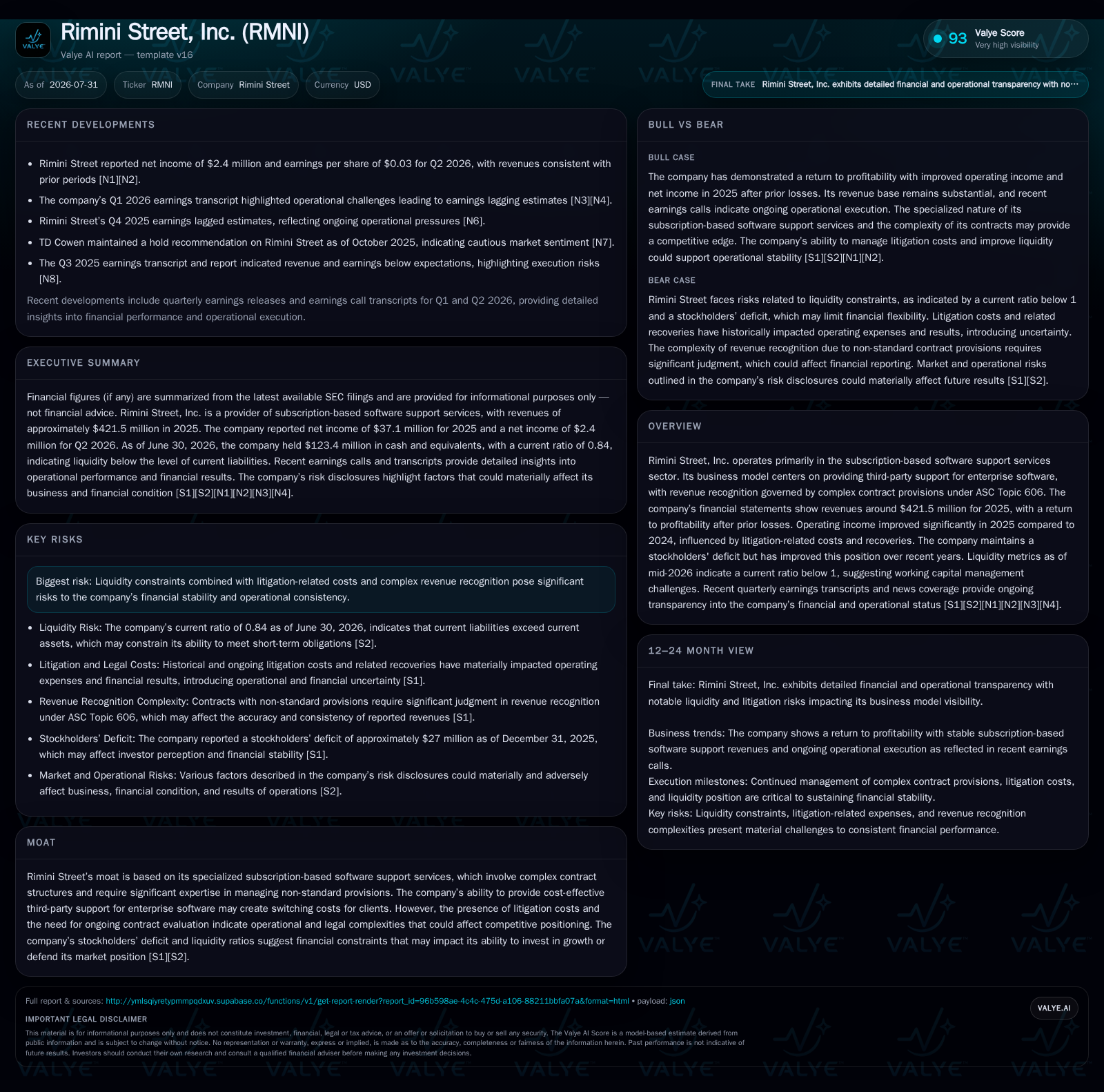
Rimini Street, Inc. continues to operate as a specialized third-party support provider for enterprise software, offering subscription-based maintenance services with complex contract structures. Its Q2 2026 results confirm ongoing revenue stability and improved profitability, supported by multi-year contracted deferred revenue streams. However, liquidity constraints—evidenced by a current ratio of 0.84—and persistent litigation costs present challenges to operational flexibility and capital deployment. The company’s competitive differentiation hinges on cost-effective third-party support with switching cost dynamics but must navigate customer retention against original vendors' in-house support. Key growth drivers include extended enterprise software lifecycles and expanding subscription contracts, though legal exposures remain a material risk.
Latest Operating Update: Sustained Revenue Growth during Profit Recovery
The company held $123.4 million in cash and equivalents as of June 30, 2026, with current assets of $262 million and current liabilities of $312 million, resulting in a current ratio of approximately 0.84 [F1]. This suboptimal working capital position reflects the upfront nature of contractual obligations versus cash inflows spread over contract tenors.
Business Model: Subscription-Based Third-Party Software Support
Rimini Street operates downstream in the enterprise software value chain as a third-party maintenance provider offering technical support, updates, and consulting services for legacy business applications originally developed by major software vendors [S1]. Its value proposition centers on providing lower-cost alternatives to vendor-authorized support while extending software lifecycle management for clients with older or customized deployments.
Revenue mechanics hinge on long-term contracts under ASC Topic 606 that create deferred revenue recognition profiles reflecting multi-year service delivery [S1]. Customers pay subscription fees billed upfront or periodically for specified service levels governed by SLAs. This subscription model generates recurring revenue streams bolstered by switching costs tied to customized knowledge and the complexity of transitioning back to vendor support [S1].
Operating margins depend critically on efficient service delivery and controlling support ticket resolution costs since contract gross margins can be pressured by rising labor or technology expenses [S1]. The reported service fulfillment costs amounting to about 40% of related deferred revenue indicate substantial investment in skilled technical personnel required to meet client expectations over contract terms [S7].
Industry Structure and Competitive Positioning
Within the broader Enterprise Software Support Services industry, Rimini Street occupies a niche competing primarily against original software vendors’ in-house support offerings (e.g., Oracle and SAP) as well as emerging managed services providers. Peers differ widely in scale: original vendors leverage integrated ecosystems but tend to command higher prices; third-party providers like Rimini focus on cost efficiency and specialized legacy systems expertise.
Retention and renewal metrics are key indicators of competitive strength but remain undisclosed publicly; these factors influence annual recurring revenue (ARR) stability and predictability.
Litigation risk is a salient distinguishing factor for Rimini Street relative to peers, given historical intellectual property disputes with large software vendors [S21]. These legal proceedings impose direct costs—defense, settlement—and indirect costs through management distraction or reputational impact, constraining margin expansion potential.
Growth Drivers: Extended Lifecycle Demand and Subscription Expansion
Growth levers derive from multiple secular trends:
- Enterprises face pressure on IT budgets yet require ongoing maintenance for entrenched legacy software—creating demand for lower-cost third-party alternatives.
- Migration away from expensive vendor contracts often leaves organizations needing high-quality localized support, a niche Rimini fills.
- Increasing complexity of enterprise environments boosts the value proposition of specialized maintenance bundled with consulting.
- Shifts toward subscription billing align supplier incentives with long-term client retention rather than transactional sales.
- Regulatory compliance demands consistent updates sustain need for ongoing service contracts.
These drivers underpin steady deferred revenue backlogs approaching $269 million as of December 31, 2025 reflecting contracted future billings anchored in diverse geography/industry customer bases [S7][F1]
Risks, Watchpoints, and Growth Constraints
Several factors temper Rimini Street’s outlook:
- The company’s liquidity profile presents a constraint: a current ratio below one coupled with significant deferred revenue liability requires effective working capital management lest operational disruptions emerge [F1].
- Litigation exposure remains a cyclical earnings headwind; resolution or escalation could materially affect profitability and cash flow projections [S21].
- Competitive pressure from large original vendors capable of bundling advanced features alongside support may erode price competitiveness over time.
- Contract complexity and intricate ASC Topic 606 rules impose ongoing accounting/reporting burdens that could lead to earnings volatility if estimates shift materially.
- Customer churn risk exists if organizations revert to vendor-provided support due to perceived higher quality or strategic alignment.
- Technological obsolescence risk affects demand if legacy platforms rapidly phase out or become unsupported externally.
Interest rates on these credit lines approximate an effective rate around 7%–8%, adding financing cost pressure amid narrow margins.
Cash reserves totaled $123.4 million at mid-2026 end Q2 against current liabilities slightly above $312 million, underpinning the sub-one current ratio calculation (~0.84) indicating potential near-term liquidity stress [F1][S2]. The company discloses sufficient liquidity coverage for at least the coming year assuming no adverse macro or litigation impacts [S7][S2].
Operating income recovery (to nearly $60 million in 2025) juxtaposed with stockholders' deficit signals gradual balance sheet healing but underscores caution in financial health with residual deficits presenting equity cushion concerns [F1][S1]. Capital allocation includes stock repurchase programs authorized up to $50 million extending through mid-2029 but depends heavily on compliance with credit terms restricting discretionary spending [S20].
In conclusion, Rimini Street benefits from steady contracted revenue streams backed by specialized third-party enterprise software support expertise but faces persistent execution risks stemming from legal matters and constrained liquidity that may limit growth investments or operational agility going forward. Sustained careful management of contract renewals alongside litigation progress will be pivotal indicators of its evolving business quality.
Disclaimer: This is research-only, informational analysis and not investment advice. It may include AI-generated interpretation and general industry context. Always verify important details using primary sources.

Comments