
Cullen/Frost Bankers Navigates Texas Growth with Stable Margins and Robust Risk Controls
The regional Texas bank reports resilient net interest income amid balanced loan growth and continued capital returns.
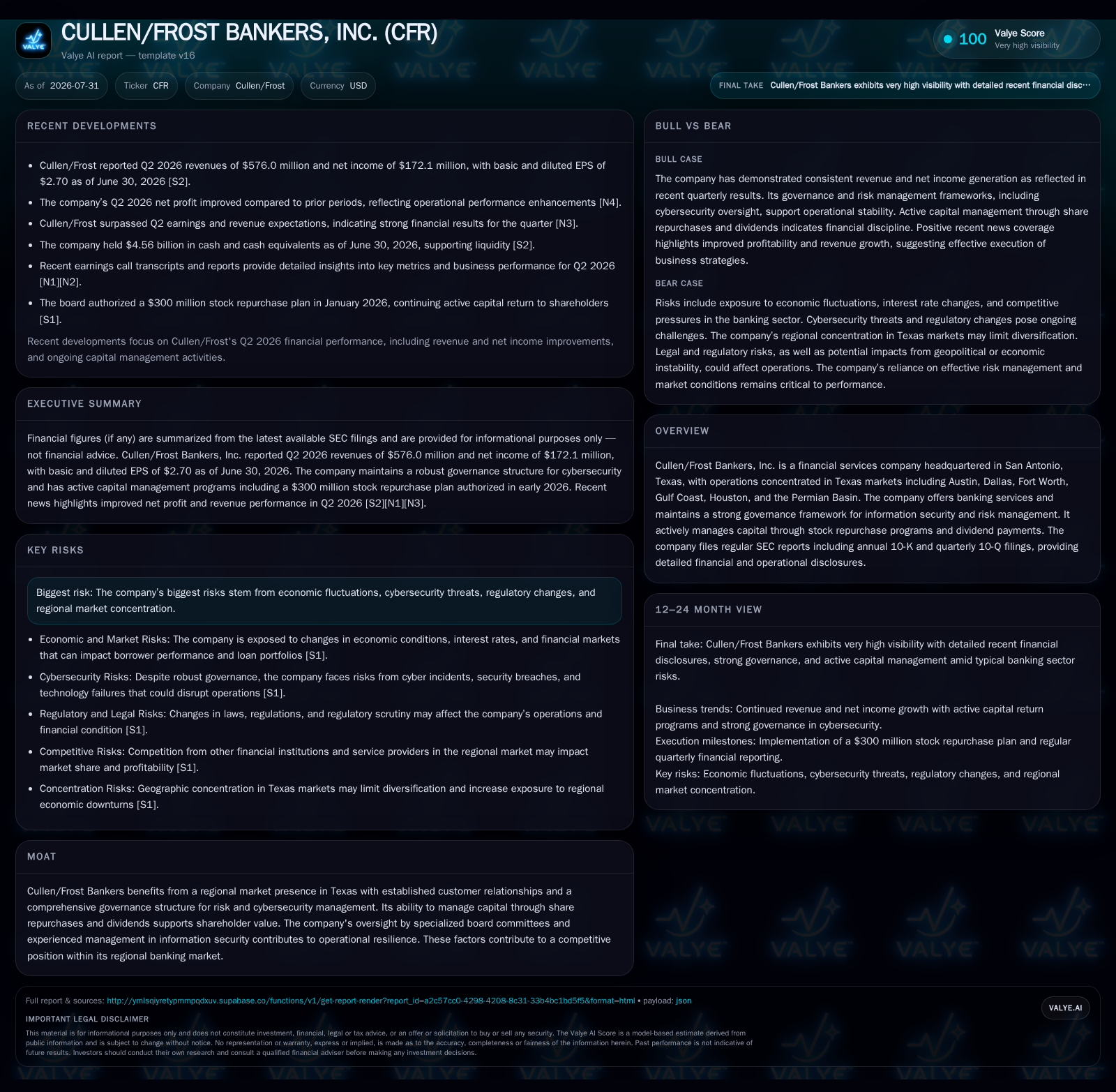
Cullen/Frost Bankers, Inc. (CFR) posted solid Q2 2026 results driven by stable net interest income and effective capital deployment. Loan growth remains modest with consistent asset quality, supported by comprehensive risk and cybersecurity governance frameworks. Operating within a concentrated Texas market, the bank leverages its local expertise and disciplined credit management to navigate economic and regulatory headwinds while maintaining shareholder-friendly dividends and share repurchases.
Recent Operating Update: Q2 2026 Highlights
Loan balances exhibited measured growth across commercial, real estate, and consumer segments within core metropolitan areas including Austin, Dallas, Houston, Fort Worth, Gulf Coast regions, and the Permian Basin. Although specific loan portfolio segments are not granularly disclosed this quarter, prior annual filings establish a diversified mix emphasizing commercial real estate and energy-sector lending mitigated through risk grading policies [S1][S2]. Importantly, asset quality indicators such as non-performing loans remained low relative to total loans with conservative provisions for credit losses maintained; a sign of prudent underwriting amid Texan market cyclicality [S2][S1].
More specifically, loan interest income was approximately flat year-over-year ($346 million vs. $344 million), while taxable securities yield contributions slightly decreased alongside reduced balances in interest-bearing deposits, signaling cautious liquidity management favoring higher-quality liquid assets [S2]. The bank’s securities held-to-maturity position remained stable at about $3.39 billion, underpinning capital adequacy and long-term funding strategies.
Complementing core lending operations, fee-based revenue streams have been identified as a growing contributor to overall earnings stability through wealth management services, transaction fees, and treasury operations—common supplemental sources for regional banks seeking diversification beyond net interest margin pressures [S1]
Business Model Overview
Cullen/Frost Bankers operates as a traditional regional bank focused on the Texan economy serving retail customers, small-to-medium enterprises (SMEs), commercial clients—including significant exposure to energy-related sectors—and public entities. The company acts as an intermediary deploying deposits into loan assets while engaging in securities investments to diversify asset yields.
Revenue generation hinges on net interest margin (NIM), which is the difference between interest earned on loans/securities versus interest paid on deposits/other borrowings. Margins depend heavily on loan volume growth, pricing discipline relative to prevailing rates, deposit mix shifts, and effectiveness of liquidity management. Fee income supplements these margins, particularly from wealth management advisory services and commercial treasury products that command fees independent of interest rate cycles.
Operational leverage is influenced by the efficiency ratio—costs relative to revenue—which Cullen/Frost monitors carefully given branch operating costs across its multiple Texas markets. The firm emphasizes strong risk controls including detailed underwriting standards and layered governance over credit risk and operational technology risks.
Capital allocation reflects standard regional banking priorities: maintain regulatory capital well above Basel III thresholds (evidenced by stable CET1 ratios), return excess capital to shareholders via dividends and calibrated buybacks (notably a $300 million repurchase authorization active through early 2027), and fund strategic initiatives such as digital enhancements or selective boutique acquisitions within Texas markets [S26][S2][S1]
Industry Structure and Competitive Positioning
Within Texas’ vibrant but concentration-prone regional banking landscape, Cullen/Frost distinguishes itself through established customer relationships spanning retail banking to large-scale commercial lending predominantly in key metro hubs like San Antonio (headquarters), Houston, Dallas-Fort Worth metroplexes, Austin’s tech-influenced economy, Gulf Coast ports-related commerce, and the oil-and-gas rich Permian Basin.
This geographic concentration imparts strategic advantages: intimate local market knowledge enabling tailored credit decisions aligned with client needs; reputation-driven customer retention yielding stable deposit bases; and regulatory familiarity reducing compliance friction compared to out-of-state competitors venturing into Texas. However, this localization also concentrates exposure to Texas-specific economic cycles—energy price volatility or real estate market swings can pressure loan demand or asset quality more severely than more diversified peers.
Peers generally include regional banks like Prosperity Bancshares or Texas Capital Bancshares sharing overlapping footprints yet vary by niche specialization or balance-sheet scale. Cullen/Frost’s durable governance framework particularly around information security distinguishes it amid heightened cyber risk concerns affecting financial institutions—overseen by dedicated board committees ensuring comprehensive risk mitigation beyond common operational risks [S1].
Growth Drivers
Key growth levers center on continuing regional economic expansion fueling demand for commercial real estate financing as businesses scale or relocate within prosperous Texan metros. Consumer lending expansion remains opportunistic but measured given macro uncertainties affecting spending behaviors.
Deposit growth stems from business clients maintaining operating accounts supplemented by retail base attracted through competitive product offerings reinforced by digital banking improvements—a critical channel given regional demographic shifts favoring younger tech-savvy populations.
Expanding fee income streams—such as wealth management products aimed at rising affluence clusters in metropolitan zones—and treasury services designed for mid-sized commercial clients support diversified revenue resilience against fluctuating interest environments.
Interest rate movements also serve as indirect growth drivers—periods of rising rates may enhance NIM if loan repricing outpaces deposit costs; conversely rate declines compress spreads challenging profitability but often increase refinancing or new credit demand temporarily.
Capital deployment aligned with shareholder returns through consistent dividends combined with judicious share repurchases aims to preserve investor confidence supporting valuation amidst cyclical banking sector sentiment swings.
Risks and Watchpoints
The major risk categories encompass economic shocks localized within Texas that could impair borrower capacity leading to increased non-performing loans or elevated loss reserves impacting profitability. Energy sector downturns present particular susceptibility due to concentrated exposure.
Interest rate volatility poses margin compression risks if liability repricing outpaces asset yields or if deposit attrition accelerates unexpectedly.
Regulatory compliance cost escalations driven by banking oversight bodies or cybersecurity mandate enhancements require ongoing expenditure commitments potentially pressuring efficiency ratios.
Cybersecurity threats remain material risks given increased frequency of attacks targeting financial institutions; however Cullen/Frost’s multi-tiered governance including quarterly board-level oversight committees suggests proactive mitigation capability though cannot fully eliminate threat likelihood [S1].
Investor attention should also center on competitive pressures from larger national banks expanding regional footprint alongside fintechs disrupting traditional service delivery channels influencing customer retention dynamics.
What to Watch Next
Key milestones include monitoring upcoming quarterly loan portfolio compositions for signs of accelerating commercial lending or shifts toward higher-risk segments. Tracking changes in net interest margin components will provide insights into balancing asset yield trends against funding costs amid fluctuating rate environments.
Earnings releases will reveal progress on loan loss provisioning adequacy vis-à-vis realized credit outcomes signaling asset quality trajectory.
Updates on capital allocation plans—specifically pace of stock repurchases under the $300 million authorization—and dividend maintenance will inform shareholder return sustainability viewpoints.
Further disclosures regarding digital platform adoption rates or service innovation may highlight operational modernization success crucial for client acquisition/retention going forward.
Regulatory developments impacting compliance burden or capital requirements merit continuous review given their influence on operating expense structure or capital flexibility constraints.
Financial Profile Discussion
At June 30, 2026, Cullen/Frost held roughly $6.47 billion in cash and cash equivalents combining cash balances ($698 million) with interest-bearing deposits ($5.77 billion) distributed across short-term instruments aligning with liquidity policies favoring safety amid potentially volatile funding markets [S2]. Securities held-to-maturity stood near $3.39 billion providing steady income streams while bolstering capital adequacy buffers.
Net interest income for Q2 approximated $547 million between loans ($346 million) and securities ($195 million combined taxable and tax-exempt) though a decline in deposit-related yields was noted due to lower balances affecting overall funding costs efficiency [S2]. Loan growth was modest but consistent while provisions for credit losses remained stable indicating conservative credit risk outlooks [S2].
The previously announced $300 million share repurchase program initiated early 2026 supports active capital return policies complementing stable dividend payouts confirmed in recent quarters [S26][N12][N3]. This balance between capital preservation for regulatory compliance coupled with shareholder remuneration characterizes sound financial stewardship suitable for prevailing macroeconomic uncertainties common to regional banks.
In sum, Cullen/Frost maintains a well-capitalized base with disciplined liquidity measures feeding into strong operational performance consistency aided by seasoned management controlling costs amid evolving industry challenges.
Disclaimer: This is research-only, informational analysis and not investment advice. It may include AI-generated interpretation and general industry context. Always verify important details using primary sources.

Comments