
Sonic Automotive’s Leveraged Scale Faces Pressure Amid Cyclical Auto Market Dynamics
Sonic Automotive's Q2 2026 results reflect its multi-segment business model cushioning cyclical downturns but reveal margin compression driven by inventory costs and competitive pricing.
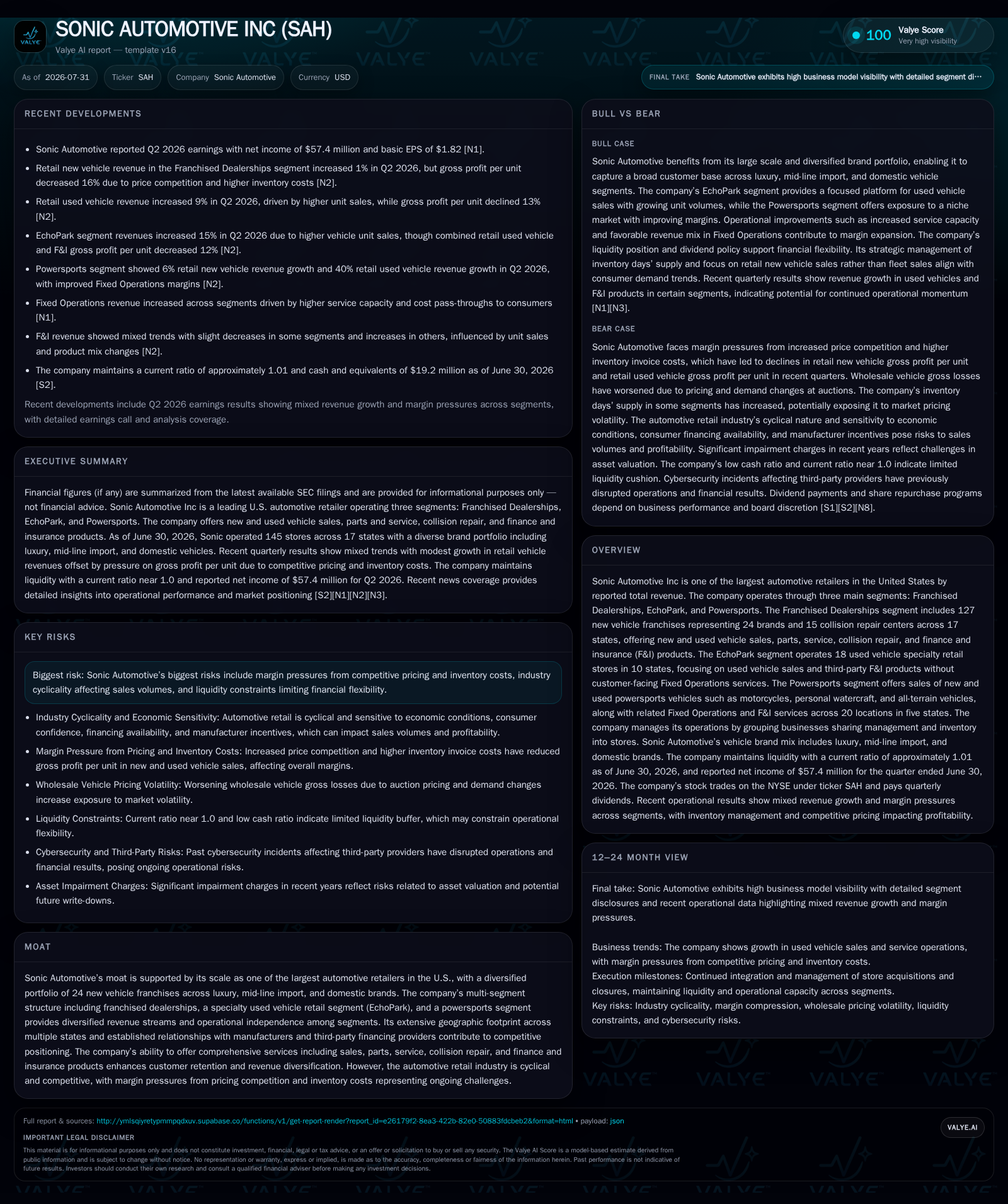
In Q2 2026, Sonic Automotive maintained revenue diversification through its franchised dealerships, EchoPark used vehicle stores, and Powersports segments despite mixed volume trends and margin challenges. The company faced sustained pressure from automotive retail cyclicality, especially in new vehicle sales and inventory costs, while fixed operations and F&I product sales played a key role in stabilizing profitability. Geographic and segment diversification partially mitigated localized demand weakness. Liquidity remains balanced but capital intensity and leverage warrant close monitoring amid ongoing industry headwinds.
Q2 Performance Highlights Reveal Mixed Volumes and Margin Pressures
In the second quarter ended June 30, 2026, Sonic Automotive reported a continuation of the cyclical pressures characteristic of the automotive retail sector. The company experienced a complex performance pattern where new vehicle unit sales saw softness reflective of broader consumer spending caution in the auto market. Used vehicle sales at EchoPark remained stable though constrained by lack of customer-facing fixed operations services which limits margin expansion there [S2][N1]. Meanwhile, the Powersports segment showed incremental growth supported by expanding powersports demand in select states. Despite overall revenue breadth across segments, gross profit per vehicle showed compression primarily due to rising inventory costs during competitive pricing strategies aimed at maintaining volume share [S2][N3].
Finance and insurance (F&I) product penetration slightly increased offsetting some unit sale weaknesses by contributing higher-margin backend income. Fixed operations revenue from parts and service along with collision repair held relatively steady, providing a margin buffer that is typical for large franchised dealership operators amidst volatile new car sales cycles [S2][N1]. However, the aggregate effect was a narrowing of operating margins indicating heightened challenges in balancing volume retention with profitable pricing.
Sonic’s Multi-Brand Franchise Model: Revenue Diversification at Scale
Sonic Automotive's business is structured into three distinct yet complementary segments: Franchised Dealerships, EchoPark used vehicles specialty retail, and Powersports dealerships. The Franchised Dealerships segment commands the largest scale with 127 new vehicle franchises across 17 states representing 24 different brands ranging from luxury to mid-tier imports and domestic lines. This segment benefits from ancillary revenue streams through fully integrated fixed operations—covering parts sales, maintenance, warranty repairs, collision services—and robust third-party F&I offerings that diversify income beyond pure vehicle sales [S1][S2]
EchoPark operates as a specialty used car retailer emphasizing high-volume turnover in pre-owned vehicles supported solely by third-party financed F&I products without offering direct service or collision repair to customers [S1][S2]. This model lowers fixed cost overhead related to aftersales but caps potential margin enhancement from fixed ops contributions. The business operates 18 stores in 10 states with localized market grouping for operational efficiency
The Powersports segment leverages niche demand for motorcycles, personal watercraft, ATVs, and other recreational vehicles through 46 franchises at 20 locations in five states [S1][S2]. Unlike EchoPark, it couples new and used sales with fixed operations servicing tailored to specialty powersports products plus targeted F&I packages
This multi-segment approach provides Sonic with geographic diversity that smooths localized economic or regulatory fluctuations and offers independent operational levers within each segment to adjust to shifting consumer preferences or supply chain dynamics [S1]. Dealer agreements with manufacturers impose certain constraints on inventory procurement timing but also ensure preferential access enabling Sonic to reposition inventory effectively across its footprint.
Industry Context: Cyclicality, Inventory Management, and Competitive Pricing
Automotive retail is inherently cyclical with significant sensitivity to macroeconomic variables such as consumer credit availability, interest rates, fuel prices, and general economic confidence. The sector also faces prolonged inventory management challenges arising from supply chain disruptions which inflate holding costs while constricting inventory turns—particularly acute in new vehicles financed largely through manufacturer captive floor plan facilities.
Pricing pressures extend into used vehicles even though aftermarket products remain less price elastic; however, intense competition among specialty used vehicle sellers like EchoPark restrains achievable gross profit per unit. This environment necessitates efficient inventory turnover metrics — a KPI reflecting how many times average inventory cycles during a period — as slower turns increase exposure to depreciation losses.
Role of Fixed Operations and F&I in Margin Resilience
Fixed operations segments encompassing parts, service work orders including warranty repairs and collision centers are critical for dealer profitability resiliency given their recurring nature typically insulated from new vehicle sale volatility [S2][S1]. Sonic's franchised dealerships feature a network of 15 collision repair centers contributing steady aftermarket parts/service revenue streams that support stabilized operating margins even during soft market periods
Complementing this is finance and insurance product penetration—such as extended warranties, insurance offerings, service contracts—that generate high-margin fees often less cyclical than core vehicle sales volumes [N1]. Sonic's ability to offer diverse third-party financing options tailored per customer risk profile helps increase average transaction revenue per vehicle over peers who might have thinner backend offerings
Though these components do not fully offset downturn-driven top-line softness or rising cost inputs related to inventory financing expenses, they enhance cash flow predictability critical for financing obligations on fleet floor plans and long-term debt servicing.
Specialty Segment Growth: EchoPark Used Cars and Powersports Expansion
EchoPark stands out as a growth platform leveraging growing consumer appetite for certified pre-owned models sold via streamlined specialty stores focusing heavily on customer experience through variable third-party financial product mix rather than direct service offerings. Stability in used vehicle volumes observed during Q2 reflects this strategic focus on price-sensitive yet credit-dependent buyers seeking value without full dealer fixed ops engagement [N1][S2]
The absence of customer-facing fixed operations limits margin capture potential relative to traditional dealerships but reduces operating complexity as well—a tradeoff underpinning a scalable model suited potentially for further geographic expansions where dealer presence is limited or cost prohibitive.
The Powersports segment extends Sonic’s footprint into lifestyle-oriented vehicles gaining momentum among younger demographics less attached to traditional car ownership paradigms but willing to pay premium prices for recreational assets [S1][N1]. Its presence across five states with expanding store count evidences an attempt to capitalize on this niche while maintaining synergy with core dealership services for maintenance and F&I offerings enhancing overall portfolio resilience
Risks to Watch: Inventory Costs, Pricing Competition, and Capital Intensity
Amongst notable near-term risks facing Sonic Automotive are elevated working capital demands fueled by increased vehicle inventories carried longer amid episodic demand lulls coupled with pressures from rising interest rates impacting floor plan financing costs substantially. Competitive pricing intensification leads to narrower gross profit per unit on both new and used vehicles challenging leverage potential on volume recoveries seen historically among large-scale multi-brand retailers.
Financial Profile Discussion: Current Liquidity, Debt Structure, and Capital Allocation
As of June 30, 2026, Sonic Automotive reported cash and equivalents held at roughly $19 million against total debt near $1.78 billion resulting in net debt above $1.75 billion facilitated largely by long-term senior notes plus material floor plan obligations for both new and used inventories—total notes payable around $2 billion implicate sustained asset-heavy capital intensity [F1]
The current ratio stands close to unity at approximately 1.01 reflecting tightly managed working capital offsets between current assets ($3.10 billion) and liabilities ($3.06 billion) [F1]. Floor plan deposit balances around $275 million serve as collateral reducing effective interest burdens though exposure remains notable under higher rate environments.
Capital allocation prioritizes balanced approaches involving steady dividends ($0.41/share approved recently) alongside aggressive share repurchase activities backed by over half a billion dollars in authorized capacity signaling confidence while navigating cyclical headwinds [S16][S19]
All numerical references adhere strictly to cited filings without speculative projections or unsupported market share estimates.
Disclaimer: This is research-only, informational analysis and not investment advice. It may include AI-generated interpretation and general industry context. Always verify important details using primary sources.

Comments