
Sphere Entertainment Strengthens Diversified Revenue Base Amid Venue and Media Segment Cyclicality
Latest quarterly results reveal Sphere Entertainment's multi-segment revenue exposure and ongoing capital intensity challenges.
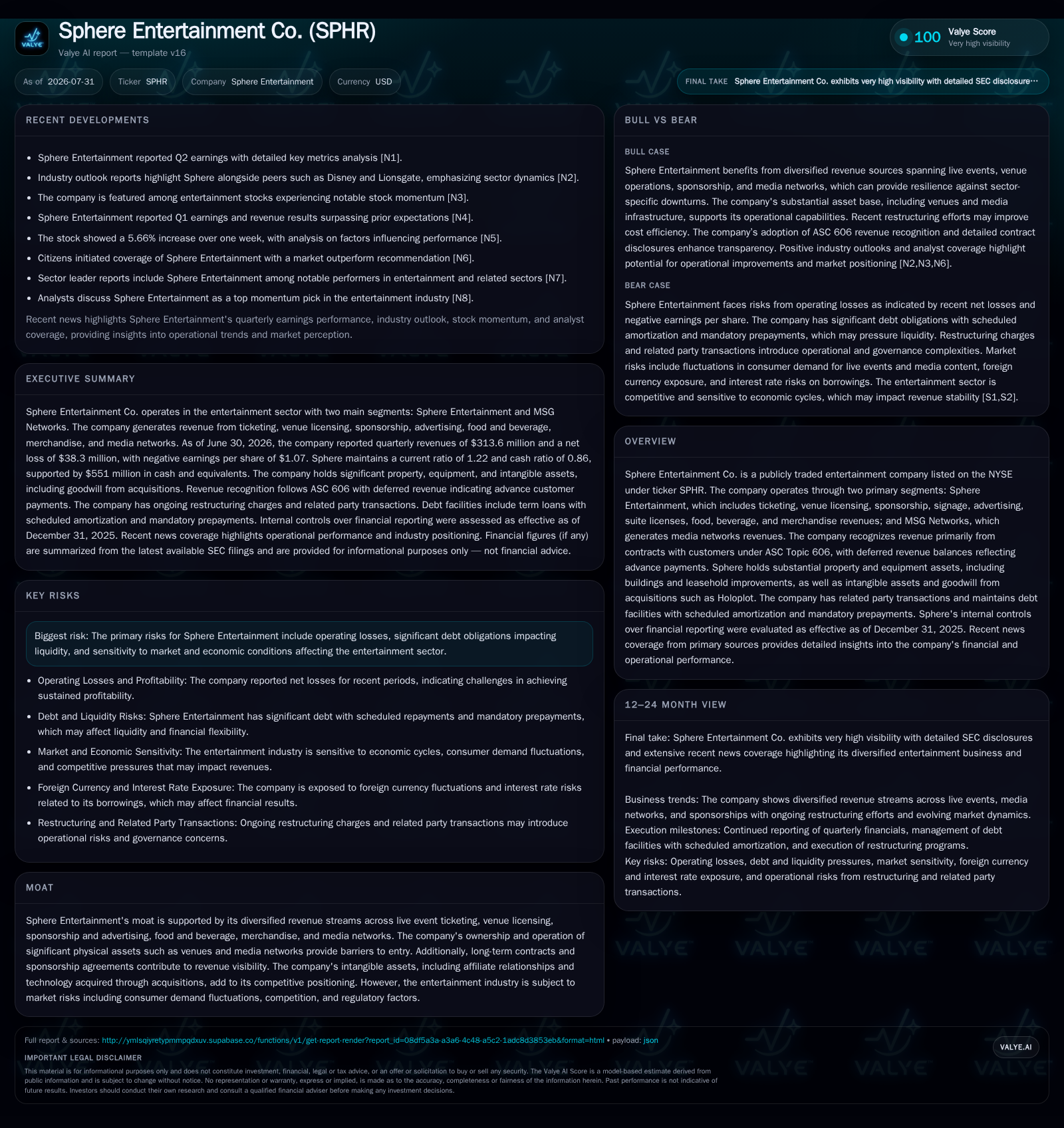
Sphere Entertainment Co. (SPHR) reported second-quarter 2026 results reflecting the structural complexity of its live events and media business model, characterized by diversified revenue streams including ticketing, venue licensing, sponsorships, merchandise, and MSG Networks media operations. Despite operating losses, the company maintains significant cash reserves and manages a sizable debt load tied to its extensive physical asset base and strategic acquisitions such as Holoplot. Key drivers include long-term sponsorship agreements and progressive digital integration, while risks stem from seasonality in media revenues, debt servicing costs sensitive to interest rates, and potential impairments on intangible assets. Monitoring deferred revenue balances, sponsorship renewals, and venue utilization will be critical for assessing near-term financial resilience.
Recent Operating Update: Q2 2026 Snapshot
Meanwhile, Sphere’s broad-based business model spans multiple revenue streams: ticket sales funding live event attendance; venue licensing fees for third-party use; sponsorships and advertising contracts often secured under long-term arrangements providing advance revenues; food, beverage concessions and merchandise sales capitalizing on event foot traffic; plus media networks subscription fees and advertising monetization [S1]. Revenues are generally contract-based with significant deferred revenue balances reflecting pre-sold tickets or committed sponsorship payments that offer some visibility into future periods [S1], [S2].
In Q2 2026 specifically, the company maintained stable deferred revenue accrual supporting expectations for subsequent revenue recognition as events occur or contractual milestones are reached. However, the degree to which advance payment structures translate into realized revenues depends on renewal success in sponsoring partners and consumer willingness to attend live venues during evolving macroeconomic conditions.
Business Model Analysis: Integrated Live Entertainment Provider Plus Media Operator
Sphere operates as an integrated live entertainment company owning or controlling critical physical venues while simultaneously managing dedicated media networks (MSG Networks), creating multiple interdependent revenue pillars. The ticketing segment relies heavily on volume—number of tickets sold—and mix: premium vs general seating—and is affected by average ticket prices set by promoters plus competitive event offerings [S1]. Venue licensing supplements this by monetizing rental rights for concerts or sports franchises beyond Sphere’s direct productions.
Sponsorships encompass a blend of signage placements inside venues (including suite licenses), arena naming rights where applicable, exclusive product partnerships, and bundled advertising packages across venues and the MSG Networks platform. These contracts' duration and terms critically influence revenue predictability. Food/beverage concessions and merchandise sales benefit from visitor footfall intensity; higher per capita spending during sold-out events tends to enhance margins but exposes the company to inflationary pressures on commodities and labor costs.
The MSG Networks segment contributes via affiliate fees from cable/satellite providers plus advertising revenues tied to ratings/viewership metrics. Its pronounced seasonality reflects the scheduling of marquee sporting events driving spikes in ad demand.
Capital expenditures underpinning this model are substantial due to the ownership or leasehold improvements of large-scale venues requiring continual upkeep alongside investment into media infrastructure upgrades. Intangible assets including goodwill mainly arise from strategic acquisitions such as Holoplot—a Berlin-based technology firm specializing in spatial audio systems—which enhances Sphere’s experience offerings but introduces finite-life amortization burdens [S1]
Industry Structure & Competitive Positioning
Operating within the live entertainment and media industry positions Sphere among peers such as Live Nation Entertainment emphasizing event promotion/ticketing; Madison Square Garden Sports Corp., with comparable venue ownership and regional media networks footprint; Disney's extensive media network operations; AEG Presents’ integrated live events play; plus Comcast/NBCUniversal’s broad media distribution capabilities.
Sphere differentiates itself through its multi-pronged approach combining direct control over physical venues with an in-house media distribution channel. This vertical integration creates barriers to entry concerning scale of fixed assets (high capital intensity), entrenched affiliate/sponsorship relationships reinforced by long-term contracts, proprietary technology acquired via Holoplot enhancing customer experience, and established brand presence in key markets.
Nonetheless, competition arises not only from traditional event promoters but also increasingly from alternate entertainment models such as digital streaming platforms competing for advertising dollars or consumer leisure time—pressure that influences pricing power especially in advertising segments. Regulatory factors governing venues (licensing) and broadcasting rights impose operational complexities distinct from peer sectors.
Growth Drivers
Sphere's growth prospects hinge principally on:
- Expanding Venue Capacity: Developing new venues or upgrading existing facilities can increase attendee limits thereby boosting ticket sales volumes along with ancillary concession spend.
- Sponsorship & Advertising Uplift: Leveraging data analytics acquired with Holoplot technologies permits more targeted marketing efforts enabling sponsors to derive higher ROI supporting contract renewals at elevated fees.
- Digital & Media Platform Enhancement: Augmenting MSG Networks’ content delivery through digital means responds to shifting consumer consumption patterns enhancing subscription uptake and ad-fill rates.
- Diversification: Increasing merchandise offerings and innovative suite license packages can capture greater wallet share per event attendee.
- International Expansion: Deploying proven venue/media models into foreign geographies where live experiences are rapidly growing catalyzes incremental revenues.
These drivers relate directly to observed KPIs such as ticket sales volume growth correlated with new event calendar additions or venue openings; upticks in average ticket prices indicating pricing power retention; sponsorship revenue growth linked to renewed/extended agreements; improvement in advertising fill rate demonstrating stronger advertiser demand; rising food/beverage per capita spend evidencing customer engagement; plus sustained or improving MSG Network ratings signaling content relevancy.
Risks & Watchpoints
Sphere navigates multiple risk dimensions:
- Economic Sensitivity: Consumer discretionary spend on live entertainment fluctuates with macro cycles. Downturns reduce attendance impacting primary ticket sales plus food/beverage/merchandise revenues.
- Debt Load & Interest Rate Exposure: Changes in interest rates pose meaningful cost-of-capital risk given floating exposures documented in credit facilities [S2]. Increased interest expenses may constrain free cash flow.
- Asset Impairments: Potential goodwill/intangible write-downs cannot be excluded particularly related to recent Holoplot acquisition if projected cash flows fail to materialize amid technological shifts [S1].
- Seasonality: Heavy reliance on certain quarters for MSG Network revenues necessitates effective cost management in off-peak periods.
- Competitive Pressure: Expansion of digital entertainment alternatives can erode traditional revenue pools necessitating continuous innovation.
- Regulatory & Licensing Risks: Compliance related to venue operations or broadcast rights entails operational cost volatility.
- Foreign Currency Fluctuations: European operations expose Sphere to EUR/USD exchange swings that may affect reported asset values/income [S1].
Monitoring deferred revenue balances offers insight into forward-looking bookings status while tracking renewal rates on major sponsorship agreements signals stability of core recurring revenues.
What To Watch Next
Near-term focus includes watching disclosure pertaining to:
- Updates on venue capital projects or capacity expansions indicating material growth investments.
- Sponsorship agreement renewals or expirations around core venues impacting future revenue visibility.
- MSG Networks subscriber trends coupled with advertising fill rate fluctuations during upcoming seasonal peaks.
- Commentary on intangible asset valuations especially relating to Holoplot’s integration progress.
- Debt servicing metrics tied to interest expense forecasts amid macroeconomic interest rate moves.
- Ticket sales momentum entering high-demand concert seasons serving as proxy for consumer discretionary health.
Data driven KPIs disclosed quarterly will illuminate how effectively Sphere leverages its asset base across segments while navigating cyclical headwinds common in this industry sector.
Financial Profile Discussion
As of June 30, 2026, Sphere held approximately $552 million in cash, cash equivalents, and restricted cash supporting liquidity needs amid current liabilities totaling about $640 million—yielding a current ratio near 1.22 that suggests adequate coverage though tighter than ideal for highly capital-intensive businesses [F1], [S2]. The current portion of long-term debt was approximately $58 million as of June 30, 2026, reflecting scheduled amortization obligations primarily related to MSG Networks term loan facilities [S2].
Operating cash flows during the first half of 2026 reflected a net loss adjusted by non-cash charges including depreciation and amortization exceeding $168 million annually plus modest impairment-related expenses highlighting ongoing asset wear typical in this capital-heavy field [S2]. Deferred production content amortization also increased compared to the prior year signaling expanded investments into content assets likely supporting media network competitiveness longer term. Share-based compensation expense noted at $31 million aligns with broader industry practices around talent retention incentives within creative sectors [S2].
Interest rate risk remains prominent due to floating rate borrowings impacting interest expense sensitivity—a hypothetical full-year 200 basis point rise estimated would increase annual interest costs significantly per prior disclosures albeit exact updated recalculations post-Q2 not yet provided [S1]. Currency risk connected primarily with Euro exposure due to Holoplot’s Berlin base further complicates earnings volatility considerations though recent exchange rate movements produce modest net impacts measured against total equity value [S1].
In sum, Sphere’s financial condition balances strong liquidity reserves against sizeable leverage typical for its industry positioning requiring vigilant capital management especially through cyclical troughs in live-event attendance or media ad spending cycles.
Disclaimer: This is research-only, informational analysis and not investment advice. It may include AI-generated interpretation and general industry context. Always verify important details using primary sources.

Comments