
OneMain’s Multi-Channel Nonprime Lending Navigates Macroeconomic Shifts with Stable Credit Performance
OneMain Holdings leverages a broad branch network and digital platform to serve nonprime borrowers, balancing growth with credit discipline amid evolving economic trends.
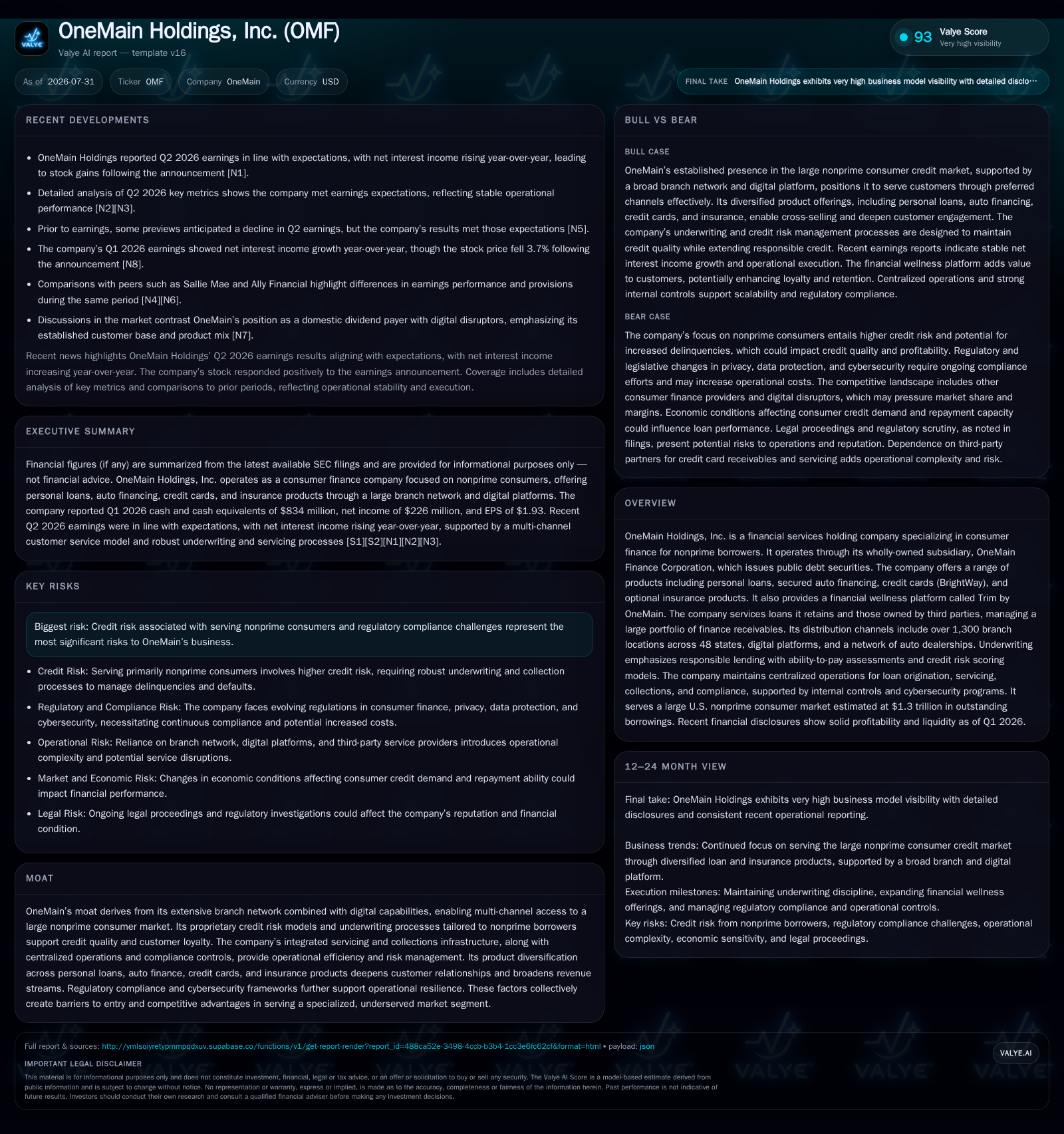
In its latest quarterly filing, OneMain Holdings, Inc. reported stable net interest income and steady credit metrics supporting its position as a leading nonprime consumer finance provider. The company’s distinctive multi-channel business model, spanning over 1,300 branches alongside digital lending and auto dealership partnerships, enables it to address a $1.3 trillion U.S. nonprime market with personal loans, secured auto loans, credit cards, and insurance products. While the macroeconomic environment introduces variability in delinquency rates and funding costs, OneMain’s underwriting rigor and centralized servicing infrastructure underpin operational resilience. Key risks remain concentrated in credit losses among nonprime borrowers and regulatory compliance complexities.
Recent Operating Update: Steady Performance Amid Economic Challenges
OneMain Holdings’ second quarter 2026 results, detailed in the July 30 10-Q filing, reveal consistent net interest income gains compared to prior year periods despite an unsettled macroeconomic backdrop characterized by elevated inflationary pressures and fluctuating consumer credit conditions [S2][N1]. The company’s disciplined underwriting approach has supported stable delinquency rates given their focus on nonprime borrowers who are inherently more sensitive to economic shifts. Notably, management signaled that controlled charge-off rates and ongoing monitoring of allowance for loan losses underpin cautious optimism about credit quality trends going forward [S2].
This quarter's metrics confirm OneMain’s ability to balance growth with prudent risk management within a large $1.3 trillion addressable market for personal loans, auto loans, and credit cards among nonprime consumers—a segment underserved by traditional banking credit [S1].
Business Model: Multi-Channel Lending Serving Nonprime Consumers
OneMain operates through its wholly-owned subsidiary OneMain Finance Corporation which issues public debt securities to fund lending activities [S1]. Its core business comprises underwriting, originations, servicing, and collections across personal unsecured loans, secured auto financing at point-of-sale through a network of franchise and independent dealerships, credit cards branded as BrightWay (originated via partnership banks), and insurance-related ancillary products. The addition of Trim by OneMain—a financial wellness platform—enhances customer engagement beyond transactional lending.
Revenue is primarily derived from finance charge income on outstanding receivables supported by fees from loan origination services and cross-sell of insurance products. Volume growth correlates directly with loan origination activity managed across over 1,300 physical branches nationwide alongside robust digital lending capabilities serving customers preferring remote or hybrid interactions [S1]. This omnichannel distribution is a strategic strength allowing tailored access to diverse consumer preferences while supporting risk assessment through proprietary credit scoring models focused on nonprime risk traits.
Loan servicing conducted centrally enables cost efficiencies and close management of repayment behavior including collection efforts to minimize losses. Maintaining ownership or servicing rights over both owned-receivables and third-party portfolios broadens cash flow streams with scale advantages.
Industry Structure and Competitive Positioning
Within the consumer finance landscape focused on nonprime borrowers—a sector that includes peers such as Avant (nonprime personal loans), Ally Financial (auto financing exposure), Sallie Mae (subprime lending concentration), Upstart (digital consumer lending), and Nu Holdings (credit card innovation)—OneMain distinguishes itself through scale of physical presence coupled with integrated digital platform capabilities.
Branch footprint depth provides trusted local access points fostering customer loyalty critical in high-touch nonprime segments where borrower trust influences originations. Meanwhile, its dealer network collaboration enhances secured auto loan origination efficiency versus pure digital lenders lacking physical ecosystem support.
Credit risk differentiation relies on underwriting sophistication tailored to borrower repayment capacity including dynamic ability-to-pay assessments. This contrasts with some fintech-centric lenders who operate with less direct borrower interaction but face challenges in addressing complex credit profiles reliably.
Growth Drivers: Market Opportunity Meets Channel Expansion
Fundamental growth drivers include:
- The vast underserved U.S. nonprime consumer market estimated at $1.3 trillion presents substantial room for market share expansion through increased penetration of personal loans, auto financing, and credit card products [S1].
- Expansion of both branch locations and enhancements to the digital lending platform aim to capture evolving borrower preferences while improving origination throughput.
- Product diversification—beyond loans into insurance offerings and financial wellness tools—builds deeper customer relationships thereby increasing lifetime value.
- Continuous refinements of proprietary underwriting algorithms improve risk-adjusted pricing accuracy supporting better portfolio performance profiles amid cyclical variability.
- Strategic dealership partnerships boost secured auto financing volumes critical for revenue mix balance.
- Access to capital markets through OMFC’s public debt issuance facilitates financing capacity necessary to scale loan book effectively.
Risks and Constraints: Credit Sensitivity and Regulatory Complexity
Key risks prominently feature:
- Credit risk inherent in the nonprime segment is substantial; economic downturns or adverse regional events can spike delinquency rates materially impacting charge-offs despite underwriting efforts [S1]. Early evidence of elevated subprime auto delinquencies nationwide highlights vulnerability despite recent periods of relative stability [N7].
- Regulatory environment remains stringent for subprime lenders; compliance costs are significant as governance frameworks evolve around responsible lending mandates. Failure to adapt could result in fines or operational limitations.
- Interest rate fluctuations impact funding costs directly via public debt spreads; rising rates could compress net interest margins absent corresponding repricing flexibility.
- Competition from digital-first lenders with AI-based credit assessment tools could put pressure on originations volume if OneMain’s multi-channel model does not swiftly innovate.
- Operational risks including maintaining efficient loan servicing infrastructure and collection practices are essential to sustain portfolio health given high-touch requirements in this borrower segment.
What to Watch Next: Execution Milestones and Credit Metrics
Market observers should track:
- Quarterly updates on delinquency buckets (30+, 60+, 90+ days) and charge-off ratios will provide early indicators of portfolio health shifts as macroeconomic variables fluctuate.
- Loan origination volumes segmented by channel (branch vs digital) will clarify effectiveness in capturing both traditional walk-in customers versus digitally inclined borrowers.
- The pace of loan product innovation especially relating to BrightWay credit cards performance vis-à-vis adoption rates influences diversification success.
- Any updates regarding regulatory challenges or legal proceedings could signal emerging compliance risks impacting profitability.
- Funding cost trends informed by OMFC’s debt issuance spreads will affect net interest margin sustainability; keeping an eye on capital markets access is critical.
Financial Profile Discussion
Overall financial leverage appears manageable within industry norms though contingent upon continued disciplined credit management reducing unexpected deterioration that could press allowance for loan loss provisions higher [S1]
This analysis incorporates insights from OneMain Holdings’ latest SEC filings including the Q2 2026 Form 10-Q [S2], recent event filings [S3], foundational annual context from the 2025 Form 10-K [S1], relevant company-specific news articles [N1][N2], current financial snapshot data [F1], along with sector knowledge frameworks relevant to consumer finance specializing in nonprime lending. The narrative emphasizes durable operating strengths balanced against sector-specific cyclical vulnerabilities without offering investment guidance.
Disclaimer: This is research-only, informational analysis and not investment advice. It may include AI-generated interpretation and general industry context. Always verify important details using primary sources.

Comments