
Guardant Health Advances Liquid Biopsy Leadership with Expanding Clinical Adoption and AI-Driven Platforms
Q2 2026 results highlight revenue progress amid ongoing investment in precision oncology diagnostics.
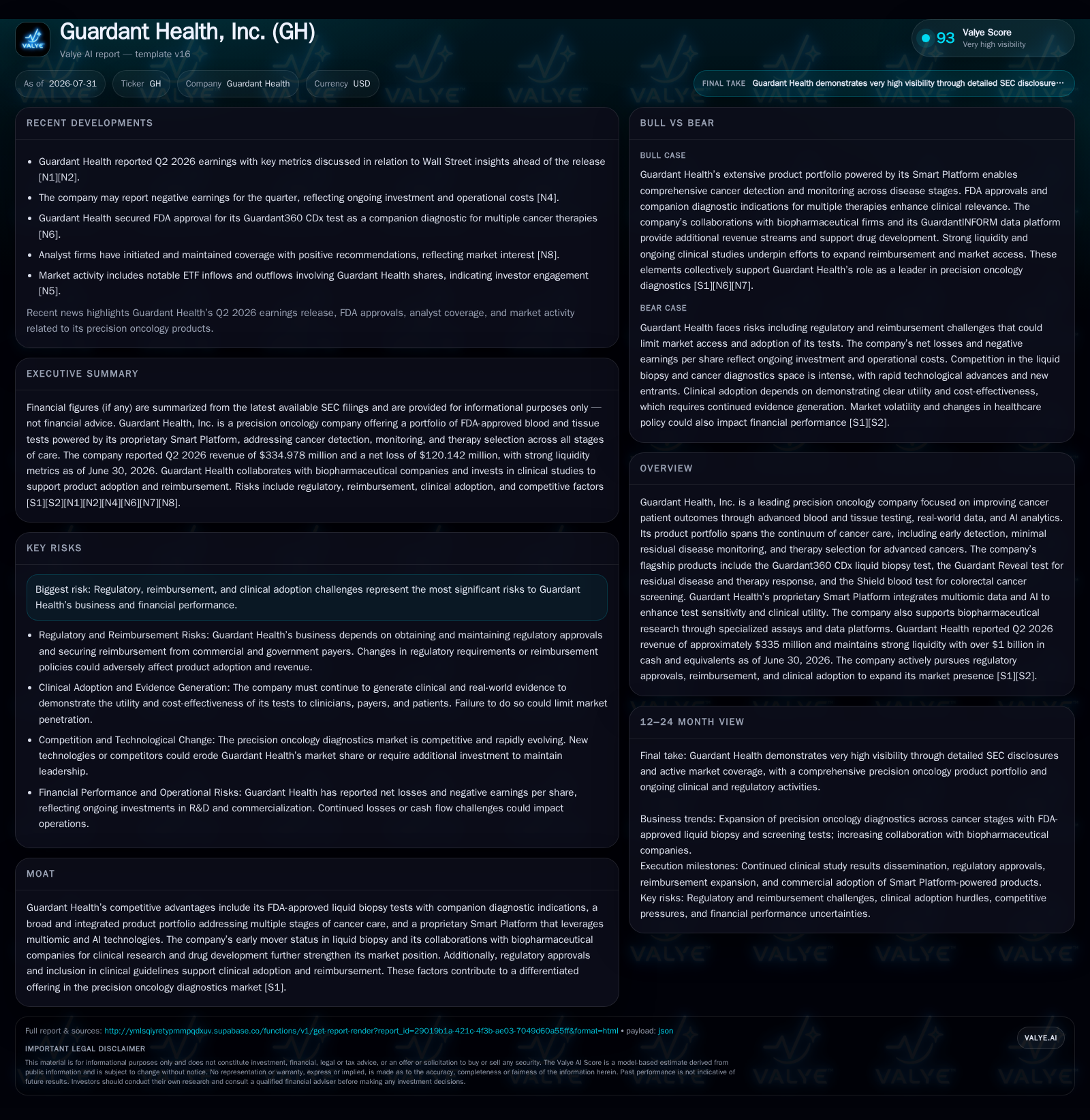
Guardant Health's Q2 2026 financials reveal growing revenue to $335 million with robust liquidity and a strategic focus on liquid biopsy tests and AI analytics integral to precision oncology. The company's FDA-approved product suite, including Guardant360 CDx and Shield colorectal screening, supports adoption across early detection, residual disease monitoring, and therapy selection. Guardant Health navigates regulatory and reimbursement complexities while leveraging biopharmaceutical partnerships and innovative multiomic platforms to advance long-term growth potential.
Recent Operating Update
Guardant Health's Q2 2026 earnings report demonstrates continued revenue growth with top-line sales reaching approximately $335 million [S2][N1]. This performance exceeded Wall Street estimates despite ongoing net losses reflecting sustained investments in research, development, and commercialization activities crucial to advancing its precision oncology portfolio. The company maintains strong liquidity with over $1 billion in cash and equivalents balanced against about $1.5 billion in total debt, resulting in a healthy current ratio of approximately 4.03 as of June 30, 2026 [F1]. No material changes to the previously disclosed risk factors were reported during the quarter, sustaining known regulatory and reimbursement uncertainties as primary business risks [S2].
Business Model
Guardant Health operates predominantly in the precision oncology diagnostics domain, selling advanced molecular tests that utilize minimally invasive blood draws (liquid biopsies) to inform cancer detection, treatment decisions, and disease monitoring. Revenue generation stems from clinical testing services provided to healthcare providers caring for cancer patients across all stages—from early screening through advanced metastatic disease—and from partnerships with biopharmaceutical firms engaged in drug development.
The company's flagship product line includes the Guardant360 CDx test—FDA-approved as a comprehensive liquid biopsy companion diagnostic for tumor mutation profiling across non-small cell lung cancer (NSCLC), colorectal cancer, breast cancer—and the Guardant Reveal test for detecting minimal residual disease (MRD) post-curative intent therapy, extending also into late-stage therapy response monitoring [S1]. Additionally, the Shield blood test offers FDA clearance and Medicare coverage as a non-invasive colorectal cancer screening tool recommended by national clinical guidelines [S1].
Guardant Health’s monetization hinges on test volume driven by clinician adoption rates, payer reimbursement coverage—including government payers like Medicare—and biopharmaceutical contracts that include high-volume sample testing tied to clinical trial enrollment or companion diagnostic development. Average revenue per test varies based on product complexity; molecular profiling tests command higher pricing than population screening assays but require broader payer acceptance. Margins are subject to changes in reagent costs, scale efficiencies at processing laboratories, and investment mix between commercial products versus R&D services.
A critical differentiator is the proprietary Smart Platform underpinning key tests. This platform integrates multiomic data modalities—genomic sequencing coupled with DNA methylation patterns, epigenomic signals, RNA expression profiles—and applies AI analytics via the InfinityAI engine to increase detection sensitivity and refine clinical insights. This technical innovation enhances competitive positioning versus peers lacking multiomic integration or advanced algorithmic support [S1].
Industry Structure and Competitive Position
In the fast-evolving precision oncology diagnostics industry, Guardant Health competes alongside molecular diagnostics companies such as Exact Sciences—focused on molecular cancer screening—and Foundation Medicine—which emphasizes comprehensive tissue genomic profiling. Unlike these peers primarily oriented towards either early detection or tissue-based assays respectively, Guardant commands an integrated/liquid biopsy-centric offering spanning screening (Shield), minimal residual disease/residual monitoring (Reveal), and advanced cancer genomic profiling (Guardant360).
Competitiveness relies heavily on clinical validation robustness, regulatory clearance/approval status (FDA approvals create durable market barriers), inclusion in national guidelines enhancing physician uptake, reimbursement breadth across commercial insurers and Medicare/CMS policies, as well as technological differentiation through AI-enabled multiomic platforms. Guardant's early mover advantage with FDA-cleared liquid biopsy tests as companion diagnostics establishes a defensible position given the complex regulatory pathways involved.
Clinical adoption depends on physician confidence in test accuracy (sensitivity/specificity metrics), ease of integration into standard workflow versus traditional invasive biopsies, evidence of impact on patient outcomes demonstrated through peer-reviewed publications or guideline endorsements, plus favorable payer policies that mitigate patient out-of-pocket costs.
Biopharmaceutical collaborations extend Guardant's role into drug development pipelines by supplying tumor mutation profiling data or minimal residual disease assays essential for targeted therapies' companion diagnostic needs. Such partnerships diversify revenues beyond direct patient testing volume while anchoring long-term industry relationships.
Growth Drivers
Organic growth is propelled by increasing adoption of liquid biopsy tests driven by:
- Rising awareness among oncologists regarding noninvasive genomic profiling benefits over tissue biopsies.
- Expanded Medicare reimbursement coverage notably equalizing rates for Guardant360 Liquid versus Guardant360 CDx tests effective January 2024 boosts utilization incentives [S1].
- Clinical guideline inclusions (e.g., Shield test inclusion in National Comprehensive Cancer Network research views) which catalyze physician trust.
- Regulatory milestones such as FDA Breakthrough Device designation awarded to Shield MCD (multi-cancer detection) test pave accelerated review paths that may lead to expanded indications beyond colorectal cancer screening.
- Technology innovation advances within the Smart Platform integrating multiomic data sets alongside AI algorithms improve sensitivity thereby expanding clinical utility across additional cancers.
- Growing prevalence of biopharmaceutical partnerships relying on real-world data generated through GuardantINFORM platform that supports trial enrollment optimization and biomarker discovery.
- Initiatives targeting multi-cancer early detection markets leveraging methylation technology encapsulated within Shield platform expand future addressable markets beyond current scope.
Risks and Watchpoints
The principal risks stem from:
- Regulatory approval delays or adverse changes undermining market access for existing or pipeline products.
- Uncertainties around reimbursement coverage policies especially from private insurers which influence physician ordering patterns.
- Challenges achieving broad physician adoption particularly if competing technologies demonstrate superior accuracy or cost-effectiveness.
- Ongoing federal investigation under the False Claims Act related to government program billing practices represents litigation risk with uncertain financial implications [S6][S7].
- Intense patent litigation environment impacting intellectual property protection could pressure competitive moat erosion [S12][S24].
- Operational risks associated with ramping new product launches entail capital intensity that may further widen current net losses before scale benefits accrue.
- Evolving healthcare regulations including HIPAA privacy safeguards require continuous compliance expenditure with potential penalty liabilities for failures.
Monitoring quarterly test volumes performed per product line would offer timely visibility into clinical adoption trends. Similarly, tracking payer coverage expansions—in particular announcements by CMS or major commercial payers—will signal reimbursement environment shifts influencing revenue durability. Product pipeline milestones related to FDA clearances or Breakthrough Device designations should be watched closely as they provide catalysts for incremental sales growth potential.
What to Watch Next
Investors should focus on several near-to-medium term catalysts:
- Updates on Medicare and commercial payer coverage decisions potentially widening reimbursement scope or adjusting pricing frameworks beyond recent improvements.
- Reports of additional FDA clearances for expanded indications of existing tests (Guardant360 CDx extension into new tumor types) or novel tests within multi-cancer detection categories.
- Clinical trial partnership announcements suggesting strengthening biopharma engagement driving sample volume upside.
- Technology platform enhancements announced relating to InfinityAI analytics accuracy improvements or integration of emerging biomarkers like methylation signatures influencing assay sensitivity/specificity metrics.
- Resolution progress on outstanding legal investigations under False Claims Act that could affect financial provisions or reputational outlook.
- Quarterly disclosures detailing growth in number of tests performed across product lines providing real-time KPIs around customer retention/expansion dynamics.
Financial Profile Discussion
As of June 30, 2026, Guardant Health reported cash and cash equivalents totaling approximately $1.05 billion against total debt near $1.5 billion translating into net debt around $449 million—supporting strong liquidity ratios such as a current ratio indicating solid short-term financial flexibility [F1]
Sequentially improving topline revenues approximating $335 million in Q2 reflect accelerating market penetration though the company continues recording operating losses highlighting the need for further margin expansion either via improved test mix or scale efficiencies. Prudent capital allocation balancing investments into next-generation technologies against cost control will be essential for guardrails toward eventual profitability sustainability.
Overall liquidity remains sufficient to support multiple quarters of continued operations at current burn levels absent unforeseen adverse events; however elevated indebtedness necessitates careful interest servicing management especially under possible macroeconomic rate volatility scenarios [F1][S26]
This analysis synthesizes publicly available SEC filings and recent earnings release information without offering investment advice. It contextualizes Guardant Health’s operational trajectory within precision oncology diagnostics industry norms emphasizing regulatorily complex reimbursements patterns, technology innovation imperatives, competitive dynamics shaped by peer benchmarks such as Exact Sciences and Foundation Medicine, while highlighting key performance drivers critical for monitoring ongoing execution sustainability.
Disclaimer: This is research-only, informational analysis and not investment advice. It may include AI-generated interpretation and general industry context. Always verify important details using primary sources.

Comments