
Aqua Metals Advances Battery Recycling Pilot Amid Capital and Operational Challenges
Recent quarterly results highlight progress in sustainable lithium battery recycling technology alongside liquidity constraints.
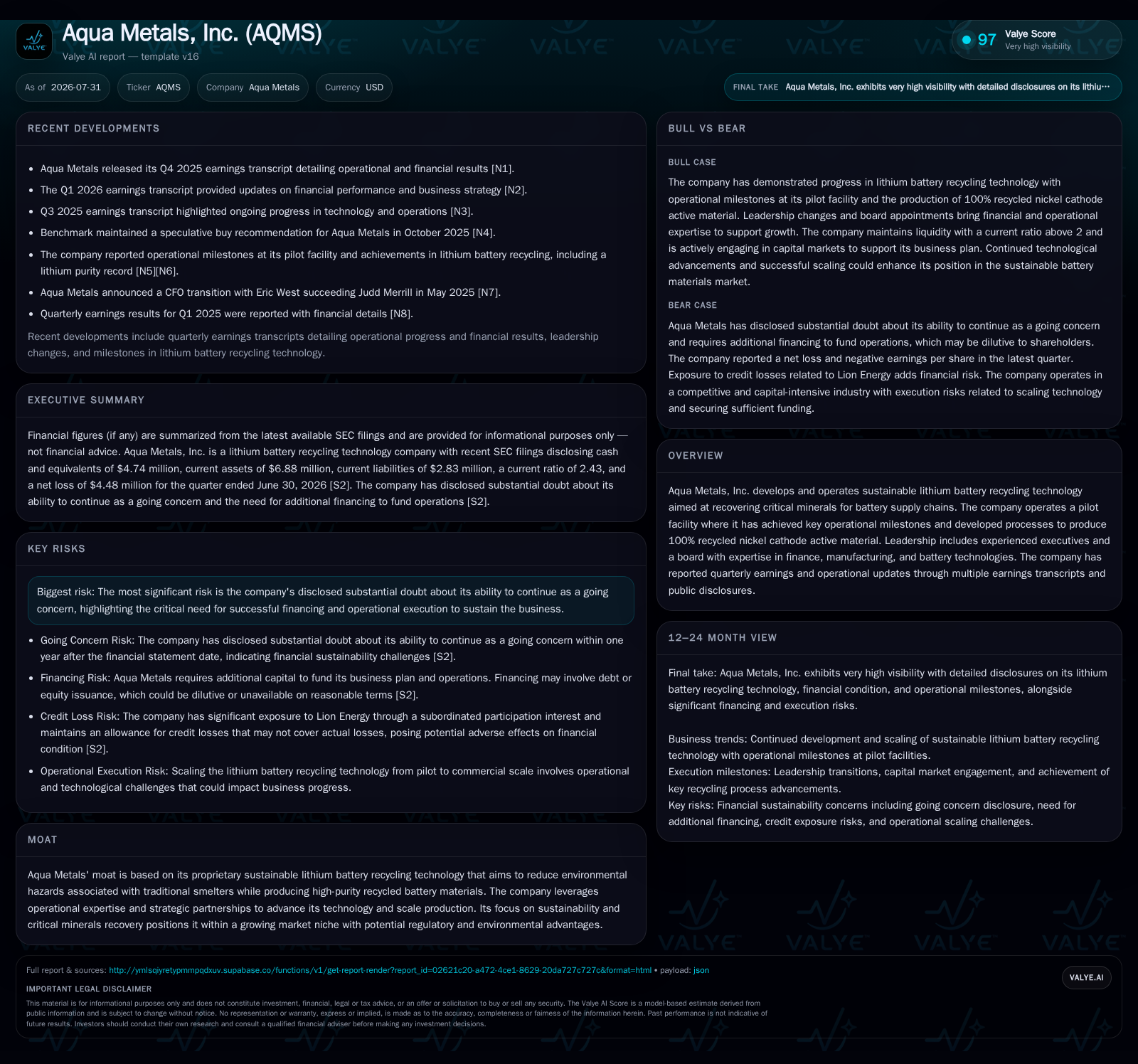
Aqua Metals, Inc. continues to develop its proprietary lithium battery recycling processes, achieving key operational milestones at its pilot facility including production of 100% recycled nickel cathode active material. However, the company faces substantial financing needs and ongoing concerns about its ability to sustain operations without additional capital. Its technology aims to reduce environmental impact compared to traditional smelters and contribute to critical minerals recovery for supply chains, positioning it within a high-growth niche despite capital intensity and execution risks.
Recent Operating Update
Aqua Metals reported second-quarter 2026 financials revealing a cash position of approximately $4.74 million against current liabilities near $2.83 million, yielding a current ratio above 2.4 and working capital of about $4 million [F1][S2]. Despite this apparent short-term liquidity buffer, management highlighted the necessity for additional financing over the next 12 months to maintain operations and advance its business plan. This capital requirement may be met through debt issuance, asset sales, or equity offerings with potential dilution implications. The firm’s accountants expressed substantial doubt regarding Aqua Metals’ ability to continue as a going concern without successful fundraising [S2][S4].
The quarter did not disclose incremental revenue gains but emphasized operational progress at their pilot recycling facility where proprietary processes have been developed to produce 100% recycled nickel cathode active material from lithium-ion battery feedstock [S1][S3]. This achievement reflects maturation of their hydrometallurgical recycling technology designed to reclaim critical minerals while minimizing environmental impact
Business Model Analysis
Aqua Metals operates within the battery recycling segment focused on closed-loop recovery of strategic elements—principally lithium and nickel—from spent lithium-ion cells. The company’s revenue model entails processing end-of-life batteries sourced from various collection channels, applying mechanical shredding combined with chemical separation techniques to extract cathode active materials at purity levels suitable for resale to battery manufacturers or materials suppliers.
Unlike traditional pyrometallurgical smelting characterized by significant emissions and variable purity outputs, Aqua Metals’ technology emphasizes sustainability by reducing hazardous waste generation and achieving superior recovery purity metrics. Such capabilities align with increasing regulatory pressures seeking greener solutions for battery end-of-life management.
Revenue is fundamentally driven by processing volume (tons of input batteries), recovery yield percentages of critical minerals reclaimed, and pricing achieved on recycled materials sold back into electric vehicle (EV) supply chains or stationary storage markets. Margins potentially improve as scale escalates due to fixed cost absorption over higher throughput and refinement of process efficiencies limiting energy consumption per ton processed.
However, current operations are limited primarily to pilot-scale output without broad commercial production or multi-site deployment. Scaling production remains a critical focus area necessary to transition from experimental validation towards consistent revenue generation.
Industry Structure and Competitive Position
The battery recycling industry sits at a pivotal junction within the EV supply chain intermediary between raw mineral mining and cathode material synthesis. Market growth is accelerated by rising EV adoption worldwide alongside heightened awareness surrounding the environmental footprint of resource extraction.
Peer competitors include specialized lithium battery recyclers like Li-Cycle Holdings Corp., Redwood Materials (private), Umicore with integrated materials technology offerings, as well as more established players like American Battery Technology Company focusing on similar sustainable recovery technologies. These peers vary in scale with some having established commercial plants while others remain pre-commercial or in pilot stages akin to Aqua Metals.
Aqua Metals differentiates itself through its proprietary hydrometallurgical approach that claims reduced emissions profiles relative to legacy smelters common in base metal recycling sectors. The production of fully recycled nickel cathode active material positions it strategically in a niche that concurrently addresses regulatory sustainability mandates and the scarcity-driven economics boosting recycled material value.
Nevertheless, the company faces significant challenges competing against incumbent smelters benefiting from scale economies and entrenched raw material sourcing relationships. Additionally, emerging battery manufacturers increasingly seek supply chain circularity but remain cautious pending demonstration of consistent quality and volume assurances from recyclers.
Growth Drivers
Key growth catalysts include:
- Rising demand for EVs: As global vehicle electrification accelerates, demand for battery raw materials such as nickel increases correspondingly.
- Environmental regulations: Stricter laws on battery disposal incentivize economically viable recycling solutions over landfill or incineration routes.
- Raw material price volatility: Increasing prices for virgin materials encourage substitution with recovered feedstock enhancing recycling economics.
- Technology advances: Improved yields and processing throughput lower unit costs enhancing competitive positioning.
- Corporate sustainability commitments: OEMs’ ESG targets boost interest in recycled cathode materials fostering potential off-take agreements.
- Supply chain disruptions: Geopolitical factors elevating import risks increase attractiveness of local or regional recycling capacity expansion.
These factors collectively underpin structural demand growth rather than cyclical trends but require commercial-scale execution to translate into meaningful financial returns.
Risks and Constraints
Aqua Metals’ principal risk centers on executing planned scale-up amid capital constraints. The recent filing reiterates a critical need for financing; failure to secure resources may force curtailment or suspension of operations resulting in permanent value impairment [S2][S4].
Credit exposure related to a subordinated participation interest in Lion Energy totaling approximately $4.16 million elevates financial uncertainty due to limited access following assignment restrictions and required judgment estimates under CECL accounting standards for expected losses [S2][S6]. Any deterioration beyond allowances may further impair liquidity.
Operationally, transitioning from pilot-scale demonstrated proof-of-concept devices to continuous large-scale production entails risks in equipment reliability, process reproducibility, feedstock variability handling, regulatory compliance expansions, and workforce capability development—all critical variables influencing cost per ton processed and margin stability.
Market acceptance remains contingent on demonstrating recycled cathode material equivalency or superiority relative to mined alternatives. Given nascent stage commercialization industry-wide, customer adoption rates will significantly influence ramp timelines.
Tracking such markers will inform whether the company’s propositions are transitioning from technical feasibility towards sustainable commercial viability.
Financial Profile Discussion
As of June 30, 2026, Aqua Metals posted cash and equivalents at roughly $4.74 million with total current assets around $6.88 million versus current liabilities at approximately $2.83 million [F1]. The resultant current ratio stands at about 2.43—technically indicative of short-term solvency yet tempered by recognition that additional funding is essential for continuation beyond one year [S2].
Total debt appears minimal relative to cash reserves based on best available data ($332 thousand as of late 2020) suggesting low leverage but not necessarily offsetting cash burn requirements driven by operating expenses related to R&D activities and scaling efforts [F1]. Continued operating losses combined with reliance on external financing underscore liquidity vulnerability accentuating financing risk as a paramount concern alongside operational execution challenges shaping future viability [S2][S4].
Disclaimer: This is research-only, informational analysis and not investment advice. It may include AI-generated interpretation and general industry context. Always verify important details using primary sources.

Comments