
Oil States International Navigates Cyclical Oilfield Services with Operational Breadth and Stable Liquidity
The company reports a solid Q2 performance supported by diversified segments amid ongoing commodity price sensitivity.
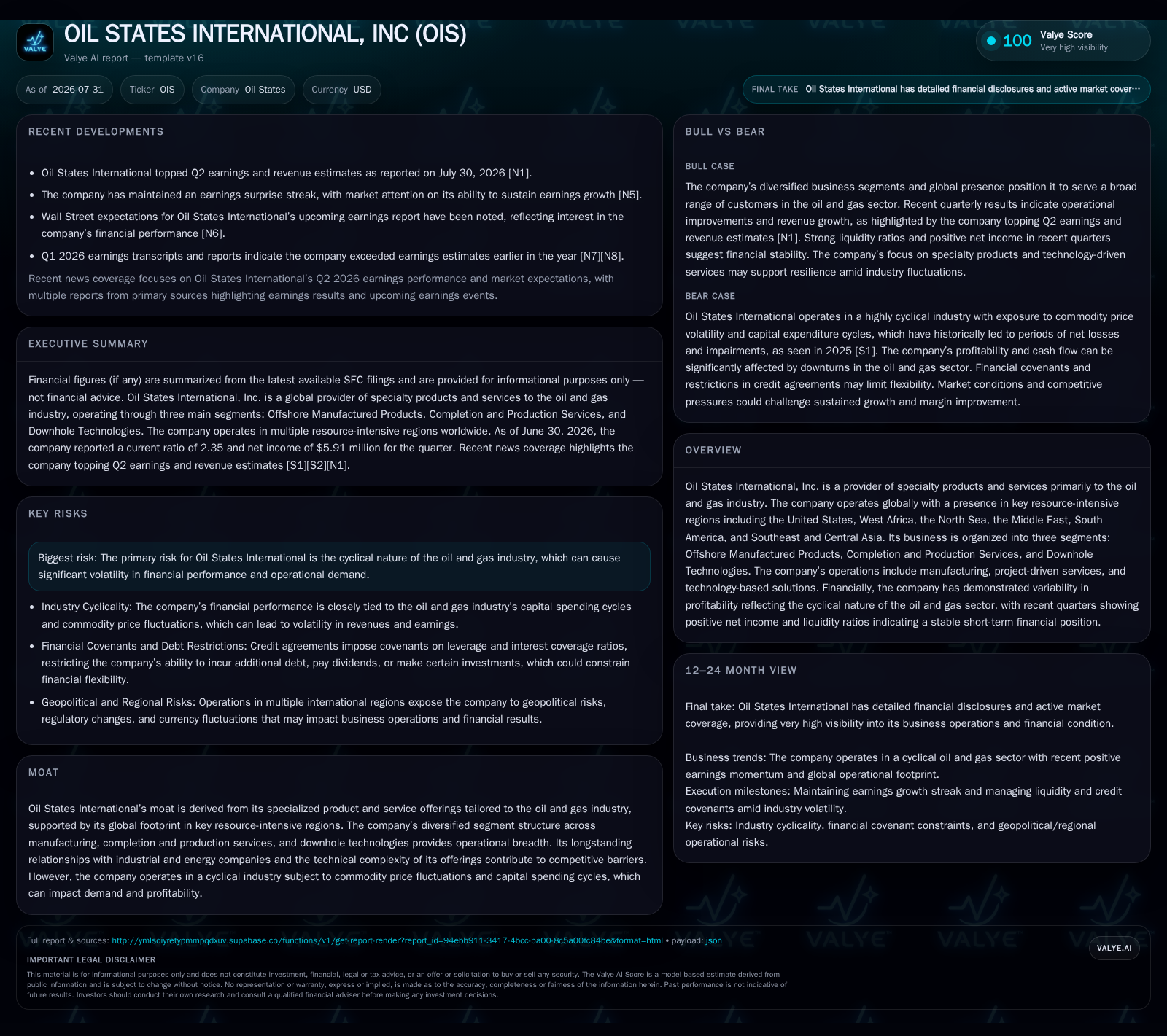
Oil States International, Inc.'s latest quarterly filing shows continued stability in its core oilfield services business, benefiting from a global presence across offshore manufacturing, completion and production services, and downhole technologies. While subject to the cyclical oil and gas capital expenditure environment, the firm maintains a healthy current ratio of 2.35 and net cash position as of Q2 2026. Key growth drivers remain tied to upstream spending cycles and technological innovation, though risks such as commodity price volatility and project execution uncertainties persist.
Recent Operating Update
Oil States International’s Q2 2026 filing confirms that the company continues to navigate the inherent cyclicality of the oilfield services industry with operational resilience. The latest quarterly report highlights steady revenue contributions from all three core segments: Offshore Manufactured Products, Completion and Production Services, and Downhole Technologies [S2]. Despite the volatile backdrop of commodity prices influencing upstream capital expenditure (capex), Oil States benefits from its diversified segment structure and global footprint spanning key producing regions such as the U.S., West Africa, North Sea, Middle East, South America, and Asia-Pacific [S1]. This geographic spread helps mitigate localized market fluctuations.
The June 2026 quarter also reflected a positive liquidity position with $19.8 million in cash and equivalents against total debt of approximately $17.8 million, translating into a modest net cash figure that supports short-term financial stability [F1]. Furthermore, the current ratio stands at a healthy 2.35, indicating strong working capital management amid ongoing capex investment cycles by customers [F1]. This balance-sheet strength provides the company operational flexibility as it adjusts capacity utilization rates based on project demand.
Business Model Overview
Oil States operates as a midstream supplier within the upstream oil and gas value chain. It supplies engineered equipment and delivers specialized project-driven services crucial for exploration, drilling completion, and production processes. Revenue stems from three segments:
- Offshore Manufactured Products: Fabrication of complex equipment required for offshore drilling rigs and production platforms.
- Completion and Production Services: On-site services including well completions, interventions, and enhanced recovery techniques that require tight integration with operators’ drilling schedules.
- Downhole Technologies: Development and support of innovative downhole tools leveraging advanced technology solutions to improve drilling efficiency.
Revenue mechanics rely on a combination of product sales (equipment manufacturing), time-and-material or fixed-price services contracts executed over project timelines, and technology licensing or support fees [S1]. Given the capital-intensive nature of oilfield development, customer capex budgets strongly dictate order intake volumes and contract backlogs. Service renewal rates depend on ongoing well maintenance needs while pricing power is influenced by technical differentiation relative to peers
Notably, costs include significant R&D expenditures (~$5 million annually) concentrated within downhole technologies to maintain competitive advantage through innovations addressing operational efficiency and safety regulations [S19]. Expenditures for major renewals on manufacturing assets are capitalized to extend productive capacity aligned with anticipated market demand.
Industry Structure and Competitive Position
The oilfield services and equipment sector is characterized by high cyclicality linked directly to commodity prices impacting exploration budgets. Companies face pressure from fluctuating demand timing, regulatory complexities in international markets, supply chain constraints for specialized materials, and intense competition particularly among large integrated service providers like Schlumberger or Halliburton.
Within this landscape, Oil States balances scale with specialization. Its segmented focus across offshore manufactured products paired with field-level completion services creates operational breadth not always matched by pure-play competitors focused exclusively on equipment or services. Its global placement in both traditional basins (Gulf of Mexico, North Sea) and emerging regions (West Africa, South America) provides access to varied operator groups reducing concentration risk.
Peer candidates such as National Oilwell Varco (NOV) cover similar equipment/service scopes but differ on scale; Schlumberger offers broader integrated service portfolios whereas Weatherford focuses more narrowly on downhole technologies. Oil States must manage operating leverage carefully — fluctuating project volumes have outsized impacts on margins due to fixed overheads associated with manufacturing plants and technical workforce deployment.
Growth Drivers
Key growth drivers for Oil States hinge on an expected gradual recovery and expansion in upstream capital spending following commodity price upcycles. Increasing activity in deepwater drilling projects fuels demand for offshore manufactured products with long lead times enhancing backlog visibility when new rig builds proceed.
Technological advancement remains pivotal; investments in R&D enable provision of enhanced downhole tools that improve drilling precision or environmental safety compliance — attributes increasingly valued under evolving regulation regimes across operating jurisdictions [S19]. Emerging basins in Southeast Asia and Latin America represent potential geographic expansion opportunities complementing mature market operations.
Further growth is supported by aging oilfield infrastructure requiring replacement equipment alongside rising well completion complexity necessitating comprehensive production services. An operator focus on cost optimization favors vendors like Oil States offering bundled service/product packages tailored for efficient execution.
Risks and Watchpoints
The primary risk remains cyclical exposure - tight correlation between commodity prices and upstream capex constrains predictable revenue flows especially during downturn phases where project deferrals or cancellations increase sharply [S29]. Additionally:
- Geopolitical tensions or regulatory shifts in critical regions could impede operational continuity or elevate compliance costs.
- Currency volatility affects earnings translation from international markets where a meaningful portion of revenues originate [S1].
- Asset impairment risks exist if market conditions worsen abruptly given high fixed asset base especially within Offshore Manufactured Products segment where specialized equipment has limited redeployment alternatives [S1].
- Competitive pricing pressures may erode gross margins if customers leverage alternative suppliers or internalize certain functions.
- Customer concentration risk persists despite geographic diversification due to reliance on large integrated oil companies' project pipelines.
These concerns require vigilant contract backlog monitoring alongside tight operating cost control across segments.
What to Watch Next
Important upcoming milestones include quarterly updates on backlog trends revealing shifts in order book strength versus prior periods—critical given project-driven nature of business. Management commentary around capital expenditure plans by key customers will provide insights into demand sustainability or potential bottlenecks impacting delivery timelines.
Additionally:
- Tracking innovation progress through R&D outcomes will be essential to gauge future competitive positioning especially within downhole technologies.
- Any changes in lending covenants or credit facility terms offer early signals about balance sheet leverage tolerance amid earnings swings [S21].
- Monitoring raw material cost inflation or supply chain disruptions affecting manufacturing throughput will impact margins closely.
Maintaining consistent renewal rates on service contracts post-project completion phases will also indicate customer satisfaction levels.
Financial Profile Discussion
As of June 30, 2026, Oil States International reported $19.8 million in cash & equivalents alongside total debt of $17.8 million resulting in a net cash position of roughly $2 million—signaling conservative leverage usage given industry volatility [F1]. The current ratio stood at a robust 2.35 reflecting strong liquidity resources able to meet short-term obligations without stress [F1].
These metrics are underpinned by an amended Cash Flow Credit Agreement signed January 2026 providing combined revolving credit facilities totaling $125 million with maturities extended through January 2030 [S21], offering substantial financial flexibility to manage through capex cycles or opportunistic investments.
Consistent R&D expenditures close to $5 million annually demonstrate commitment to sustaining technology leadership despite margin pressures typical during cyclical troughs [S19]. Capitalization policies maintain asset base integrity as assets are renewed or upgraded rather than expensed prematurely boosting depreciation stability over time.
Overall profitability reflects ongoing operating leverage effects characteristic of oilfield services—with margin expansion tied closely to volume ramp-ups funded by stronger commodity prices driving customer spend decisions.
This analysis synthesizes public SEC filings up to July 30, 2026, combined with industry knowledge specific to oilfield services manufacturers emphasizing operational drivers amidst cyclical industry dynamics. It does not constitute investment advice but aims to clarify Oil States International's positioning within its sector context.
Disclaimer: This is research-only, informational analysis and not investment advice. It may include AI-generated interpretation and general industry context. Always verify important details using primary sources.

Comments