
Eastern International Leverages Project Logistics in China's Renewable Energy Expansion
A specialized logistics provider expanding in wind and photovoltaic infrastructure with evolving capital structure and operational scale.
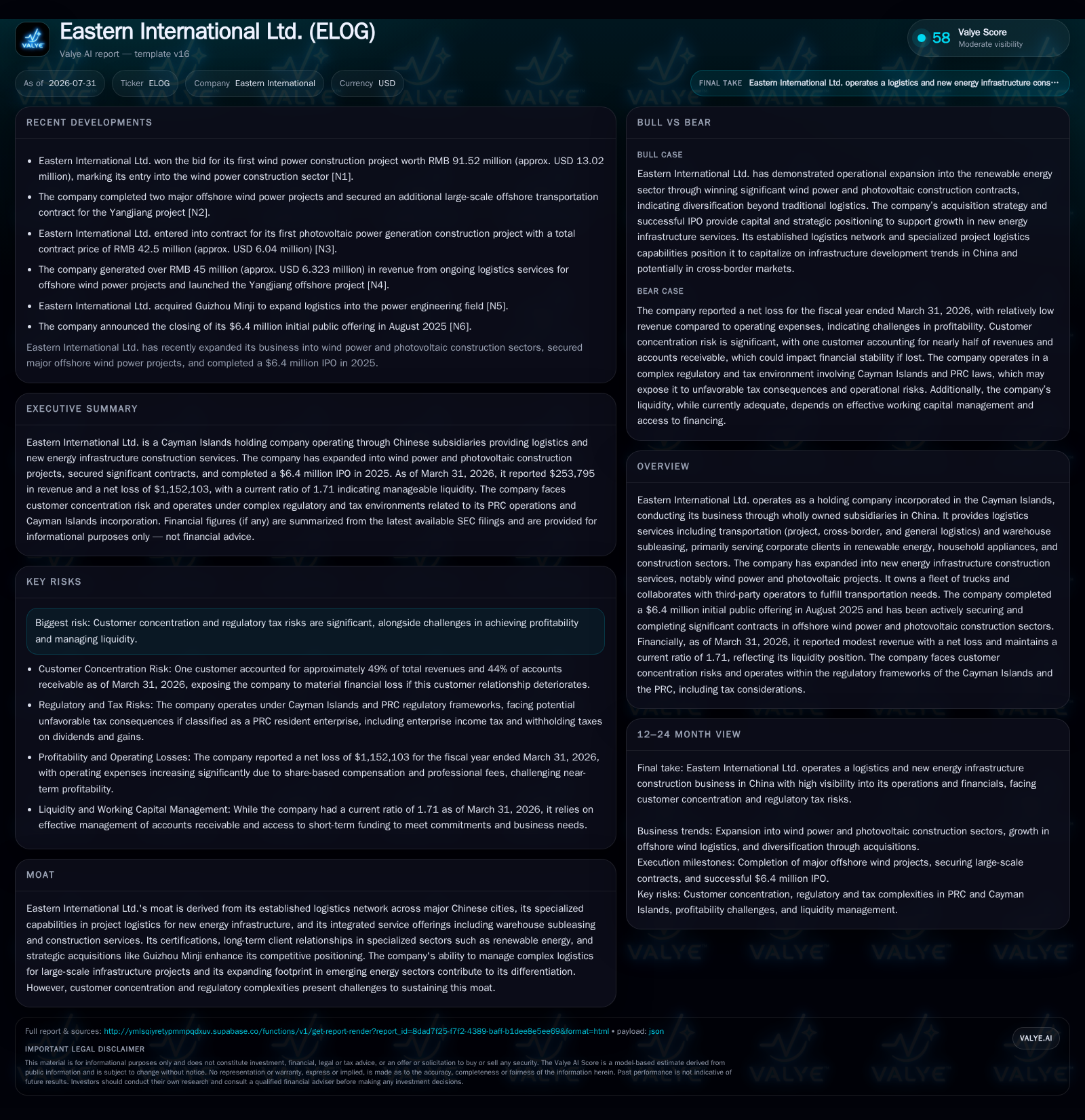
Eastern International Ltd. operates through Chinese subsidiaries delivering integrated logistics services, notably in project logistics for new energy infrastructure such as wind turbines and photovoltaic installations. Recent quarterly disclosures reveal strategic shareholder approvals and corporate governance refinements but no immediate shifts in operational capacity. The company’s business model depends on managing a mix of owned trucking assets and a broad network of third-party operators to serve corporate clients primarily in renewable energy, household appliances, and construction sectors. While revenue remains modest and operating losses persist, Eastern is investing in expanded capabilities including construction services tied to new energy projects. Customer concentration and regulatory complexities pose notable risks typical for mid-size project logistics firms in China.
Latest Operating Developments
The most recent material event for Eastern International Ltd. was the Extraordinary General Meeting held on June 22, 2026, where shareholders approved a restructuring of preferred shares involving the re-designation of existing shares into series A preferred shares with rights adjustments governed by a newly amended memorandum and articles of association [S2]. This move signals a maturing governance framework post-IPO but does not indicate direct changes to operational strategy or capacity.
No additional significant operational updates were announced between May and June 2026 other than routine filings confirming compliance with annual reporting obligations [S3]. Taken together, the latest quarterly disclosures confirm that Eastern International continues to execute its plan centered on servicing large-scale industrial clients through physical logistics assets coupled with contract-based third-party transportation.
Business Model Specificity
Eastern International operates as a Cayman Islands holding entity controlling wholly owned subsidiaries based primarily in China which conduct all material operations [S1]. The core business revolves around providing integrated logistics solutions encompassing project logistics, cross-border logistics, general freight transport, and warehouse subleasing. The company specializes in logistics support for complex new energy infrastructure projects—specifically wind turbine installations, photovoltaic systems, and energy storage—which require precise handling of oversized and specialized cargo through all phases including packaging, storage, transit, securing, and installation support.
Revenue streams derive from fees associated with: (1) contract-based project logistics particularly for precision equipment in renewable energy; (2) full truckload (FTL) and less-than-truckload (LTL) transport for household appliances and standard goods; (3) warehouse leasing via long-term leases totaling over 25,000 square meters; and (4) recently expanded construction services targeting new energy infrastructure projects after acquiring Guizhou Tianrun Zhicheng Construction Engineering Co., Ltd [S8]. This vertical integration amplifies Eastern's capacity to win larger turnkey projects within growing green infrastructure sectors
Operating alongside its owned fleet of 20 trucks is a networked pool of more than 2,000 third-party trucking operators who are engaged dynamically based on competitive rate quotes relative to specific shipment demands [S1]. This hybrid asset-light/asset-heavy model supports scalability while managing capital intensity typical for project logistics providers
To manage complexity across its network spanning major Chinese cities plus Hong Kong and extending to Southeast Asia and Central Asia corridors, Eastern leverages an internally developed enterprise resource planning (ERP) system tailored to optimize contract management, route scheduling, cargo tracking, billing accuracy, and compliance monitoring including transportation permits required for oversized cargo handling [S1].
Industry Context and Competitive Positioning
The logistics sector supporting infrastructure projects—particularly new energy—is capital intensive with substantial barriers tied to regulatory compliance (transport permits), technical expertise in handling specialized cargo, timely coordination across multiple subcontractors, and geographic footprint. Eastern’s ISO 9001 certification alongside AAA-level credit ratings endorsed by regional authorities in Jiangsu Province position it credibly against peers offering similar integrated service bundles such as Kerry Logistics or Sinotrans in Asia but with a more concentrated niche focus on renewable-related projects.
Its project logistics operation caters predominantly to large corporate clients within renewable energy sectors that demand exacting delivery schedules for high-value machinery like wind turbines or photovoltaic panels.[S1] Such specialization acts as a moat by embedding the company deeply into client supply chains due to the complexity of these shipments that limit substitution.
However, customer concentration remains elevated; one client accounted for roughly 49% of total revenues during fiscal year 2026 [S13]. This exposes Eastern to customer-specific demand risk which is intensified by regulatory intricacies affecting contract enforcement and tax treatment under PRC foreign exchange controls—common challenges for firms operating across jurisdictional boundaries within China’s domestic market constraints
Standard freight services for household appliances offer more commoditized margins but provide steady baseline revenue complemented by warehouse subleasing income which helps balance utilization rates amid cyclical project-based work.
Growth Drivers
Structural industry growth drivers include accelerating development of renewable energy infrastructure projects driven by Chinese government policy commitments to expand wind power generation capacity and solar photovoltaic installations. Increasing project scale demands sophisticated logistical support capable of handling oversized cargo movement over challenging terrain.
Eastern’s strategic acquisition of a construction engineering firm expanding its engagement into actual infrastructure build-out aligns neatly with market trends towards integrated service provision—from initial logistic planning through physical installation—enabling it to capture greater share within renewables value chain beyond transport alone.
Cross-border trade expansion in Southeast Asia also presents upward volume pressure on inland rail and truck shipments where Eastern began cross-border operations since 2019; however current reported activity is mostly domestic within China’s ports/terminals ecosystem which reduces some exposure to volatile international customs regimes but limits geographic diversification risk [S1]
Further investments into ERP system upgrades funded partly from IPO proceeds improve operational transparency, rate competitive intelligence gathering from third-party operators' bidding processes, load factor optimization (FTL vs LTL ratio), and adherence to stringent delivery timelines critical for project contract renewals.
Risks & Constraints
Key risks include the substantial reliance on a single customer accounting for nearly half of revenues; loss or non-renewal would significantly impair cash flows given modest contract backlog data available. Additionally, macroeconomic headwinds or regulatory clampdowns on freight permits or cross-border movement would inhibit execution capabilities impacting on-time delivery KPIs essential in project logistics contracts.
Rising general administrative expenses mainly reflect enhanced costs from post-IPO public company compliance obligations including share-based compensation grants totaling an increase of $816k alone during FY2026 alongside headcount expansion especially in sales/marketing functions aimed at capturing new business opportunities amid competitive pressures highlighted in S22.
Furthermore, reliance on third-party operators requires sustained engagement rigor ensuring contractor reliability without excessive pricing volatility—an ongoing challenge in Chinese freight markets characterized by fragmented asset ownership.
Inflationary cost pressures like fuel price hikes can also compress margins unless tariff adjustments pass through quickly—which may be constrained by fixed-price contracts common in infrastructure projects.
Finally cybersecurity risks exist though mitigated via internal controls overseen directly by the board; no material incidents have occurred thus far but digital systems underpinning ERP platforms remain critical infrastructure vulnerabilities needing continued investment allocation [S10].
What To Watch Next
Key indicators include quarterly updates on: incremental progress integrating construction services contributing broader margin mix; changes in the number of completed contracts especially within highly specialized project logistics segment; expansion or diversification beyond dominant client profiles reducing concentration risk; fleet utilization rates signaling scaling efficiency improvements; warehouse occupancy trends reflecting underlying industrial activity levels; incremental ERP deployments enhancing operational cost discipline;
Finally the company's ability to negotiate favorable rates from third-party trucking providers maintaining load balances between FTL/LTL shipments will influence gross margin stability amid fluctuating fuel price environments.
While no explicit forward guidance is published currently beyond management’s statement regarding sufficient working capital coverage over next twelve months using existing cash flow resources plus potential external fundraising if required [S1], market participants should monitor public filings closely over coming quarters as execution proof points around these vectors become clearer.
Financial Profile Discussion
Capital expenditures have risen modestly reflecting ongoing investments to maintain fleet age profile plus ERP system enhancements noted post-IPO funding deployment.[S22]
Overall financial posture suggests solid runway provided normal cash inflows continue combined with disciplined cost control though profitability remains elusive pending contract portfolio maturation and more diversified margin contributions from integrated construction service lines.
This analysis reflects only publicly disclosed information up to July 2026 without forward-looking investment research views. It focuses on Eastern International Ltd.’s specific context within China’s fast-evolving renewable infrastructure logistics landscape balanced against industry-wide risks typical for mid-tier entrants offering hybrid asset/logistics service models.
Disclaimer: This is research-only, informational analysis and not investment advice. It may include AI-generated interpretation and general industry context. Always verify important details using primary sources.

Comments