
Worthington Steel Advances Through Market Cycles with Focused Automotive Exposure and Strategic Acquisitions
Latest quarter reveals mixed operating results amid raw material cost pressures and ongoing integration of European acquisition.
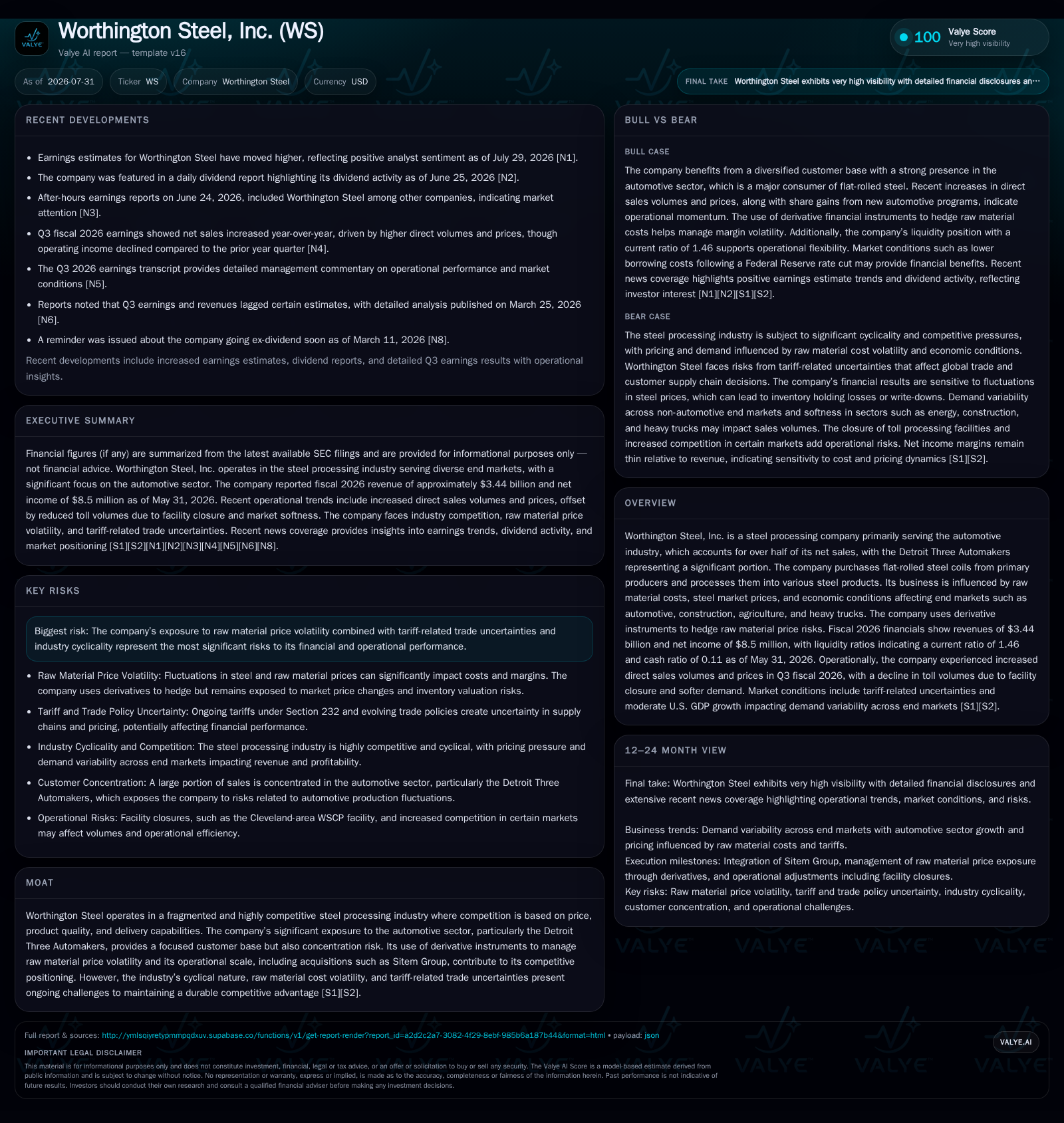
Worthington Steel, Inc. reported a slight decline in operating income in the third quarter fiscal 2026 despite revenue growth driven by increased direct sales volumes and pricing improvements. The company's concentrated exposure to the automotive industry, particularly the Detroit Three Automakers, continues to define its demand profile, while strategic moves such as acquiring Klöckner GmbH reflect efforts to expand its geographic footprint. Raw material volatility and toll processing volume declines remain key operational challenges. Financially, Worthington maintains modest net leverage with a current ratio of 1.46 and cautious liquidity management supporting operations and dividend payments.
Recent Operating Update
In the third quarter of fiscal 2026 (ended February 28), Worthington Steel experienced a nuanced operational landscape characterized by increased direct sales volumes accompanied by higher selling prices per ton across product lines. Despite these gains, total gross margin improvements were muted by declining toll processing volumes—a segment where Worthington acts primarily as a contract processor rather than direct seller—reflecting shifting customer procurement strategies or competitive pressures on that service line. These dynamics contributed to reported EBIT (non-GAAP) falling from $20.2 million in Q3 FY25 to $16.0 million in Q3 FY26 after adjusting for acquisition-related and impairment expenses [S15]. Impairments related mainly to internal-use software assets signal reevaluation of certain non-core investments.
Business Model: Value Addition Amid Raw Material Volatility
Worthington Steel operates principally as an intermediary steel processor, purchasing flat-rolled steel coils from primary producers such as Nucor and Steel Dynamics and employing value-add coil processing techniques including slitting, cut-to-length, coating, and finishing services tailored to end-user specifications. These processed products serve primarily automotive OEMs but also extend into construction machinery, agriculture equipment, and heavy truck manufacturing segments.
Revenue generation hinges on converting raw coils into customer-specified formats—a process generating margin from efficient sourcing combined with high throughput volume and favorable pricing power. Vehicle manufacturers typically require steel products matching exacting dimensional tolerances and just-in-time delivery schedules; thus, Worthington’s ability to meet delivery performance metrics forms a key competitive differentiator alongside product quality.
A significant component of earnings variability stems from fluctuations in raw material costs—primarily commodity-grade flat-rolled steel prices—which can be volatile due to global supply-demand imbalances, trade tariffs affecting imports/exports, and input cost inflation. The company employs derivative instruments extensively to hedge raw material price risks; these hedges seek to stabilize cost inputs over contract terms but may imperfectly align with physical procurement timing or market movements [S1][S2].
Toll processing volumes have contracted recently amidst changing customer preferences; this service generally commands lower margins compared to direct sales due to its contract nature where materials are customer-owned. Hence, shifts away from toll to direct sales or vice versa materially affect revenue mix and margin profiles.
Industry Structure and Competitive Positioning
The North American steel processing industry is highly fragmented with numerous regional players competing primarily on price competitiveness, product quality consistency, capacity reliability, and speed of order fulfillment. Competitors include large steel service centers like Reliance Steel & Aluminum Co., Ryerson (now part of Kloeckner), alongside smaller independent processors focused on niche geographies or commodities.
Worthington Steel's competitive advantage derives partly from its operational scale enabling efficient coil processing capacity utilization across multiple facilities including acquisitions such as Sitem Group which broaden geographic reach [S3][S22]. The pending full acquisition offer for the remaining shares of Kloeckner & Co SE represents an effort to consolidate platform capabilities internationally—potentially creating synergies through supply chain integration and cross-selling across Europe and North America
Customer concentration remains a double-edged sword: exposure mostly to the Detroit Three automakers provides stable demand backed by established supplier relationships but subjects Worthington to sector cyclicality risks tied directly to automobile manufacturing cycles which are inherently cyclical and sensitive to macroeconomic conditions.
Monitoring processed steel tonnage shipped along with average pricing per ton will provide good leading indicators for short-term revenue momentum while backlog positions offer visibility into near-term demand trends.
Risks and Watchpoints
What To Watch Next
Investors should closely follow updates on:
- Progress toward finalizing Klöckner acquisition integration including regulatory approval timelines and post-close synergy capture forecasts [S3].
- Quarterly trends in automotive industry production statistics given their outsized influence on Worthington’s sales volume [S2].
- Changes in toll vs direct sales volume mix reflecting shifts in customer sourcing behavior or competitive pressures [S15].
- Raw material cost trajectory relative to hedged positions impacting gross margins [S1].
- Operating margin trends reflecting efficiency improvements or restructuring impacts such as facility consolidations reported previously [S25].
- Liquidity status especially given dividend payments balanced against capital investments and possible debt funding linked to acquisitions [S6].
Financial Profile Discussion
As of fiscal year-end May 31, 2026, Worthington Steel posted revenues of approximately $3.44 billion with net income amounting to $8.5 million—reflecting slim profitability under challenging raw material cost environments [F1]. The operating income was slightly negative at -$1.4 million highlighting margin strains despite healthy top-line scale.
Balance sheet liquidity remains solid with cash & equivalents standing at $84.6 million against total debt levels around $71.4 million yielding a net cash position near $13.2 million positive [F1]. The company sustains a current ratio of 1.46 signaling moderate working capital coverage although total current liabilities remain sizable at $775.8 million versus current assets at roughly $1.13 billion indicative of inventory-heavy business model working capital needs typical for steel processors [F1].
Nevertheless, macroeconomic uncertainties and raw material price volatility necessitate vigilant cash flow monitoring going forward.
Conclusion
Worthington Steel remains entrenched as a mid-scale processor dominantly serving the automotive manufacturing sector while expanding its footprint internationally via strategic acquisitions like Klöckner & Co SE shares purchase attempts. Its operating results demonstrate resilience amid raw material volatility offset partly through hedging programs but constrained by toll processing declines impacting revenues mix negatively.
Customer concentration around Detroit Three OEMs heightens cyclical exposure but also grants access to sizable stable demand sources when North American vehicle production is robust. The unfolding integration success of European assets will be pivotal along with managing cost pressures driven by steel tariff regimes globally.
Key operating KPIs like processed steel volumes, average selling prices per ton, order backlogs including shifts between toll versus direct sales volumes alongside evolving automobile build rates will dictate near-term performance trajectories together with successful synergies capture from acquisitions shaping longer-term growth prospects.
This analysis is based exclusively on publicly available filings dated through July 30, 2026 including recent quarterly (10-Q), annual reports (10-K), event filings (8-K), company announcements and financial disclosures without any investment research view implied.
Disclaimer: This is research-only, informational analysis and not investment advice. It may include AI-generated interpretation and general industry context. Always verify important details using primary sources.

Comments