
Peoples Bancorp Navigates Rising Interest Rates and Funding Pressures with Diversified Loan Portfolio
Recent quarterly disclosures highlight stronger net interest income amid operational expense growth and regulatory tax impacts for Peoples Bancorp Inc.
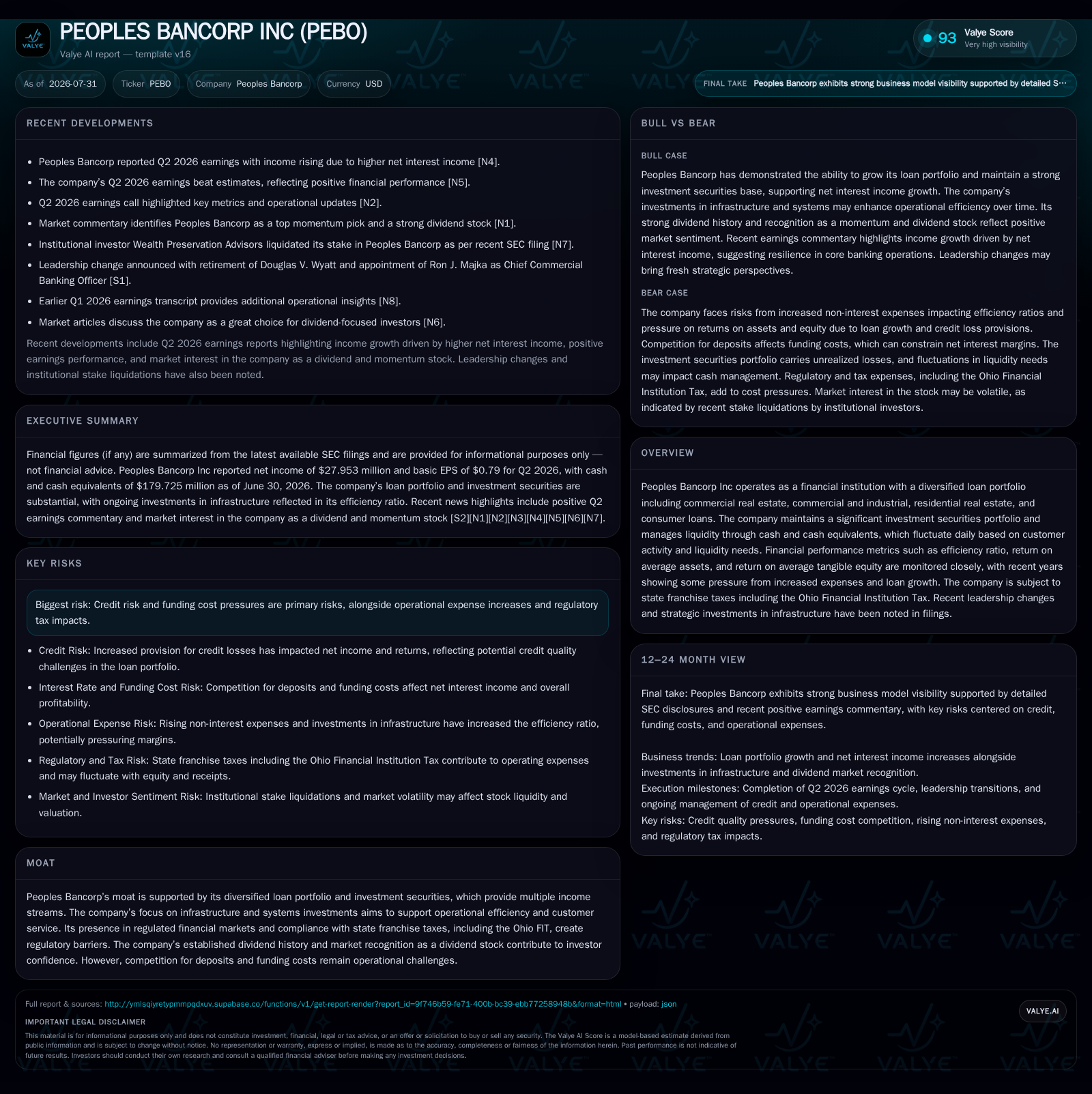
Peoples Bancorp Inc reported in its latest quarterly filing that net interest income improved due to asset-liability management amid a rising rate environment, although pressures on funding costs and operational expenses persist. The company maintains a diversified loan portfolio across commercial real estate, commercial and industrial, residential real estate, and consumer loans, supported by significant investment securities and liquidity buffers. Regulatory burdens such as the Ohio Financial Institution Tax continue to influence cost structure. Robust capital ratios and prudent liquidity management underpin the bank’s stability, though competitive deposit markets and credit risk remain watchpoints. Management has also signaled ongoing infrastructure investments to bolster efficiency and customer service.
Recent Operating Update
Peoples Bancorp Inc’s (PEBO) Q2 2026 report [S2] underscores a notable increase in net interest income attributable to effective asset-liability management amid recent interest rate rises. The company’s Asset-Liability Committee (ALCO) employs simulation modeling incorporating varied interest rate scenarios to optimize net interest income while controlling economic value at risk [S1]. As of June 30, 2026, cash and cash equivalents stood at approximately $179.7 million exceeding total debt of $156.3 million by about $23.5 million [F1], reflecting a solid liquidity cushion despite competitive deposit markets.
An event filing from late July [S3] detailed upcoming investor presentations aimed at clarifying ongoing strategic initiatives including enhanced infrastructure investment and operational efficiency improvements. Together with positive earnings call commentary in mid-July [N1], these updates provide confidence in management’s proactive posture towards interest rate risk exposure, funding cost control, and credit quality preservation.
Business Model
Peoples Bancorp functions as a regional bank primarily funded through customer deposits supplemented with wholesale borrowings from Federal Home Loan Bank (FHLB) advances and Federal Reserve facilities [S4]. The firm generates revenue predominantly through net interest income arising from a diversified loan portfolio concentrated in commercial real estate (CRE), commercial & industrial (C&I), residential real estate (RRE), and consumer loans [S1]. This multi-segment approach moderates earnings volatility caused by sector-specific downturns. The company further supplements revenue with non-interest income derived from fees, investment securities portfolio yields, insurance agency operations, and trust services.
Revenue mechanics hinge on the spread between yields earned on loans/securities versus interest paid on deposits/borrowings. Deposit beta—the degree to which deposit rates rise with market rates—is actively monitored to manage funding cost escalation amid rising rate cycles [S1]. Products such as certificates of deposit (CDs) are offered at competitive yields strategically timed to attract stable funds while balancing cost.
Operationally, Peoples invests in technology upgrades to enhance efficiency ratios—the ratio of non-interest expense to total revenue—allowing sustainable margin improvements despite increased regulatory tax burdens such as the Ohio Financial Institution Tax (FIT), which scaled up franchise tax expenses in recent years [S1]. Marketing expenditures have been adjusted downward following prior years’ peaks while communication-related expenses rose temporarily due to branch network enhancements [S1].
Industry Structure and Competitive Position
As a regional bank operating primarily within Ohio’s regulated ecosystem, Peoples faces competition for deposits from other regional banks like Old National Bancorp (ONB), community banks, credit unions, and wholesale funding sources. Its diversified loan book reflects typical exposure categories for similarly sized Midwest banks including CRE loans sensitive to localized economic conditions.
The regulatory framework demands rigorous capital adequacy compliance; Peoples comfortably exceeds well-capitalized thresholds with a CET1 capital ratio near 12.3% as of year-end 2025 [S18]. This robust capital base supports dividend payouts and provides flexibility for loan growth or opportunistic acquisitions without immediate dilution.
Interest rate risk is carefully managed via ALCO-driven policies employing scenario simulations encompassing parallel/non-parallel yield curve shifts, influencing strategic decisions on asset maturities, deposit repricing terms, swap hedges ($45 million notional reported in 2025) [S16]
Growth Drivers
Loan portfolio expansion underpins growth prospects with emphasis on CRE lending given its higher yield profile balanced against rising credit risk considerations. Residential mortgage originations remain steady benefiting from regional housing market dynamics. Select consumer lending complements the mix without overexposing the balance sheet.
Deposit growth combined with retention of stable core funding sustains liquidity strength; periodic CD specials are tactically deployed to counteract deposit beta pressures during rising rate phases [S1]. Improvement in net interest margin is anticipated through disciplined repricing strategies enabled by sophisticated asset-liability management.
Fee income generation benefits from ancillary services such as insurance sales via subsidiary agencies alongside trust & wealth management offerings enhancing client stickiness.
Strategic investments into digital platforms aim to reduce long-term operating costs while sharpening customer service differentiation — an important factor considering intensifying industry competition for retail deposits.
Risks and Watchpoints
Key risks include exposure to credit deterioration within CRE or C&I portfolios should economic conditions weaken locally or nationally—a scenario mitigated partially by stringent underwriting standards including annual reviews of larger credits [$1 million+] and ongoing grading updates [S21]
Funding cost inflation remains notable given deposit beta realities; failure to balance competitive deposit pricing could compress margins if asset yields cannot keep pace.
Operationally, elevated non-interest expenses tied to technology upgrades plus rising state franchise taxes impact profitability metrics; these costs must be controlled to preserve efficiency ratio gains.
Regulatory developments affecting capital requirements or tax regimes could pose incremental costs or limit capital return capacity over time.
Lastly, legal proceedings disclosed appear routine without material impact anticipated but will require monitoring for any escalation [S1].
What To Watch Next
Upcoming investor meetings scheduled through Q3 2026 will offer critical insights into the pace of loan growth, deposit mix shifts, net interest margin trajectory under current rate expectations, expense control initiatives, and capital deployment plans including dividend policy evolution [S3]
Key performance indicators include quarterly updates on:
- Loan portfolio composition shifts particularly CRE concentration,
- Provision expense trends reflecting credit quality,
- Deposit beta adjustments impacting funding cost dynamics,
- Efficiency ratio changes vis-à-vis infrastructure spending,
- Capital adequacy ratios confirming regulatory cushion,
- Liquidity coverage ratios validating contingency funding readiness. These metrics will signal operational traction or emerging headwinds ahead.
Financial Profile Discussion
Peoples Bancorp displays solid financial footing as evidenced by its net cash position approaching $23.5 million at mid-year 2026—cash & equivalents of $179.7 million exceed total debt of $156.3 million [F1]. This liquidity supports balance sheet flexibility amidst competitive deposit pressures. Capital ratios reported at December 31, 2025 include CET1 at roughly 12.3%, well above regulatory minimums plus conservation buffers [S18], allowing prudent dividend distributions ($58 million paid in 2025) without jeopardizing solvency.
Return metrics such as return on average tangible equity declined modestly from prior years reflecting higher equity bases post-merger but remain healthy near double-digit percentages supporting shareholder returns [S12]. Non-interest expense increases tied largely to communication upgrades and higher franchise taxes exert margin pressure but are balanced by growing net interest income driven by favorable rate environments [N9][S2].
Liquidity management policies maintain stringent limits on volatile funding components including brokered deposits and wholesale borrowings while forecasting cash flows over rolling twelve-month horizons ensures resilience under stress scenarios ranging from mild up to severe disruptions [S4][S5][S6]. The annual third-party validation of simulation models used for IRR assessment further enhances credibility around reported risk controls.
Disclaimer: This is research-only, informational analysis and not investment advice. It may include AI-generated interpretation and general industry context. Always verify important details using primary sources.

Comments