
RPC INC Strengthens Fleet Efficiency and Retains Customer Base Amid Oilfield Services Cyclicality
RPC's latest quarter reveals disciplined capital deployment and steady revenue from its technical oilfield services in a volatile market.
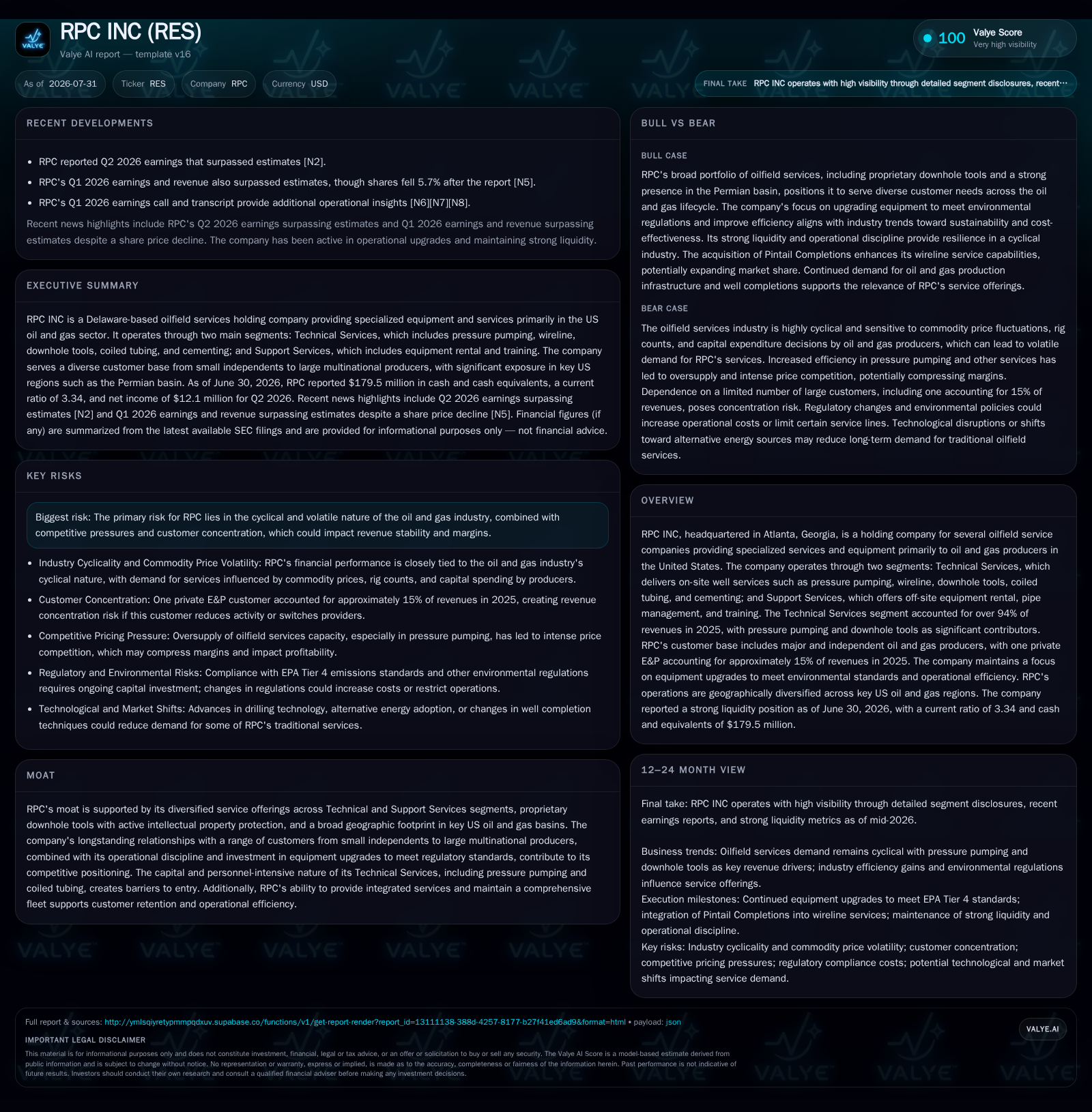
In its Q2 2026 report, RPC Inc maintained operational focus on efficiency and customer retention across its Technical and Support Services segments despite ongoing oil and gas sector cyclicality. Pressure pumping and downhole tools remained core revenue drivers, supported by geographic diversification across major U.S. basins. Capital expenditures continued toward fleet modernization to improve operating margins and meet evolving environmental standards. The company’s balance sheet remains robust with low leverage and strong liquidity, though risks from customer concentration and industry volatility persist.
Recent Operating Update
RPC Inc's Q2 2026 financial disclosures highlight steady operational performance leveraged by disciplined capital spending on asset efficiency. Total revenues remain primarily driven by the Technical Services segment which accounts for over 94% of sales, dominated by pressure pumping and downhole tools — critical well completion services that are highly capital intensive [S2],[S1]. Despite ongoing sector cyclicality impacting drilling activity levels, RPC maintains focus on utilization rates through logistics optimization and equipment upkeep.
Net income for the first half of 2026 was $12.9 million compared to $22.2 million for the same period in 2025 alongside depreciation expense of nearly $86 million reflecting sustained investment in fixed assets [S2],[F1]. Share-based compensation rose modestly to $7.7 million during this period indicating continued talent retention efforts aligned with incentive plans [S2]. Importantly, RPC reported robust cash reserves of $179 million against minimal debt of $10 million as of June 30, underpinning financial flexibility during volatile demand conditions [F1].
Additionally, the company declared regular quarterly dividends continuing its balanced capital return approach while maintaining ample liquidity for strategic investments or acquisitions [S3],[S25].
Business Model
RPC operates through two major segments: Technical Services delivering on-site well completion solutions such as pressure pumping — used for hydraulic fracturing — wireline services critical for diagnostics and maintenance within wells, downhole tools that include proprietary technologies designed to improve well control, coiled tubing deployed for interventions without removing casing, and cementing which stabilizes the wellbore; plus Support Services providing off-site equipment rental including drill pipe management and operator training programs [S1].
Revenue generation stems from highly project-based contracts tied closely to customer drilling and completion activity [S5]. Customers pay for a combination of equipment usage hours, personnel required to operate specialized machinery, consumable materials like chemicals used in fracturing fluids or cement mixtures, and logistical support including scheduling across multi-well clusters. Given the short lead time from order to service delivery—often just weeks—RPC rarely holds a significant sales backlog implying revenue is sensitive to near-term fluctuations in upstream producer capex plans
Margins are influenced by equipment utilization rates where increased pump hours per day can dilute fixed costs; strong maintenance practices minimize downtime; logistical precision reduces idle fleet costs; and technological updates can command pricing premiums occasionally amidst competitive pressures. The company's integrated offering provides bundled solutions that deepen customer relationships across service lines lowering switching risk.
Industry Structure and Competitive Position
RPC positions itself as a diversified oilfield services provider serving both major multinational producers and independents across vital U.S. shale basins such as the Permian—the most active unconventional play—as well as mid-continent, Rocky Mountain formations like DJ Basin, Appalachian basins fueling natural gas supply growth, Gulf region offshore activities, and some international exposure [S1],[S5]. This geographic breadth helps moderate basin-specific cyclicality though broad price trends remain dominant demand drivers.
Compared to peers like Halliburton or Schlumberger who operate globally with broader technology suites but higher complexity overheads; or National Oilwell Varco focusing more on equipment manufacturing; RPC’s scale is mid-tier but offers strength through specialization in pressure pumping fleets optimized for regional basin needs along with proprietary downhole tools protected by intellectual property arrangements enhancing differentiation. Weatherford International represents a closer peer in certain pressure pumping niches but lacks RPC’s integrated training services or pipe management capabilities.
Customer concentration is notable with one private E&P comprising about 15% of revenues—a figure unchanged from prior years—reflecting reliance on large customer projects tethered to their development plans which inject volatility risk into revenue stability [S1]. However, RPC offsets this through multi-customer diversification especially in its Support Services business whose rental tools often support smaller operators more susceptible to spot market activity shifts.
Growth Drivers
Growth primarily correlates with increased drilling completions by customers driven by oil/natural gas price cycles influencing upstream capex budgets [S1]. Technological advances implemented via fleet upgrades enhance operational efficiency enabling higher asset utilization (e.g., running pumps up to 20-22 hours daily) thus growing revenue per unit deployed without proportional capital increase
Regulatory changes increasingly mandate equipment enhancing environmental compliance such as reduced emissions fracturing pumps or safer cementing methods driving incremental fleet renewals considered necessary to retain contracts particularly among larger producers focused on ESG goals.
Expansion into adjacent support lines such as pipe inspection services combined with training programs broadens addressable market allowing cross-selling opportunities while mitigating pure cyclical downturn impact concentrated in Technical Services.
Acquisitions present additional avenues to augment scale or technology competencies exemplified by integration of Pintail Alternative Energy acquired in April 2025 aimed at complementing downhole intervention capabilities though synergy realization remains underway [S16]
Risks and Watchpoints
The fundamental risk centers on the inherent cyclicality of oilfield activity dictated by commodity price fluctuations which directly impact drilling rig counts and completion projects pivotal to RPC’s revenue base. A prolonged downturn induces equipment idling leading to burned assets (wear without corresponding returns), compressed pricing power due to competition intensification among service providers vying for limited contracts, and downward margin pressure.
Customer concentration exposes the firm if major clients shift strategy or cut back capex abruptly without ready replacement easing the impact. Operational risks persist regarding safety incidents typical in high-capital oilfield operations potentially disrupting service delivery or increasing costs.
Equipment obsolescence requires continuous capital expenditure commitment estimated at tens of millions per quarter—balancing fleet modernization against free cash flow availability remains critical especially during softer market periods [S22],[S24]. Additionally, workforce availability skilled in technical roles remains a subtle constraint amid tight labor markets impacting project execution efficiency.
Environmental regulations represent evolving compliance costs demanding upfront investments in less pollutive technologies even if shorter-term benefit is limited beyond contractual qualification within tender processes.
What to Watch Next
Key indicators include shifts in active well site counts serviced by RPC which signal near-term demand changes; average revenue per job reflecting pricing environment or mix improvement; operating margins drilled down by Technical versus Support segments revealing cost control effectiveness; capital expenditure levels showing investment pace toward fleet renewal; safety incident frequency affecting operational continuity; new contract wins particularly among large customers mitigating concentration risk; progress integrating acquired assets like Pintail to expand service offerings; balance sheet leverage alongside liquidity ensuring cushion for downturns; dividend announcement patterns providing insight into free cash flow confidence; competitive pricing dynamics especially compared to hubs like Weatherford or national players replicating niche technologies.
A smooth alignment of all these factors would confirm durability amid prevailing sector volatility while sustained gains could indicate incremental moats through technology leadership or basin reach extension.
Financial Profile Discussion
As of June 30, 2026, RPC held $179 million in cash versus only $10 million total debt resulting in net cash positive standing approximating $169 million reflecting conservative leverage prudence supporting business resilience during commodity-driven cycles [F1]. The company's current ratio exceeded 3x evidencing solid short-term liquidity buffer facilitating uninterrupted operational funding even under adverse scenarios [F1].
Operating cash flow conversion remains sound with adjusted EBITDA support consistent over recent quarters despite lower net income attributable partly to elevated depreciation from aggressive asset investment strategies designed for long-term margin gains rather than short-term earnings maximization [S22].[F1]
This balanced financial stance complements operational discipline fostering adaptability crucial for success within the capital-heavy oilfield services landscape dominated by cyclic demand patterns driven ultimately by upstream investment decisions beyond direct company control.
This analysis synthesizes publicly disclosed metrics alongside sector-specific dynamics shaping RPC Inc’s business trajectory without providing investment advice or forecasts. Market participants should consider broader macroeconomic conditions alongside company fundamentals when evaluating future prospects.
Disclaimer: This is research-only, informational analysis and not investment advice. It may include AI-generated interpretation and general industry context. Always verify important details using primary sources.

Comments