
Trane Technologies Advances Earnings on Backlog Growth and Sustainability Focus
Q2 results reflect solid performance driven by backlog expansion, AI integration, and strong Americas segment growth.
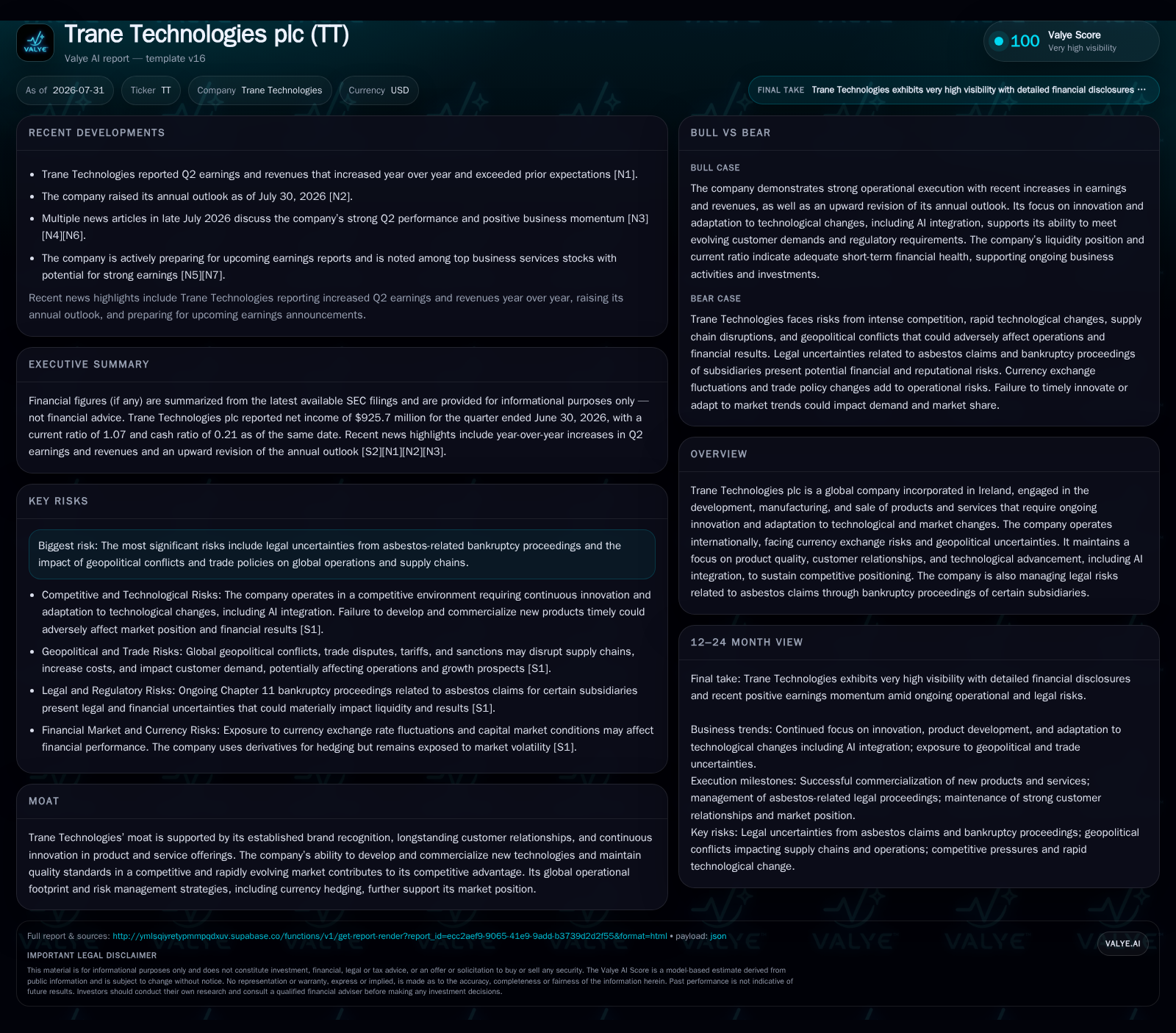
Trane Technologies reported robust second-quarter 2026 results anchored by strength in the Americas region, with revenues climbing alongside expanding order backlog. The company’s focus on sustainability initiatives, including ambitious carbon reduction targets and AI-enabled HVAC optimization through recent acquisitions, supports its competitive position in energy-efficient climate solutions. Ongoing legal risks from asbestos-related bankruptcies remain a consideration, but operational momentum and technological innovation underpin growth opportunities.
Recent Operating Update
Backlog data as of December 31, 2025, indicated a firm order book totaling $7.77 billion, up from $6.75 billion at the end of 2024. This backlog primarily covers equipment and installation contracting obligations and is a key indicator of near-term revenue visibility given the project-based nature of many HVAC contracts with multi-month lead times [S1]. However, the company notes that specialized customer applications may experience deferrals or cancellations linked to resource constraints or project delays—a typical risk factor in industrial capital goods sectors.
Additionally, Trane Technologies completed strategic acquisitions of AI-based building management platform BrainBox AI Inc., various distributors extending transport refrigeration sales and service networks in both Americas and EMEA, and a minority stake in European building automation provider Kieback&Peter [S1]. These moves fortify the company’s product offering around connected intelligent controls and AI optimization—areas gaining critical traction industrywide as customers seek enhanced energy efficiency and operational intelligence.
Business Model and Strategic Position
Operating predominantly as an OEM and global service provider within industrial equipment and HVAC systems, Trane Technologies monetizes through direct equipment sales combined with installation services plus aftermarket maintenance contracts. Its portfolio spans residential and commercial heating/cooling units under the Trane® brand alongside Thermo King® transport refrigeration systems, serving multiple end markets spanning real estate developments to cold chain logistics [S1]. The monetization balance reflects upfront capital sales with recurring annuity-like revenue streams from long-term service contracts that govern product lifecycle value extraction.
The company’s competitive strengths stem from longstanding customer relationships cultivated through brand reliability, engineering innovation centered on sustainability benchmarks (e.g., carbon emissions reduction goals), and technology integration such as AI-enabled building management platforms that lower total cost of ownership for clients. Its broad geographic footprint exposes it to currency risks but also diversifies end-market cyclicality across developed and emerging regions.
Trane competes with large HVAC manufacturers like Carrier Global Corporation and Johnson Controls International plc, which similarly emphasize energy-efficient innovations coupled with extensive service networks. Differentiation hinged on proprietary AI applications in HVAC optimization has become increasingly vital in responding to tightening environmental regulations mandating carbon footprint reductions globally.
Industry Structure and Competitive Landscape
The industrial HVAC sector remains capital-intensive and regulatory-sensitive—demand is correlated closely with construction activity cycles but structurally underpinned by growing urbanization trends requiring new infrastructure investment. Regulatory thrusts toward sustainable building codes worldwide continue to accelerate replacement cycles of aging HVAC systems with more efficient models fitted with connected intelligent controls.
Peers such as Daikin Industries Ltd. and Honeywell’s building controls segment also invest heavily in IoT-enabled solutions that optimize energy consumption via predictive analytics powered by AI—a fast evolving battleground where rapid innovation cadence shapes market leadership. Amid rising raw material costs (copper, steel) and supply chain disruptions exacerbated by geopolitical conflicts, companies maintaining resilient supply chains have an operational edge.
Furthermore, transport refrigeration demands are buoyed by expanding cold chain logistics across food safety-sensitive sectors; acquisitions expanding distribution footprint provide Trane selective growth avenues beyond conventional HVAC segments.
Growth Drivers
Key drivers include:
- Increasing regulatory mandates for building carbon emissions reductions stimulate retrofit spending replacing older HVAC units with low-GWP refrigerants and high-efficiency designs.
- Urbanization notably in Asia-Pacific fuels new commercial construction requiring climate control installations embedding cutting-edge automation.
- Technological advances integrating AI into building management systems enable predictive maintenance reducing downtime costs—a value proposition increasingly embraced by commercial property owners.
- Expansion of aftermarket services supported by long-term maintenance contracts offers steady revenue streams less sensitive to cyclical equipment sales volatility.
- Acquisition strategy targeting complementary technology providers (BrainBox AI) and regional distributors bolsters market penetration while enhancing sustainable solution portfolios.
Risks and Watchpoints
Despite operational progress, significant risks persist:
- Ongoing legal exposures related to asbestos claims are sequestered within subsidiaries Aldrich Pump LLC and Murray Boiler LLC undergoing Chapter 11 bankruptcy proceedings; though isolated legally from core operations, reputational risks or changes in claims resolution terms could impose financial impacts over time [S1].
- Supply chain vulnerabilities remain non-trivial given continued geopolitical tensions affecting sourcing of essential components; any disruptions could inflate costs or delay backlog fulfillment.
- Rapid innovation cycles require continued R&D investment; failure to commercialize emerging technologies efficiently may erode competitive positioning amid aggressive peer investments.
- Currency fluctuations against the U.S. dollar affect reporting results substantially given international revenue exposure; hedging strategies partially mitigate but not fully eliminate this volatility.
- Labor market tightness for skilled engineers could elevate costs or decelerate development timelines critical for sustaining innovation leadership.
What to Watch Next
Investors should monitor:
- Quarterly updates on order backlog figures as leading indicators for revenue trajectory.
- Progress reports on integration success of recent acquisitions expanding digital/AI capabilities alongside geographic reach.
- Sustainability milestone achievements aligned with the Gigaton Challenge tonnage reductions claimed publicly; regulatory developments influencing product design requirements will be instructive.
- Legal proceedings around asbestos trust funding plans providing insight into potential contingent liabilities realization.
- Capex deployment trends targeting automation or manufacturing efficiencies addressing labor market constraints affecting margins.
- Segment revenue evolution across geographies indicating resilience amid regional economic disparities or trade policy shifts.
Financial Profile Discussion
At midyear 2026, Trane Technologies maintained healthy liquidity with approximately $9.0 billion in current assets against $8.4 billion in current liabilities for a current ratio near 1.07, indicative of adequate short-term financial flexibility amidst capital-intensive operations [F1]. On April 23, 2026, it secured a new $1.5 billion senior unsecured revolving credit facility extending maturity through April 2031 while retiring a prior $1.0 billion facility due in April 2027—demonstrating proactive debt management enhancing balance-sheet durability [S2].
Short-term borrowings and current maturities of long-term debt totaled approximately $693 million as of June 30, 2026, including $400 million in commercial paper and $293 million in debentures with put features [S2]. The company maintains two senior unsecured revolving credit facilities totaling $2.5 billion, with maturities in 2030 and 2031, providing ample liquidity headroom [S2].
Operating cash flow remains supported by strong segment income generation notably within Americas markets where operating income approached $1.88 billion over six months ended June 30 versus $1.73 billion prior-year period [S2]
This analysis draws exclusively from Trane Technologies’ SEC filings dated February 2026 (10-K) and July 2026 (10-Q), supplemented by contemporaneous earnings disclosures issued July 30, 2026 alongside relevant peer context within the industrial HVAC equipment sector worldwide. It refrains from speculative forward guidance absent explicit company commentary.
Disclaimer: This is research-only, informational analysis and not investment advice. It may include AI-generated interpretation and general industry context. Always verify important details using primary sources.

Comments