
Employers Holdings Balances Underwriting Discipline and Technology to Sustain Its Niche Workers’ Compensation Growth
Focused on small and mid-sized businesses in low hazard industries, Employers Holdings advances underwriting precision and distribution breadth amid geographic concentration risks.
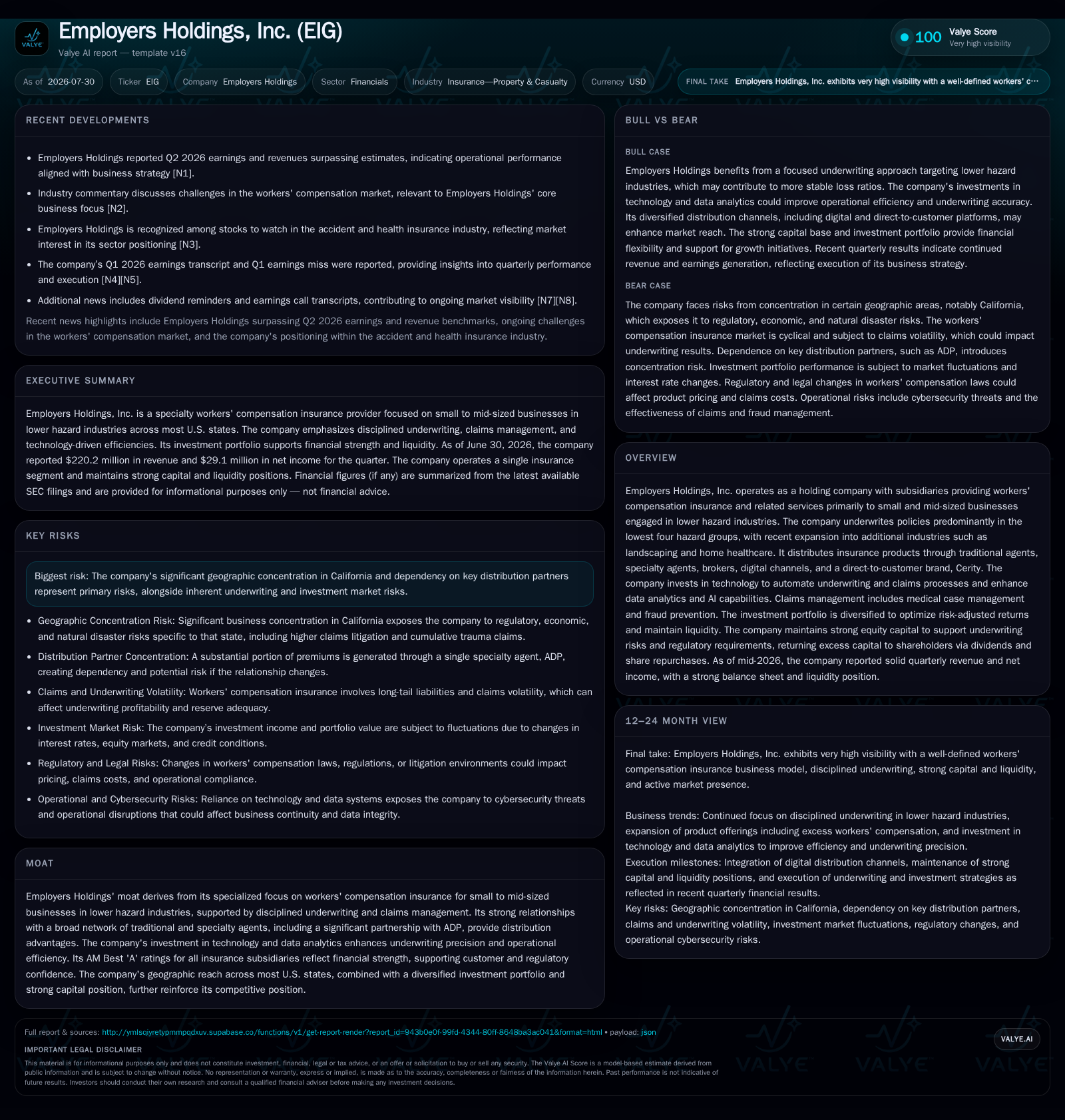
Employers Holdings, Inc. continues to leverage disciplined underwriting and claims management tailored to small and mid-sized businesses in lower hazard classes, emphasizing profitable growth over volume. Its recent quarterly results show resilient earnings and premium trends, supported by investments in automation and diversified distribution including digital channels and a direct-to-consumer brand. The company's AM Best 'A' ratings underpin its strong financial position, although its significant California exposure and reliance on key agency relationships remain areas to watch. Technological enhancements in underwriting and claims automation constitute important levers for competitive differentiation and operational efficiency.
Recent Operating Update: Continuing Discipline Amid Market Challenges
This quarterly update confirms that the company’s business model remains centered on leveraging underwriting rigor combined with enhanced claims management capabilities.
Business Model Focused on Specialty Workers' Compensation Insurance
Employers Holdings operates through wholly owned insurance subsidiaries specializing exclusively in workers' compensation insurance tailored primarily for small to mid-sized U.S. businesses classified within the bottom four hazard groups per industry classification [S1]. This focused product offering serves workplaces with relatively lower injury risks but still requires precise loss estimation given statutory restrictions. The launch of an excess workers’ compensation product targeting self-insured enterprises across multiple jurisdictions in early 2026 represents a notable product innovation aimed at capturing additional adjacent market segments while leveraging existing claims expertise [S1].
Revenue comprises net earned premiums supplemented by investment income from a diversified portfolio managed to balance liquidity needs with yield optimization [S1]. The underwriting income component is critically dependent on effective loss ratio control driven by disciplined premium pricing calibrated against expected losses plus loss adjustment expenses (LAE) and maintaining expense discipline
The company’s underwriting strategy focuses on evaluating individual policyholder risk characteristics including prior claims history while controlling selection through tighter classifications within specialized lower hazard classes. This approach mitigates pricing errors that could erode profitability given the long-tail nature of workers’ comp claims [S1]
Industry Structure and Competitive Positioning
Within the specialty workers’ compensation space—a niche under the broader property casualty insurance sector—Employers Holdings has carved out a defensible moat through expertise serving smaller accounts traditionally underserved or viewed less profitably by larger carriers. With AM Best “A” ratings across all insurance subsidiaries reflecting excellent financial strength, Employers sustains access to reinsurance markets under favorable terms which underpin capital adequacy requirements enforced by state regulators [S1].
Competition stems from regional and national single-line workers’ comp specialists alongside multi-line carriers offering bundled insurance products including commercial property/casualty lines. Multi-line insurers often apply cross-line pricing advantages that can pressure standalone workers’ comp rates—a persistent challenge detailed in Employers' risk disclosures emphasizing pricing risk due to intense competition particularly from larger peers willing to sacrifice short-term margins for broader account relationships [S1]
Geographically, Employers is licensed nationwide except for North Dakota, Ohio, Washington, and Wyoming which are served exclusively by state funds. However, California accounts for approximately 46% of gross written premiums making it a significant concentration exposure subject to evolving regulatory frameworks favorable or adverse to insurers [S1]. This concentration necessitates ongoing monitoring of regulatory changes impacting claim costs or premium schedules.
Distribution is notably diversified. Apart from traditional independent agents focusing on large blocks of business within specialized industries, Employers increasingly leverages specialty agents and brokers familiar with niche market needs. The Cerity brand complements this mix by providing direct-to-customer digital quoting options targeting tech-savvy small businesses desiring streamlined purchasing experiences [S1]. Partnerships with third parties such as ADP help deepen penetration into small business payroll segments enabling access to a geographically widespread base otherwise difficult for single agents alone.
Growth Drivers: Technology Adoption & Market Expansion
Technology investments are central pillars driving operational improvements at Employers Holdings. Automated underwriting platforms facilitate consistent data collection and risk classification leading to more precise premium pricing algorithms [S1]. Claims processing benefits from AI-enabled analytics that enhance medical case management outcomes while fraud detection algorithms reduce unnecessary claim payouts—both pivotal tactics improving combined ratios over time
The introduction of excess workers' compensation products broadens coverage scope allowing Employers to capture policyholders seeking layered retentions beyond primary coverage limits especially among self-insured midsize enterprises—a growing segment requiring tailored risk financing solutions introduced in early 2026 signaling proactive product innovation efforts [S1]
Expansion of alternative distribution models via Cerity's digital channel reflects broader industry trends favoring online policy issuance capabilities tailored for smaller clients preferring minimal human interaction without sacrificing coverage specificity. This also aligns with partnerships like ADP’s payroll services linking pay-to-premium data seamlessly enhancing policy accuracy.
Across many specialty insurers covering smaller accounts, persistency levels tend to be stronger given focused service models addressing unique client risk profiles rather than commoditized mainstream commercial lines—a positive structural factor benefitting Employers' revenue stability.
Risks / Watchpoints / Growth Constraints
Key risks include:
- Geographic Concentration: Heavy reliance on California exposes Employers Holdings to heightened regulatory shifts affecting premium rates or claim severity unpredictably.
- Competitive Pricing Pressure: Larger multi-line carriers possessing scale advantages may continue exerting downward price pressure disproportionately impacting single-line specialists like Employers who cannot cross-subsidize losses easily.
- Underwriting Errors: Misclassification or inaccurate loss projection inherent to workers’ comp insurance long-tail liabilities can lead to reserve strengthening adversely impacting results.
- Dependency on Distribution Partners: Key agent/broker relationships coupled with external partners like ADP are essential; disruptions could impair new policy acquisition.
- Investment Market Volatility: Fluctuations affecting portfolio yields can reduce net investment income that supplements underwriting profits.
- Operational Risk: Technology adoption offers advantages but also introduces cybersecurity threats or potential system failures impacting business continuity.
These risks underscore the importance of continuous refinement in actuarial modeling accuracy, robust claims recovery practices including medical provider network leverage, cautious geographic expansion strategies beyond the existing footprint—and prudent capital management.
What To Watch Next
Investors and analysts should monitor these milestones:
- Quarterly combined ratio disclosures will signal how effectively Employers sustains underwriting profitability amid inflationary claim cost environments.
- Retention rates and average premium per policy trends indicating account stability and pricing power dynamics.
- Progress in scaling alternative distribution channels such as Cerity’s digital platform impacting new business volumes among tech-enabled small employers.
- Development trajectory of excess workers' compensation product uptake translating into meaningful premium diversification.
- Regulatory developments notably within California shaping permissible premium rate changes or benefit mandates.
- Any change in AM Best financial strength ratings affecting capital costs or investor confidence.
- Internal technological project updates reflecting enhancements in AI-driven underwriting or claims automation efficiencies.
Financial Profile Discussion
As of June 30, 2026, companyfacts shows Employers Holdings with approximately $113 million in cash and equivalents and total debt near $125 million, resulting in modest net debt levels around $12 million—reflecting conservative leverage relative to equity capital reported at December 31, 2025 [F1]
Total insurance subsidiary cash/investment holdings exceed $2 billion enabling strong liquidity buffers supporting timely claims payments [S6][S18]. Their statutory surplus exceeds regulator minimums comfortably contributing to operational resilience under volatile claim cycles or economic conditions.
Operating cash flow patterns show consistent net cash inflows supporting working capital needs alongside disciplined dividend policies returning capital steadily through quarterly dividends—and sizeable share repurchase programs indicating confidence from the Board regarding available capital above regulatory cushions [S8][S10]. Investment portfolio quality is high grade (weighted average "A+" rating) dominated by fixed maturity securities at about 87%, balancing yield targets against credit risk exposures [S22].
Overall financial health contributes positively both toward sustaining insurer credibility when negotiating reinsurance arrangements—critical for layering catastrophic loss protection—and supporting distribution partner confidence who favor well-capitalized carriers capable of prompt payments during claim surges.
Conclusion
Employers Holdings remains a focused player within specialty workers' compensation insurance characterized by disciplined underwriting honed over years serving lower hazard small/mid-size business segments. Its concerted push into technological automation—from policy initiation through claims settlement—coupled with broadening distribution reach including direct digital brand Cerity equip it well for navigating competitive dynamics where price sensitivity intersects with quality service demands.
While concentrated exposure to California warrants vigilance due to regulatory unpredictability inherent there alongside competition from large multi-line insurers bundling products below standalone cost structures, Employers manages these challenges appropriately via prudent capital policies supported by AM Best "A" ratings preserving stakeholder trust.
Current quarterly performance confirms stable execution aligned with long-term profitable growth goals rather than aggressive volume chasing—a hallmark attractive within specialty segments prone otherwise to cyclicality driven by underpricing missteps. Success hinges on maintaining razor-sharp risk analytics powered increasingly by artificial intelligence supporting quicker decisions combined with sustaining durable agent/broker partnerships extending geographic and sectoral reach meaningfully beyond legacy footprints.
This positions Employers uniquely amidst its peers leveraging specialization advantages amid ongoing transformation pressures reshaping how workers’ compensation insurance is priced, distributed, and administered today.
Disclaimer: This is research-only, informational analysis and not investment advice. It may include AI-generated interpretation and general industry context. Always verify important details using primary sources.

Comments