
Western Union's Strategic Shift Under Regulatory and Market Pressures
Western Union’s Q2 2026 results reveal persistent margin pressures from regulatory compliance and competitive dynamics as the firm balances legacy agent networks with digital growth initiatives.
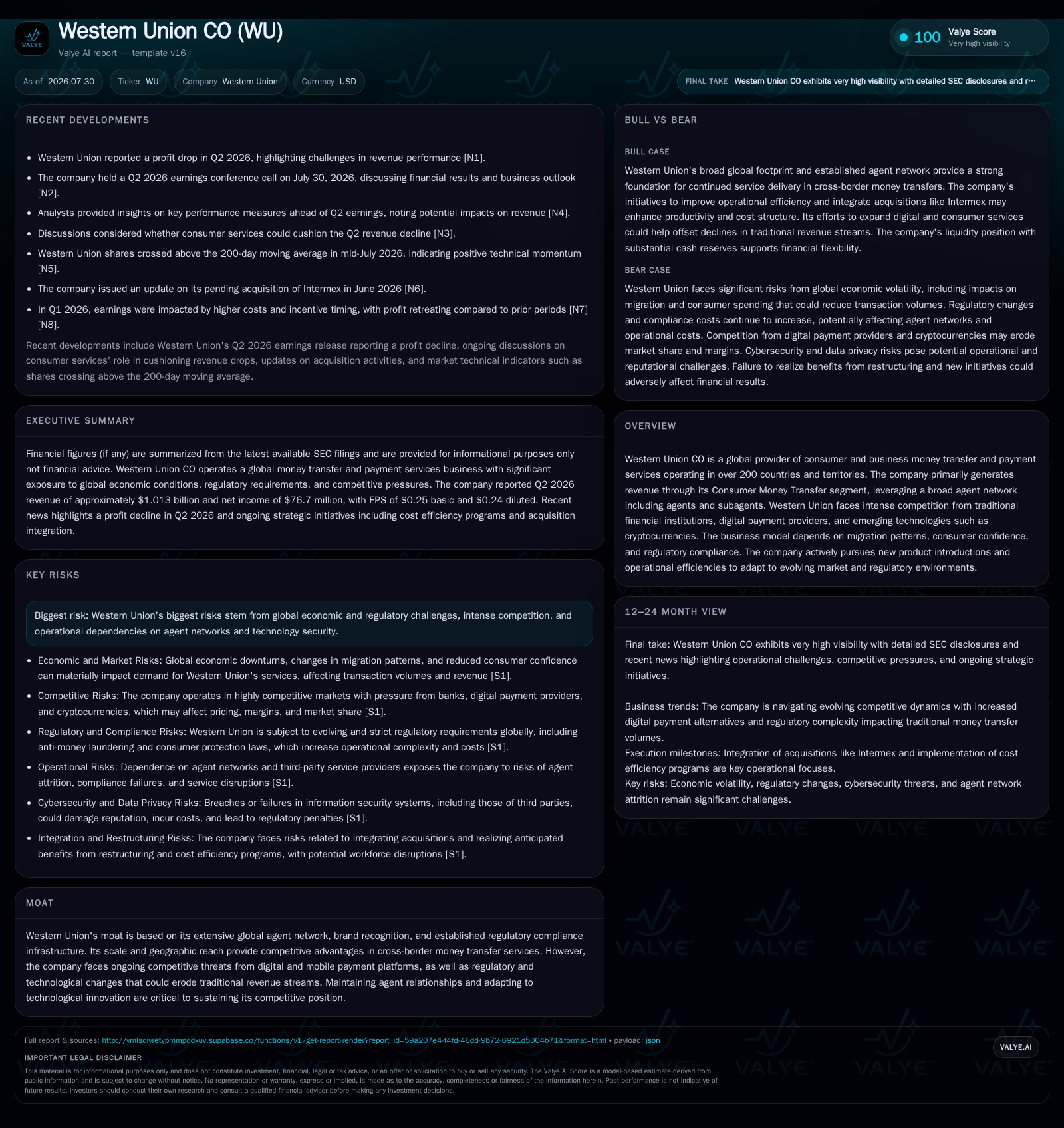
The Western Union Company reported Q2 2026 results highlighting margin compression attributable to elevated compliance costs and evolving consumer preferences. Revenue drivers remain closely linked to transaction volumes, pricing power via foreign exchange margins, and agent network dynamics amid rising competition from digital remittance services. The company pursues operational efficiencies through restructuring and technology investments, seeking to maintain agent relationships while expanding its digital wallet penetration. Key risks include regulatory scrutiny, fraud prevention challenges, and global economic volatility impacting transaction demand. Monitoring transfer volume trends, average revenue per transaction, and digital adoption metrics will be critical for assessing execution progress.
Q2 Operating Update: Earnings Pressure from Compliance and Competition
Western Union’s latest quarterly filing for Q2 2026 reveals ongoing challenges manifesting as compressed earnings margins largely driven by the cost of regulatory compliance programs alongside intensified competition in the consumer money transfer segment. The company reported continued softness in revenue growth as cross-border remittance volumes face headwinds from global economic uncertainties including inflationary pressures and subdued migration patterns that traditionally underpin demand for its services [S2], [S3]. Elevated expenditures tied to anti-money laundering (AML), know your customer (KYC) measures, fraud prevention initiatives, and remediation related to historic enforcement matters contribute materially to operating cost inflation. This manifests in squeezed profitability despite efforts toward efficiency gains via restructuring programs initiated since late 2025 aimed at technology rationalization and fraud loss reduction [S7].
Revenue Mechanics: Tying Transfers, Fees, and FX Margins
Western Union’s business model is fundamentally anchored on transaction fees charged to consumers sending money internationally combined with foreign exchange spreads earned when converting currencies during cross-border transfers. These components drive gross margin performance given the widespread use of cash-to-cash transfers through its agent network as well as increasingly digital channels. Transaction volume fluctuations correlate closely with migration trends and consumer confidence; thus any adverse macroeconomic or geopolitical factors tend to depress total funds transferred. The reported average revenue per transaction serves as a critical metric reflecting pricing power amidst competitive pressures—from both traditional operators like MoneyGram and Ria as well as disruptive fintech platforms offering leaner fee structures or faster settlement times [S1], [F1]. Foreign exchange margins continue representing a meaningful portion of gross profit but are volatile given currency rate swings.
Agent Network Resilience Versus Digital Adoption Acceleration
Western Union maintains a sizable global agent network providing physical locations where senders can remit funds in person—this network is a moat offering strong brand recognition and broad geographic reach. Retention of these agents under favorable terms remains vital for customer coverage but presents operational complexities regarding compliance monitoring and payout cost control. To address evolving consumer preferences favoring convenience, the firm simultaneously accelerates digital wallet penetration—facilitated by investments in online platforms enabling mobile app transactions that bypass costly physical payout channels and enhance user experience. This dual-channel strategy aims to balance agent-based customer intimacy with the scalable benefits of digital payments. Restructuring efforts announced last year focus on leveraging technology for fraud mitigation while rationalizing back-office functions to improve efficiency without disrupting service reliability or agent relations [S1], [S7].
Industry Comparison: Scale, Cost Structures, and Innovation Challenges
Compared with peers such as MoneyGram or regional players like Ria, Western Union stands out due to its unparalleled geographic footprint spanning over 200 countries. This scale provides competitive advantages yet also amplifies exposure to diverse regulatory regimes necessitating substantial compliance overhead relative to purely digital entrants like Wise or Remitly. These fintech disruptors benefit from nimble cost structures focusing solely on app-based remittances but lack the entrenched agent relationships critical in less digitized markets. Western Union's legacy systems require continuous modernization amidst this landscape—where regulatory settlements impose ongoing vigilance costs that may not burden faster-evolving peer models equally. Maintaining fee competitiveness without sacrificing margin becomes increasingly challenging given these operational constraints alongside innovations introduced by fintech competitors lowering entry barriers for customers seeking lower-cost cross-border payments solutions.
Growth Vectors: Migration, Digital Wallets, and Emerging Markets
Prospective growth avenues for Western Union predominately lie in expanding usage within emerging markets characterized by large diaspora populations often underserved by formal banking structures. Partnerships with telecom operators extending mobile money offerings or bundled payment solutions enhance service reach particularly where physical agent density is limited. Recent developments such as the pending Intermex acquisition underscore strategic expansion efforts into complementary agent markets enhancing both physical and digital distribution channels. Furthermore, growing consumer appetite for integrated services—bill pay options, prepaid card products tied to wallets—offers incremental revenue streams beyond conventional transfers. Regulatory liberalization efforts easing cross-border payment frictions could also catalyze volume growth if Western Union capitalizes promptly. However, success hinges on effective execution integrating acquisitions seamlessly while scaling digital infrastructure aligned with user demand transformation [N6], [N14].
Risks Spotlight: Regulatory Load, Fraud Controls, and Economic Headwinds
Key vulnerabilities persist around escalating compliance complexity worsened by international regulatory fragmentation—legislation such as PSD2/PSD3 directives in Europe alongside stringent AML rules entail significant resource allocation for monitoring agents’ adherence globally given indirect control. Failures or violations expose Western Union to fines or reputational damage potentially undermining customer trust essential for retention. Additionally, fraud remains endemic within money transfer services due to targeting by scammers exploiting system loopholes or unsuspecting consumers; heightened anti-fraud investments inflate costs further reducing margins. Economic downturns triggering reduced disposable income or disrupted migration patterns directly reduce transactional activity thereby pressuring top-line momentum; these cyclical factors complicate near-term volume visibility alongside structural challenges posed by fintech competition [S4]-[S10], [N2].
Key Metrics to Track: Volume Trends, Agent Retention, Digital Penetration
To gauge Western Union’s operational health going forward several KPIs merit close observation: first is overall transaction volume which signals fundamental demand dynamics supported or constrained by macroeconomic factors; second is average revenue per transaction reflecting pricing strategy effectiveness in competitive contexts while foreign exchange spreads further influence gross margin composition. Agent network size combined with retention rates indicates stability of core marketplace presence whereas progression in digital transaction share reveals successful adoption of lower-cost channels critical for future margin expansion. Fraud loss rate monitors effectiveness of risk controls protecting profitability amid threats faced across varied jurisdictions requiring tailored mitigation approaches. Compliance incident counts offer early warning of regulatory exposure potentially disrupting operations or increasing legal expenses. Collectively these metrics form an evidence base validating progress on strategic transformation ([S2], [F1], [N1]).
Financial Profile Discussion
Disclaimer: This is research-only, informational analysis and not investment advice. It may include AI-generated interpretation and general industry context. Always verify important details using primary sources.

Comments