
Charming Medical’s Governance Reset Amid Nascent Wellness Franchise Growth
Governance restructuring coincides with early franchise revenue emergence and prepaid service plan expansion in a competitive TCM-inspired wellness market.
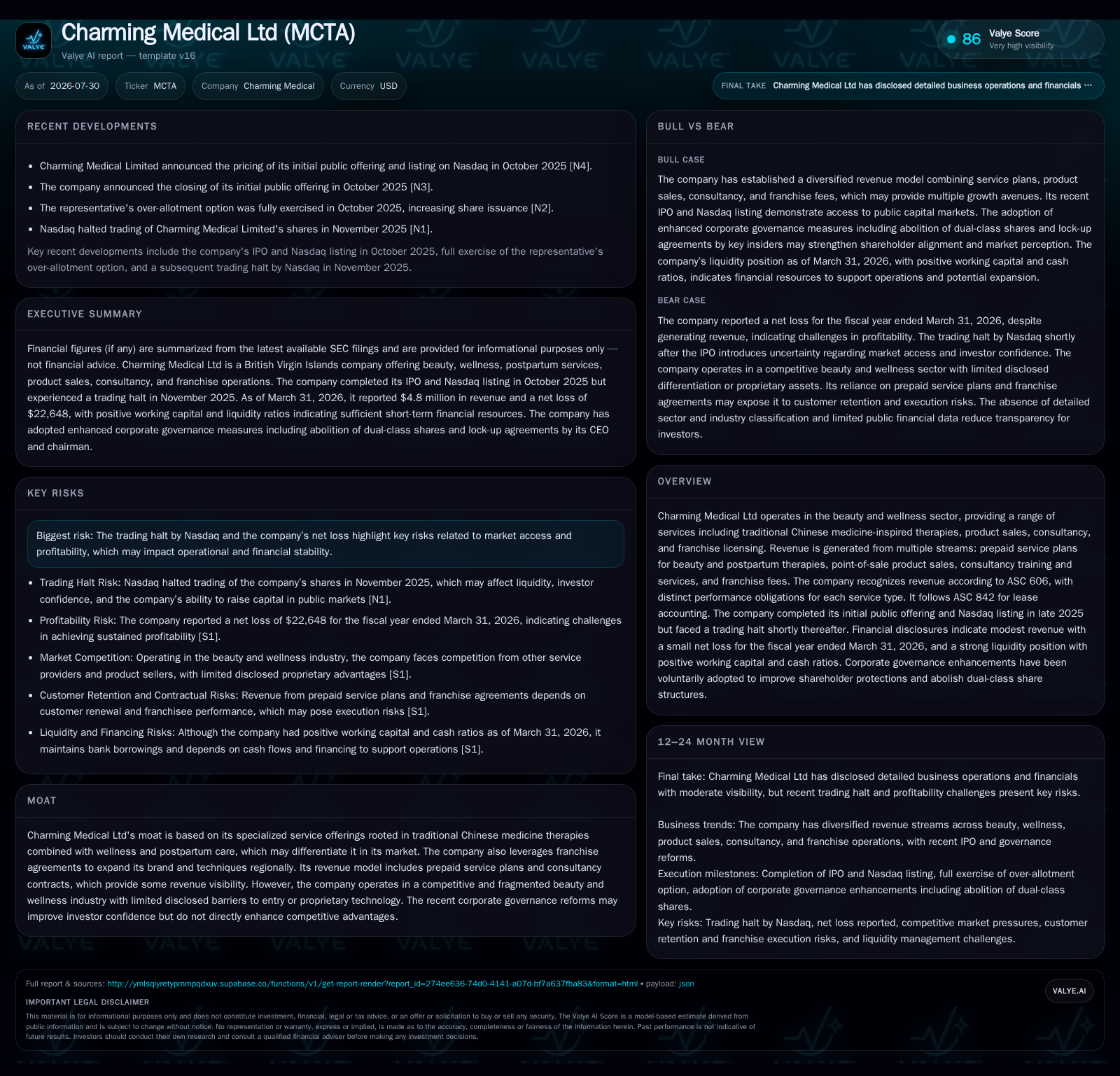
Charming Medical Ltd, a Hong Kong-based wellness services provider rooted in traditional Chinese medicine (TCM), initiated significant corporate governance reforms in July 2026, including abandoning foreign private issuer exemptions on Nasdaq rules and surrendering its dual-class share structure. These moves aim to enhance shareholder protections amid an ongoing trading suspension. Operationally, the company is cautiously scaling its franchise licensing channel and leveraging prepaid wellness service packages to improve revenue visibility. Profitability challenges persist due to fixed lease and staffing costs, while regulatory uncertainties and limited market access remain key concerns.
Nasdaq Governance Overhaul Tightens Compliance Burden at Charming Medical
In July 2026, Charming Medical Ltd implemented significant corporate governance reforms aimed at strengthening investor confidence during an ongoing trading suspension on Nasdaq. The Board voluntarily ceased reliance on foreign private issuer exemptions under Nasdaq Listing Rule 5615(a)(3), electing to comply fully with U.S. domestic issuer governance requirements covering board composition, proxy solicitation, and shareholder approvals [S2]. This shift indicates heightened regulatory scrutiny and a strategic commitment to transparency. Concurrently, CEO Kit Wong surrendered all Class B shares that previously conferred outsized voting power (20 votes per share), representing about 91% control post-IPO [S2]. This action removes prior voting concentration favoring insiders, promoting shareholder equality but eliminating protective governance features for controlling shareholders. Additionally, Ms. Wong agreed to a one-year lock-up restricting share disposals except under customary exceptions [S2]. These governance changes respond partly to challenges maintaining Nasdaq listing stability amidst suspended trading since November 2025.
Diverse Revenue Model Rooted in Traditional Chinese Medicine Wellness Services
Operating primarily through its "Beauty Lab" brand in Hong Kong, Charming Medical provides a range of traditional Chinese medicine (TCM)-inspired therapies combined with beauty and postpartum care services. These offerings emphasize holistic health principles focused on restoring internal balance via herbal formulations, acupuncture, and Tuina massage targeting predominantly women’s reproductive health but also male customers [S1]. The business model incorporates prepaid service plans enabling customers to purchase therapy packages upfront—offering cash flow visibility but obligating future service delivery governed by ASC 606 revenue recognition standards due to multiple performance obligations per contract [S1]. Additional revenue derives from product sales at points of care with distinct margin profiles. Consultancy services contribute modestly but have experienced post-pandemic demand fluctuations [S1]. Franchise licensing launched in March 2025 generates fees primarily for brand usage and promotional support rather than direct royalties initially; this segment accounted for roughly 0.8% of revenues in FY2025 ($46,708) [S1].
While the TCM heritage differentiates Charming Medical within a crowded wellness market dominated by spas and alternative clinics, the absence of extensive Western scientific validation introduces regulatory uncertainty that could affect growth prospects or consumer trust if unaddressed.
Early-Stage Franchise Licensing Provides Capital-Light Growth Pathway
Since initiating franchising in March 2025, Charming Medical has begun modestly expanding via licensing its brand and proprietary TCM techniques to third-party operators within designated territories. Despite representing under 1% of total revenues as of FY2025, this channel offers scalable growth without proportional increases in fixed costs like leases or staffing [S1]. Peer companies similarly leverage franchise fees as vital recurring revenue streams; success depends on effective franchisee recruitment, training quality (consultancy support), and brand standard enforcement across locations. Management’s shift from per-customer royalties to fixed monthly promotional fees as of March 2026 reflects a focus on stable recurring cash flows amid early development constraints [S23]. Given its current scale, franchising remains a strategic lever rather than an immediate profit driver.
Digital Marketing Drives Customer Acquisition While Supporting Retention
To sustain prepaid package revenues reliant on repeat usage and customer loyalty, Charming Medical invests heavily in digital marketing initiatives including search engine optimization (SEO), paid online advertisements via Google Ads and social media platforms, plus data-driven campaign optimization aimed at improving conversion efficiency [S1]. These efforts seek to elevate brand visibility within Hong Kong’s fragmented beauty and wellness sector where discretionary spending is recovering alongside tourism post-COVID-19 [S1]. Retention strategies emphasize continuous service improvement based on client feedback — critical given intense competition among alternative medicine providers. However, rising digital advertising costs risk compressing margins unless offset by increased package utilization rates or higher average spend per customer.
Operating Leverage Pressures Persist from Fixed Lease Commitments and Staffing Costs
The company’s operating model entails significant fixed-cost exposure primarily from leased wellness center premises accounted under ASC 842 lease standards requiring capitalization of right-of-use assets and recognition of lease liabilities on the balance sheet [S1],[S2]. Although management closed the Carnarvon Plaza location early to reduce footprint, remaining centers incur substantial rental expenses estimated above $550K annually alongside building management fees [S23]. These occupancy costs introduce operating leverage that can magnify earnings volatility as top-line fluctuates.
Staff compensation represents another major expense category exceeding $1.6 million or about one-third of total costs — consistent with industry norms where personalized therapy delivery demands skilled practitioners ensuring high-quality execution [S23]. Managing facility scale against occupancy cost burdens will be crucial; overexpansion risks margin erosion while limited presence could constrain new customer throughput.
Key Risks: Trading Suspension Impact, Regulatory Ambiguity on TCM Efficacy, Competitive Dynamics
Charming Medical faces pronounced risks including the prolonged Nasdaq trading suspension restricting capital market access and amplifying investor uncertainty [S2],[S21]. Regulatory ambiguity persists given limited Western clinical validation for TCM therapies underpinning core offerings; intensified scrutiny or negative publicity could impair reputation especially within tightly regulated Hong Kong or Mainland China health markets [S1].
Competitive pressure is strong from established spa operators, alternative medicine clinics, and emerging digital wellness platforms challenging both customer loyalty and acquisition efficiency. Franchisee compliance risk also threatens brand integrity if operational standards are not uniformly maintained.
Operationally, managing deferred obligations from prepaid service plans requires careful cash flow oversight to avoid liquidity strain during periods of slower appointment utilization.
What to Watch: Listing Status Resolution, Franchise Expansion Pace, Utilization Rates & Marketing ROI
Near-term performance indicators critical for evaluating execution progress include:
- Timing for resumption of Nasdaq trading affecting equity liquidity and investor sentiment [S2]
- Expansion velocity of franchise network beyond initial licensees reflecting scalability ambitions [S1]
- Trends in prepaid package utilization rates indicating actual demand fulfillment underpinning revenue stability [S15]
- Marketing return on investment measured by customer acquisition cost trends coupled with retention metrics showing sustainability amid rising digital ad expenses [S1] These KPIs will clarify whether operational momentum offsets structural governance challenges and market entry barriers.
Disclaimer: This report is for informational purposes only without any investment research view or advice. All analysis is based strictly on publicly available filings dated up to July 30, 2026.
Disclaimer: This is research-only, informational analysis and not investment advice. It may include AI-generated interpretation and general industry context. Always verify important details using primary sources.

Comments