
Grid Dynamics Advances AI-Led Growth with Strong Financial Health Boosting Digital Transformation Services
Grid Dynamics boosts strategic AI engagements in finance and retail, underpinned by cash-rich balance sheet and rising demand for digital transformation.
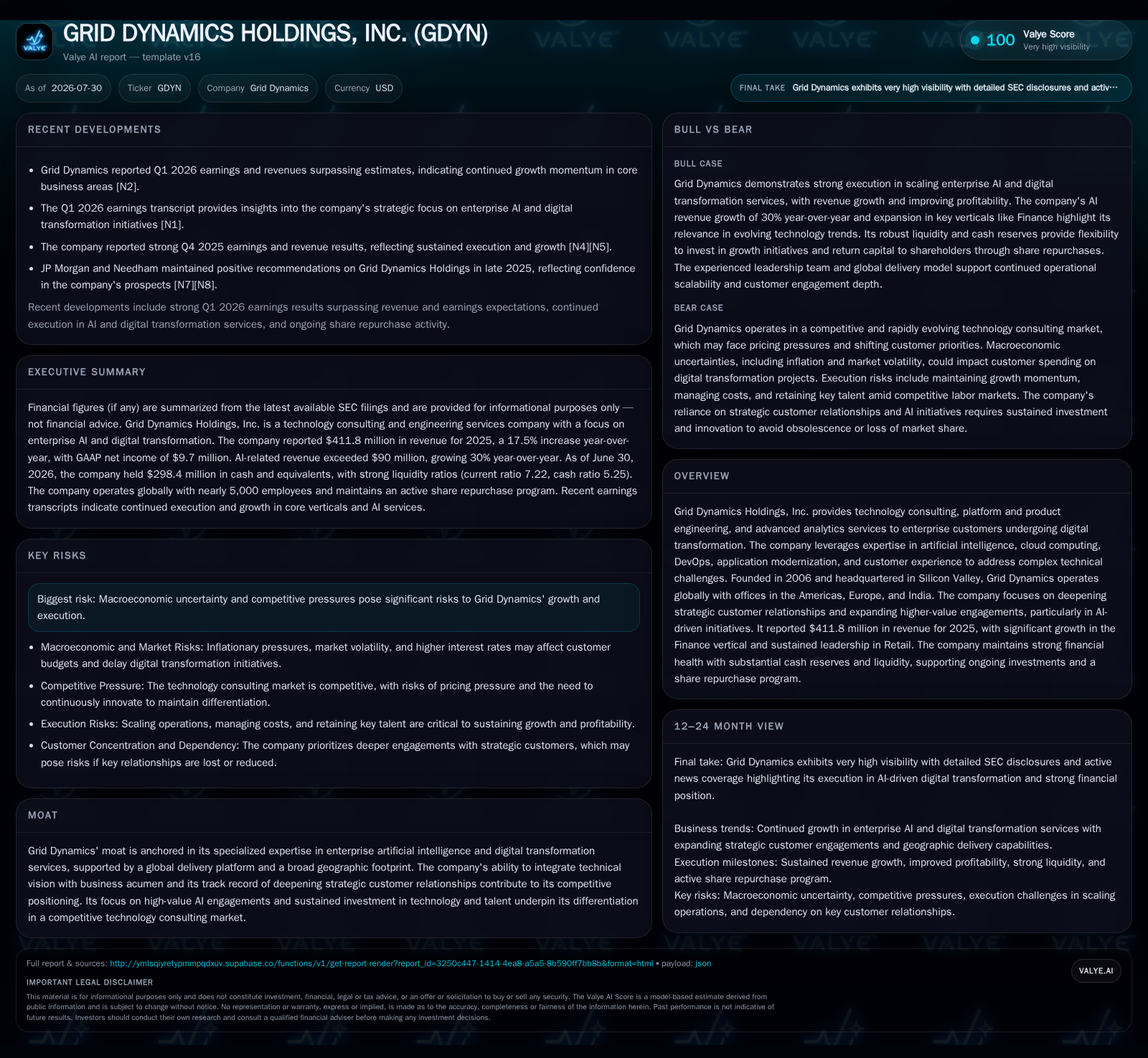
Grid Dynamics Holdings reported solid quarterly progress emphasizing AI-driven digital transformation services, especially in finance and retail verticals. The company’s business model leverages platform engineering, advanced analytics, and cloud expertise to capitalize on growing enterprise IT modernization trends. Sustained revenue growth alongside a strong cash position enhances flexibility amid competitive and macroeconomic pressures characteristic of the technology consulting industry.
Recent Operating Update
GRID DYNAMICS HOLDINGS, INC. (GDYN) disclosed its latest Q2 2026 results on July 30, showing sustained momentum in delivering AI-powered digital transformation services to enterprise clients navigating complex IT modernization efforts [S2][S3]. Building on record full-year revenues of $411.8 million in 2025—a notable 17.5% rise from the prior year—the company continues to enhance its positioning through strategic engagements that increasingly emphasize artificial intelligence applications.
The quarter reaffirmed the company’s strength in its core verticals of finance and retail. Finance achieved a remarkable growth rate of nearly 67%, bringing total revenue within the vertical to $100.4 million for 2025 while Retail sustained its role as the largest segment by revenue [S1]. This vertical focus illustrates Grid Dynamics' capability to tailor holistic technology consulting solutions customized to sector-specific demand drivers such as regulatory shifts and evolving customer experiences.
Critical to this trajectory has been Grid Dynamics’ ability to deepen AI-related workstreams—the firm reported generating over $90 million in AI revenues during 2025, rising 30% year-over-year [S1]. This growth highlights both market appetite for enterprise-scale AI adoption and Grid Dynamics’ competitive edge as an integrator blending advanced analytics with platform engineering expertise.
Business Model Specifics
Grid Dynamics operates predominantly through professional services contracts combining consulting fees with product and platform engineering engagements. Revenue generation is largely driven by billable hours from a global workforce skilled in AI, cloud computing, DevOps, and application modernization disciplines [S1]. The company emphasizes long-term customer relationships with multi-year contracts and recurring managed services that create sticky revenue streams.
The monetization mechanics revolve around deploying consultants across client projects globally—leveraging offshore and nearshore delivery centers primarily in India and Europe—to optimize utilization rates while controlling operational costs. These centers support complex project delivery timelines integral to digital transformation programs where adapting legacy systems to cloud-native architectures is vital.
Price realization benefits from Grid Dynamics’ differentiated AI capabilities that command premium contract values compared to pure-play technology staffing providers. Retention is fostered through strategic partnerships resulting in expanded scope within existing clients versus reliance on new client acquisition alone.
Industry Structure and Competitive Position
Grid Dynamics positions itself within the technology consulting and digital transformation ecosystem as a specialist focused on emergent technologies like enterprise AI and cloud migrations. Its operational scale—with approximately 4,961 employees as of end-2025—places it smaller than global IT consulting giants such as Accenture or Cognizant but larger than niche digital specialists [S1]
This scale enables sufficient geographic reach to serve multinational customers while maintaining agile delivery models responsive to fast-evolving technological landscapes. The firm competes on depth of technical expertise, particularly on AI-led product engineering versus peers more heavily weighted toward traditional IT outsourcing or software vendor consulting arms.
Margins hinge largely on project utilization rates given the labor-intensive nature of service delivery; thus talent acquisition/retention constitutes a critical competitive barrier. Organization-wide investments in technology skill sets alongside global delivery infrastructure underpin attrition management amidst fierce industry competition for qualified personnel.
Growth Drivers
Several secular trends propel Grid Dynamics’ growth prospects. First, enterprises' accelerating migration toward AI-infused processes creates demand for consulting partners capable of end-to-end solution development—from data strategy through algorithm deployment and integration with existing platforms.
Second is the broad-based cloud adoption imperative driving application modernization—a domain where Grid Dynamics combines DevOps frameworks with platform engineering to facilitate scalable system architectures suited for hybrid/multi-cloud environments.
Thirdly, the company’s strategic emphasis on penetrating high-growth verticals like Finance has unlocked outsized growth opportunities as these industries navigate regulatory compliance demands coupled with customer experience transformation needs [S1].
Also noteworthy is ongoing geographic diversification leveraging offshore teams allowing cost-competitive execution while mitigating regional economic or geopolitical risks affecting client spending cycles.
Finally, capitalizing on multi-year managed service contracts adds revenue predictability encouraging reinvestment into emerging technology capabilities such as edge computing integrations or IoT-connected solutions.
Risks and Growth Constraints
Despite robust momentum, Grid Dynamics confronts several risks prevalent among technology consulting entities. Competitive intensity remains high; numerous rivals ranging from massive global consultancies to nimble local specialists exert pressure on pricing bands potentially compressing margins over time.
Talent scarcity poses continuous challenges—retaining skilled engineers versed in cutting-edge technologies requires sustained investment in compensation packages and career development which can inflate costs disproportionally if attrition rises unexpectedly.
Additionally, macroeconomic volatility shapes client budgets; downturns or delayed decision-making cycles may temporarily reduce project volume or slow new contract ramp-ups impacting short-term revenue visibility [S2]
Contract concentration risk also merits watching—as sizeable accounts dominate business mix, loss or downsizing from key customers could materially affect financial results.
Execution complexity inherent to large-scale digital transformations implies risks around project overruns or failure to attain business outcomes desired by clients which could impair repeat business potential.
Lastly, regulatory considerations including data privacy laws add layers of compliance obligations requiring technological safeguards that can divert resources away from growth initiatives.
What to Watch Next
Upcoming performance metrics worth tracking include billable utilization rates which directly correlate with profitability given labor cost structures; any sustained declines would signal margin pressure.
Contract backlog length—especially across finance and retail segments—offers leading insight into future revenue trajectories reflecting booking activity and pipeline health. The quality of new client acquisitions alongside upsell within existing accounts will illuminate success at expanding account footprints.
In terms of capital allocation execution, continued monitoring of share repurchase activity—the Board authorized up to $50 million program initiated October 2025—is pertinent to understanding return of capital priorities vs reinvestment needs [S2][S8]
Moreover, management commentary regarding adjustments to delivery footprint or tools aimed at improving operational efficiency could provide clues about margin expansion potential amid inflating wage costs.
Financial Profile Discussion
At June 30, 2026, Grid Dynamics reported a robust liquidity position with cash & equivalents totaling approximately $298 million against modest current liabilities near $57 million yielding an exceptionally strong current ratio above 7x [F1]. This ample liquidity supports strategic optionality including investment capacity for talent acquisition or technology innovation without reliance on debt financing.
Total debt is minimal relative to cash reserves—recorded at approximately $4.8 million last verified at March 2022—indicating conservative leverage usage preserving financial flexibility [F1]
While operating income remains pressured due principally to reinvestments supporting growth phases ($-1.9 million operating loss noted at FY end 2025), rising GAAP net income ($9.7 million in 2025) combined with positive operating cash flow ($40.6 million) evidences improving profit conversion as scale advantages take hold [F1][S1]
Maintaining this balance between growth investments and profitability will remain key given sector norms that reward sustainably profitable scaling alongside technology leadership.
This analysis is based solely on publicly available SEC filings including recent quarterly reports (10-Q), annual amendments (10-K/A), event filings (8-K), and associated company disclosures as of July 30, 2026 [F1]. Interpretation integrates standard industry research frameworks relevant to technology consulting firms specializing in digital transformation services but does not constitute investment advice or research views.
Disclaimer: This is research-only, informational analysis and not investment advice. It may include AI-generated interpretation and general industry context. Always verify important details using primary sources.

Comments