
Dror Ortho-Design’s AI-Driven Smart Aligner Faces Liquidity Challenges in Early Commercialization Phase
Dror Ortho-Design’s ZSmile platform offers a novel nighttime orthodontic treatment leveraging AI and IoT, but the company confronts urgent capital constraints amid initial market entry.
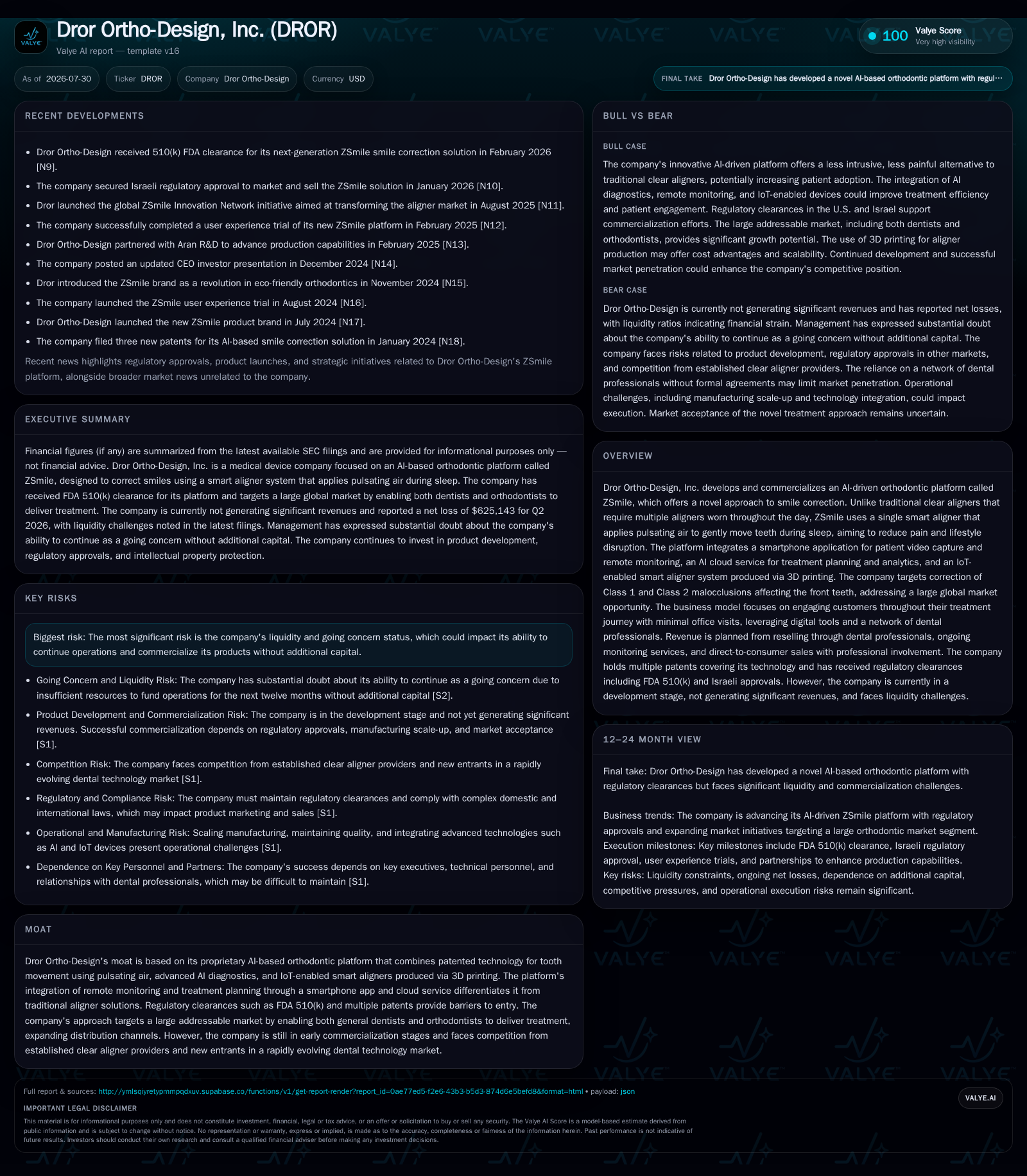
Dror Ortho-Design is advancing an innovative orthodontic treatment platform, ZSmile, which combines AI-driven treatment planning, a single smart aligner worn during sleep using patented pulsating air technology, and remote monitoring to address patient pain and lifestyle disruption challenges inherent in traditional clear aligners. Despite securing FDA 510(k) clearance and key patent protections, the company remains in early commercialization with limited revenue and faces critical liquidity issues highlighted by a cash balance of under $25,000 as of June 2026 and high quarterly cash burn. Success depends on expanding dental professional partnerships, scaling patient adoption, navigating regulatory complexities, and securing additional financing to sustain operations against intense competition from established clear aligner manufacturers.
Recent Operating Update
In its latest quarterly filing dated July 30, 2026, Dror Ortho-Design disclosed acute liquidity pressures that cast significant uncertainty over its near-term operational viability [S2]. The company reported operational cash outflows of approximately $404,000 during Q2 2026 ending June 30th while holding a dangerously low cash balance of just $23,802 at quarter-end [S2]. This depletion underscores the urgency for substantial new capital infusions. Concurrently, the balance sheet reveals current liabilities exceeding current assets by nearly twelvefold (approximately $4.1 million vs. $348 thousand), yielding a critically weak current ratio of about 0.08 [F1]. Management explicitly states substantial doubt about continuing as a going concern absent successful fundraising [S2]. These financial stress markers highlight elevated execution risk during commercial launch.
Business Model Overview
Dror Ortho-Design targets disruption of the clear aligner orthodontics market through its proprietary ZSmile platform that reimagines treatment mechanics and delivery. Diverging from incumbent solutions requiring patients to wear a series of plastic aligners nearly all day causing pain and lifestyle disruptions (e.g., Align Technology’s Invisalign), ZSmile employs a single smart aligner worn exclusively at night which uses pulsating air pressure to encourage tooth movement while preserving gum blood flow [S1]. This approach aims to lessen discomfort and improve patient adherence by eliminating daytime device wear.
The platform comprises three integrated components: an AI-enabled cloud system for precise individualized treatment planning; a smartphone app allowing patients to submit video scans for remote orthodontist monitoring; and an IoT-connected smart aligner produced via FDA-compliant 3D printing processes [S1], [S25]. This digital health-medical device hybrid reduces dependence on frequent in-office visits while maintaining clinical oversight remotely.
Revenue generation is anchored on direct sales of the smart aligner devices coupled with recurring fees tied to digital service subscriptions or treatment management software licenses [S1]. Distribution leverages partnerships with both orthodontists and general dentists aiming for broader adoption beyond specialist clinics. Marketing strategies emphasize viral social media campaigns promoting ease-of-use and minimal lifestyle interference to stimulate consumer demand alongside provider engagement
Industry Structure and Competitive Positioning
The digital orthodontic medical devices sector has evolved rapidly around innovations combining material science (clear aligners) with software-enabled treatment planning and virtual monitoring technologies. Market leaders like Align Technology dominate due to scale manufacturing capabilities, entrenched dental professional networks, strong brand equity, and extensive clinical data supporting efficacy. Direct-to-consumer entrants further intensify competitive pricing pressure.
Dror Ortho-Design occupies a specialized niche by offering patented pulsating air biomechanical technology within its smart aligner—a modality distinct from traditional mechanical force systems used by competitors [S1], [S25]. Regulatory credentials are solidified through FDA Class II clearance via the stringent 510(k) pathway along with patent protection extending through 2040 that barriers rapid replication [S17], [S25].
However, early-stage commercialization challenges persist including limited manufacturing scale despite outsourcing to ISO-certified cleanroom facilities; relatively low active treatment case counts; nascent brand awareness; intense competition for dental professional prescriptions; and high customer acquisition costs driven by required consumer education on this novel mechanism.
Growth Drivers
Key growth catalysts include rising consumer demand globally for less invasive orthodontic therapies tailored for adult patients seeking aesthetic improvements without lifestyle interruption. The preference shift towards nighttime-only wearable devices aligns well with ZSmile’s modality.
Technological advancements in AI facilitate highly personalized treatment plans improving outcomes potentially enhancing patient satisfaction and adherence—critical drivers affecting revenue per enrolled user. Telehealth acceptance accelerates adoption of remote monitoring features lowering provider burden.
Additive manufacturing improvements reduce unit costs while enhancing customization speed essential in orthodontics. Regulatory approvals expanding access across major markets such as the U.S., EU, Canada, Israel, and UK present incremental volume opportunities once obtained [S1]. Additionally, leveraging viral social media marketing campaigns can lower customer acquisition costs by harnessing authentic user testimonials advocating less painful correction during sleep.
Risks and Constraints
The paramount risk is financial sustainability given severely restricted cash reserves post-Q2 2026 coupled with ongoing high operational burn rates without secured funding commitments [S2], [F1]. Failure to raise capital imminently may necessitate operational downsizing or cessation.
Execution risks include attaining sufficient penetration among dental professionals who currently favor established clear aligner brands supported by extensive salesforces and clinical validation data. Regulatory compliance challenges encompass adherence to complex healthcare fraud statutes (e.g., Anti-Kickback laws), stringent data privacy regulations (HIPAA in U.S., GDPR in Europe), and advertising constraints impacting digital marketing efforts pivotal to growth [S3], [S21], [S22]. Non-compliance could result in costly penalties or reputational damage impeding commercial progress.
Technological obsolescence is a persistent threat amid rapid innovation cycles within digital orthodontics where emergent treatment modalities might outpace existing patented methods. Patient adherence remains an open question; although nighttime-only use mitigates daytime inconvenience barriers common to traditional aligners, sustained behavioral compliance will ultimately determine clinical success translating into steady revenue streams.
Geopolitical instability in Israel—home base for R&D and manufacturing—adds operational unpredictability affecting workforce availability or supply chain continuity during conflict periods ongoing since late 2023 [S1], [S6].
What To Watch Next
Investors should monitor detailed commercial execution indicators including monthly/quarterly active patient counts undergoing treatment; rate of new dental professional partnerships established; user engagement metrics from the digital platform signaling adherence levels; quarterly cash burn relative to financing milestones; regulatory progress especially regarding next-generation ZSmile product submissions awaiting FDA clearance; and effectiveness of social media marketing campaigns driving pipeline development.
Given repeated auditor concerns highlighting going concern doubts since late 2025 reporting periods [S1], successful equity or debt financings will be crucial for stabilizing funding uncertainty allowing continued R&D investments (~$1 million annually planned) toward product enhancements outlined in recent disclosures [S28]. Failure here risks severe cost-cutting measures eroding competitive positioning.
Financial Profile Discussion
Dror Ortho-Design remains at an embryonic commercialization stage typified by minimal reported revenues ($2,568 most recently documented) juxtaposed against recurring net losses surpassing $2.5 million annually reflecting high R&D intensity prioritizing technical validation over near-term profitability [F1]
Balance sheet metrics reveal critical liquidity strain with current assets around $348 thousand dwarfed by current liabilities exceeding $4 million as of mid-2026 producing an alarmingly low current ratio near 0.08 indicative of disproportionate short-term obligations relative to available liquid resources [F1]. Management acknowledges urgent need for capital raises but cautions no assurance exists regarding favorable terms or successful fundraising efforts [S2], [S11], heightening insolvency risk absent transformative commercial inflection.
Overall financials highlight foundational technological achievements overshadowed by operational viability challenges demanding tactical financing alongside accelerated marketing execution if Dror is to establish sustainable footholds within competitive digital orthodontics markets.
This analysis reflects information solely derived from publicly filed SEC documents through July 2026 without forward-looking investment research views. All financial figures are cited directly from audited or unaudited filings or official disclosures. Readers should weigh early-stage technology commercialization risks combined with sector-specific regulatory complexities when assessing Dror Ortho-Design's evolving business prospects.
Disclaimer: This is research-only, informational analysis and not investment advice. It may include AI-generated interpretation and general industry context. Always verify important details using primary sources.

Comments