
BioNTech’s Pipeline Evolution and Market Recalibration After Latest EU COVID-19 Vaccine Authorization
Following European Commission authorization for the XFG-adapted COVID-19 vaccine, BioNTech balances ongoing COVID revenue streams with strategic oncology collaborations and operational refinements.
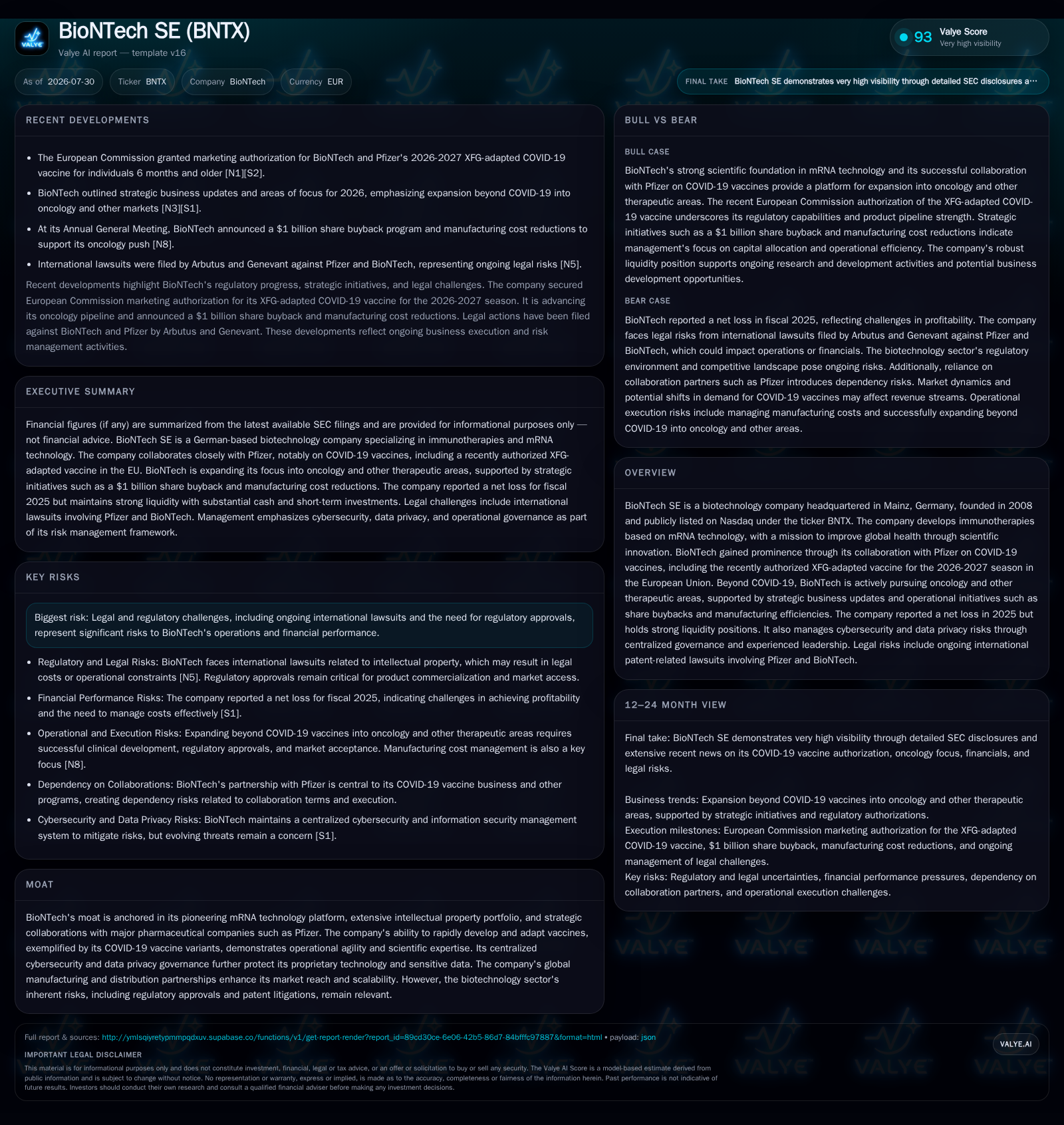
In July 2026, BioNTech secured European marketing authorization for its updated COVID-19 vaccine targeting the XFG variant, sustaining its mRNA platform's market presence amidst evolving viral strains. Despite declining COVID vaccine revenues reflecting lower global demand, the company leverages its strategic partnership with Pfizer for commercialization and a landmark alliance with Bristol Myers Squibb (BMS) in oncology to diversify revenue streams. Operational initiatives include a $1 billion share buyback program signaling confidence in long-term value creation while managing net losses through active R&D portfolio management and cost discipline. Manufacturing scale and clinical pipeline momentum, particularly in bispecific antibodies for immuno-oncology, underpin growth prospects, although regulatory hurdles and legal risks remain material constraints.
EU Marketing Authorization of the XFG Variant Vaccine: Validation of mRNA Platform Agility
BioNTech’s July 29, 2026 filing confirmed the European Commission's approval of its updated COVID-19 vaccine targeting the XFG variant for active immunization in individuals aged six months and older [S2]. This regulatory milestone underscores BioNTech’s capability to rapidly pivot its mRNA technology in response to emerging viral mutations—a critical competency that sustains product relevance and supports recurring revenue from seasonal booster programs across the EU [N3]. The authorization reinforces key biotech KPIs such as regulatory approval velocity and time-to-market efficiency, essential for maintaining competitive positioning amid evolving epidemiological landscapes.
Collaboration Revenue Engines: Pfizer Partnership Stability vs. Growing BMS Oncology Stakes
Concurrently, BioNTech expanded into immuno-oncology through a landmark global co-development and co-commercialization agreement with Bristol Myers Squibb (BMS) announced mid-2025 focused on pumitamig (BNT327/BMS986545), a next-generation bispecific antibody candidate targeting multiple solid tumors [S5]. This partnership entails equal sharing of development and manufacturing costs alongside profit/loss distributions. The upfront payment of $1.5 billion (€~1.38 billion) received in 2025, complemented by potential anniversary payments totaling $2 billion plus up to $7.6 billion in contingent milestones, provides a significant non-product sales revenue buffer against pandemic-related cyclicality.
Clinical Pipeline Momentum Beyond COVID: Bispecific Antibodies and Immunotherapy Potential
BioNTech is systematically advancing its clinical pipeline beyond infectious diseases into immunotherapies leveraging mRNA technology alongside novel biologics such as bispecific antibodies and antibody-drug conjugates (ADCs). Research & Development expenses decreased modestly by roughly 7% to €2.105 billion in 2025 due primarily to portfolio prioritization efforts and cost-sharing with collaborators like BMS, partially offset by accelerated late-stage trial activity particularly in oncology indications [S4][S12]
These clinical programs form vital KPIs indicating future commercial potential given the inherently long biotech development cycles. Upcoming data disclosures at ASCO 2026 will be pivotal for validating clinical efficacy and supporting subsequent regulatory filings, which are critical inflection points for revenue recognition tied to milestone payments under collaboration agreements [S24]. This balanced approach between disciplined R&D investment and pipeline progression reflects sound operational management within a high-risk innovation environment.
Manufacturing Scalability and Operational Efficiencies: Capacity Utilization Amid Demand Shifts
Manufacturing capacity utilization remains a key operational dimension as BioNTech navigates fluctuating demand between episodic COVID-19 vaccine surges and steady-state production needs for diversified therapeutics [S1]. The company leverages partnerships with contract manufacturing organizations (CMOs) enabling scalable biologics production without proportionate fixed asset burdens while maintaining supply chain resilience vital for cold-chain dependent mRNA products
Inventory write-downs increased due to revised commercial forecasts reflecting lower COVID vaccine volumes; however, impairments primarily relate to portfolio reprioritizations rather than structural supply constraints [S4][S12]. Gross margin sensitivity typical of biotech firms underscores the importance of optimizing production scale economies amid variable output demands.
Capital Returns amid Strategic Transition: Share Buyback Initiatives Reflect Confidence
On June 8, 2026, BioNTech launched a share repurchase program authorizing up to $1 billion in American Depositary Shares (ADS) purchases through May 2027 on Nasdaq markets [S3]. This initiative signals management’s confidence balancing shareholder return priorities against ongoing investment needs.
Risks on Horizon: Regulatory Challenges, Litigation Exposure, and Market Demand Variance
BioNTech faces material risks including ongoing international litigation primarily concerning intellectual property rights that have led to substantial operating expense impacts from settlements or provisions [S4][S8][N5]. Such legal exposures are common within biotech sectors reliant on proprietary technology platforms.
Regulatory risk persists given uncertainties around clinical trial outcomes, changing government policies post-pandemic vaccination campaigns, and dependency on key collaborators—particularly Pfizer for vaccine commercialization—which creates concentration risk despite diversification efforts.
Cybersecurity governance has been centralized under experienced leadership aligned with pharmaceutical IT risk management best practices, mitigating threats related to data privacy breaches that could jeopardize proprietary mRNA platform integrity—an essential competitive moat [S1].
Growth Catalysts: mRNA Platform Expansion, New Indications, Global Demand, and Collaborations
Looking ahead, BioNTech's growth drivers include continuous innovation within its mRNA platform extending beyond infectious disease vaccines into immuno-oncology—a sector estimated at over $500 billion globally according to analyst commentary [N4]. Regulatory approvals adapting vaccines rapidly to emerging SARS-CoV-2 variants like XFG sustain recurring revenue streams.
Clinical trial progressions especially in bispecific antibodies offer milestone-driven revenue potential under collaboration contracts while manufacturing scale-up aims to meet rising demand across diverse therapeutic areas. Strategic licensing deals further bolster non-product sales income enhancing financial resilience.
What Investors Should Watch Next: Regulatory Milestones, Sales Trajectory, and Pipeline Development
Key near-term catalysts include expanded regional regulatory filings for XFG or future variant vaccines beyond Europe; quarterly updates on COVID-19 vaccine sales reflecting epidemiological trends; and pivotal clinical trial readouts from pumitamig and other oncology candidates likely triggering milestone payments under BMS collaboration terms [S2][S5]. Monitoring R&D expenditure patterns relative to pipeline advancement will provide insight into sustained innovation productivity balanced against cost discipline.
Financial Profile Discussion: Cash Liquidity Supports R&D Investment Despite Reported Losses
This financial position underpins continued commitment to late-stage clinical investments while enabling measured capital returns through share repurchases consistent with balanced financial stewardship expected from leading biotech innovators navigating high upfront costs against promising long-term commercial opportunities.
This analysis integrates BioNTech's latest quarterly disclosures anchored on July 2026 marketing authorization news alongside annual filing context covering financials, collaborations, manufacturing strategy, pipeline advances, risk factors, and capital allocation initiatives documented herein. The company's trajectory hinges on evolving its mRNA technology platform through partnerships that mitigate cyclical COVID vaccine declines while accelerating durable immunotherapy franchises.
Disclaimer: This is research-only, informational analysis and not investment advice. It may include AI-generated interpretation and general industry context. Always verify important details using primary sources.

Comments