
Deswell Industries’ Margin Resilience and Customer Concentration Amid Raw Material Inflation
Deswell reports steady margins and dividend payouts despite revenue headwinds and cost pressures in fiscal 2026.
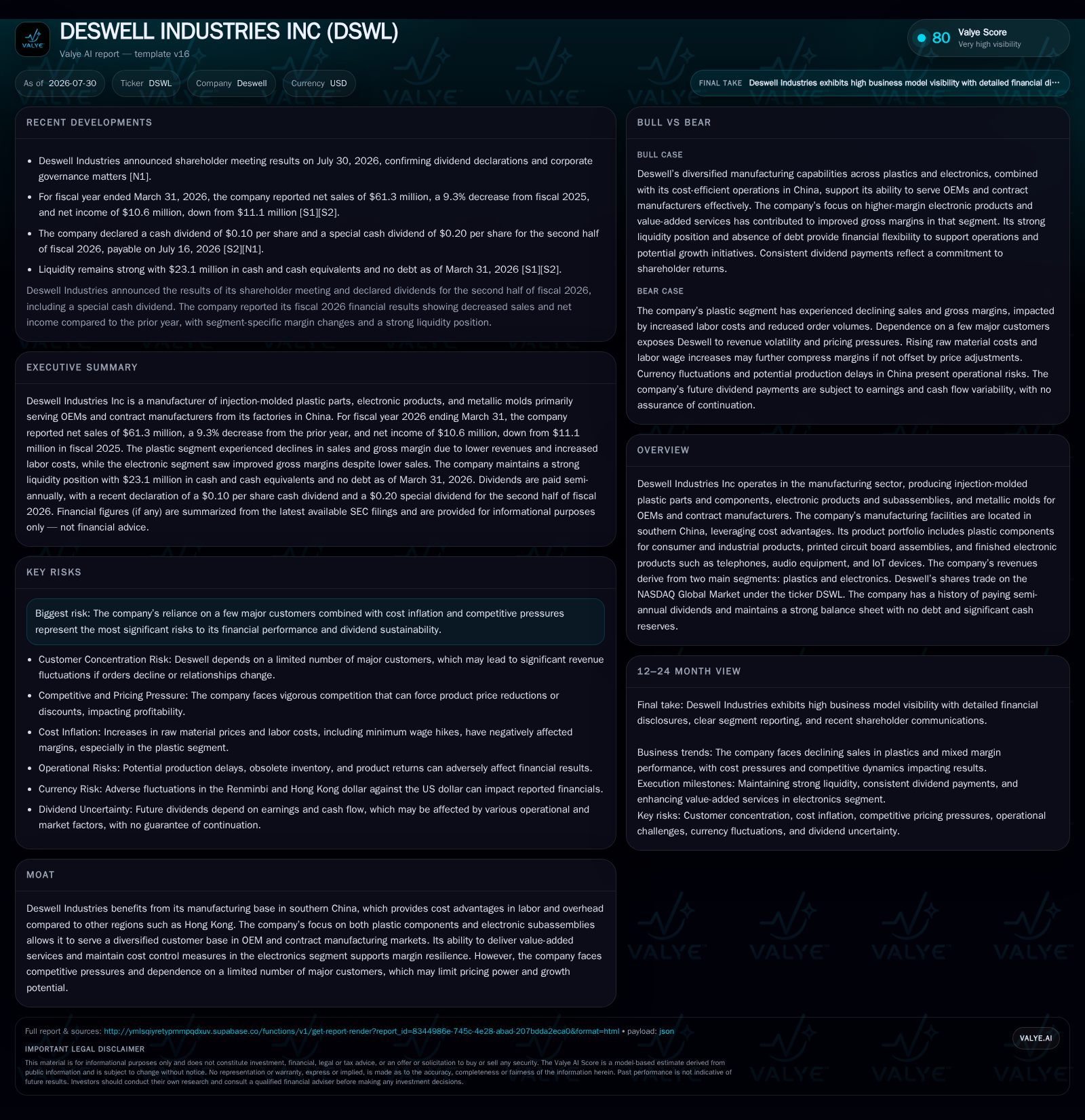
Deswell Industries Inc (DSWL) filed its fiscal 2026 annual report reaffirming a solid financial position with no debt and over $23 million in cash. The company’s revenues declined due to softer demand across its plastics and electronics segments, impacted by inflation-driven higher labor costs and raw material prices, particularly tied to AI industry demand. However, improved operational cost controls and enhanced value-added services contributed to margin stability and profit retention. Deswell continues paying semi-annual dividends with a special dividend declared for fiscal 2026’s second half, reflecting disciplined capital allocation despite industry headwinds. Customer concentration risk and inflationary pressures remain primary watchpoints.
Recent Operating Update
Gross margins remained relatively stable at about 21.1% for the second half of fiscal year 2026 and roughly unchanged full-year around that level versus last year’s subdued rates, signaling some resilience despite top-line contractions [S3]. Electronics segment margins improved notably from ~20.6% to above 22%, reflecting successful deployment of value-added services—likely design support and assembly efficiencies—and rigorous cost control over raw materials driven by tighter supplier collaboration and labor optimization measures [S3][S9]. In contrast, the plastics business suffered margin compression linked to increased minimum wage-driven labor costs and lower production volumes which hampered absorption of fixed overheads [S3][S15].
Operating expenses were well managed with a notable decrease in SG&A within the plastics division by nearly $700,000 despite overall inflation pressures on input costs indicating operational discipline during adversity [S3]. Nonetheless, total operating income fell from prior periods down to $2 million for the fiscal year ending March 2026 compared with $3.3 million last year reflective of volume declines [F1][S3]. Reported net income was marked at approximately $10.6 million after factoring non-operating items such as realized gains on marketable securities sales and interest income from short-term investments — highlights that the company leverages its cash reserves effectively despite less robust core business profitability this cycle [F1][S3].
Business Model Analysis
Deswell’s operations center on manufacturing injection-molded plastic components, printed circuit board assemblies (PCBA) employing surface mount technology (SMT), electronic subassemblies including finished consumer electronic devices such as telephones and professional audio equipment, alongside metallic molds primarily serving original equipment manufacturers (OEMs) and contract manufacturers within industrial hardware sectors [S1][S5][N1]. With factories located in southern China, the company benefits from a labor cost advantage relative to more expensive regions — an essential competitive edge given the volume-driven nature of its B2B contracts which often operate with fixed or cost-plus pricing frameworks common among component suppliers [S1][N1].
Revenue is driven largely by sales volume and pricing within these two segments: plastics comprising molded parts used in industrial tools or consumer products; electronics encompassing PCBA subassemblies plus final IoT-related products [S1][S5]. This dual-segment structure offers some diversification though customer concentration risk remains—a few major OEM customers account for substantial portions of orders heightening sensitivity to their capital expenditures or inventory adjustments typical in cyclical electronics markets [S1][S5].
Margins depend strongly on raw material input costs (e.g., resins for plastics), labor efficiency gains via automation or process improvements, product mix shifts towards higher-margin electronics offerings with more complex value-added assembly services, and internal SG&A expense control — all key levers for profit retention given inherent price competition seen throughout contract manufacturing ecosystems [S3][N1][F1]. Capacity utilization rates directly influence fixed cost absorption; management has emphasized cost reduction initiatives as offsets against inflationary pressures which appear partially effective given margin trends despite unit volume declines [S3][N1].
Industry Structure and Competitive Position
Operating within the industrial hardware manufacturing sector primarily focused on OEM components supply places Deswell among peers like Flex Ltd., Jabil Inc., or similar Asian-based injection molding firms that also integrate SMT PCBA services into their contract manufacturing portfolios. Competition is intense stemming from commoditized plastic part production combined with growing demand for integrated electronic assemblies necessitating sophisticated supply chain management capabilities.
The geographic footprint in southern China continues furnishing Deswell with important labor-cost arbitrage advantages critical against competitors less entrenched regionally or forced to operate at higher wage scales. Such positioning supports margin resilience during cyclical downturns but also exposes it to geopolitical risks or potential tariff impacts felt by offshore manufacturing setups.
Deswell counters competitive pricing pressure via incremental differentiation through value-added services such as enhanced product design collaboration—illustrated by CEO commentary highlighting innovation pipelines supporting superior product introductions—and continuous raw material procurement efficiencies that mitigate input inflation related risks triggered recently by strong AI industry component demand driving global resin prices upward [S3][N1]. However, customer concentration limits leverage over pricing negotiations while elevated minimum wage increases strain its plastics segment profitability more acutely relative to higher-margin electronics subassemblies.
Growth Drivers
Key growth vectors reside in macro trends favoring outsourcing by OEMs towards contract manufacturers offering integrated solutions combining plastic injection molding with increasingly sophisticated PCBA assembly capabilities—particularly vital amid rising IoT device adoption requiring miniaturized yet highly reliable electronics components. Deswell’s ongoing efforts enhancing design support services positions it well for securing longer-term partnerships potentially expanding share within existing customer bases or new niches related to smart consumer devices.
Simultaneously, geographic cost differentials sustained by Chinese manufacturing hubs continue attracting global OEM sourcing activities despite gradual wage inflation offset somewhat by productivity advances. Continued investments in internal process improvements aimed at reducing unit labor costs underpin medium-term margin improvement potential even if absolute sales volumes fluctuate.
The burgeoning AI sector’s surge in component demand simultaneously drives raw material price volatility posing margin pressure risks balanced by Deswell’s demonstrated ability thus far to impose internal cost controls preserving gross profitability levels.
Risks & Constraints
Primary risks center prominently on the high customer concentration narrowing bargaining power exposing revenue streams to order cyclicality or cancellations which could materially impact operating leverage due to fixed manufacturing overhead commitments.[S1] Labor cost inflation particularly minimum wage hikes directly compressed plastic segment margins during fiscal 2026 revealing sensitivity absent immediate price pass-through capability.[S3]
Raw material price volatility remains a persistent headwind enhanced recently by international energy price shocks related to geopolitical conflicts affecting resin supply chains critical for injection molding inputs. Failure to continue mitigating these inflationary pressures internally could erode reported margin gains further.
Supply chain disruptions caused by geopolitical tensions or global logistics bottlenecks present execution risks potentially delaying deliveries impacting customer satisfaction critical within B2B OEM contracts requiring just-in-time manufacturing reliability.
The company also flagged operational control deficiencies relating to internal IT general controls impairing full assurance over financial reporting integrity; though no material misstatements have been detected so far this constitutes an ongoing remediation focus area.[S1][S17]
Lastly, macroeconomic uncertainties including uneven domestic recoveries post-pandemic affecting end-market consumer spending underpin top-line instability limiting immediate growth visibility.
What To Watch Next
Investors should monitor upcoming quarterly filings for revenue trajectory signals particularly order backlog developments within both plastics and electronics segments which will clarify whether recent volume declines represent transitory economic factors or structural shifts [N1]
Margin progression indicators such as gross margin percentages alongside SG&A expenditure trends will evidence the success of ongoing internal cost improvement programs amidst raw material inflation.
Any updates on remediation progress regarding internal control material weaknesses will be critical for assessing reliability of future financial disclosures.[S17]
Management commentary on capital allocation—especially continuity of semi-annual dividends including special dividends that signal cash flow sufficiency—and potential reinvestment plans into automated production capacity or new product development should be scrutinized closely [S16]
Tracking competitor margin swings among regional contract manufacturers might provide relative efficiency benchmarks contextualizing Deswell’s performance.
Financial Profile Discussion
Overall net income of $10.6 million coupled with controlled SG&A ratios illustrates profitable operations buffered partially by non-operating investment gains yielding a healthy albeit slightly reduced EPS near $0.67 compared to prior years given top-line softness consistent with cyclical OEM demand environments prevalent in industrial hardware manufacturing sectors [F1][S3]
This analysis synthesizes publicly filed financial data and operating disclosures without offering investment advice or forecasts. It contextualizes Deswell Industries’ recent performance within sector-specific economics emphasizing operational challenges amid inflation-linked cost headwinds alongside strategic advantages rooted in geographic location and diversified product mix.
Disclaimer: This is research-only, informational analysis and not investment advice. It may include AI-generated interpretation and general industry context. Always verify important details using primary sources.

Comments