
Middlesex Water’s Capital Stretch and Regulatory Fortification Define Its Growth Path
Q2 2026 filings highlight Middlesex Water’s recent regulatory approvals and capital investments, underscoring its strategic focus on infrastructure modernization and PFAS compliance.
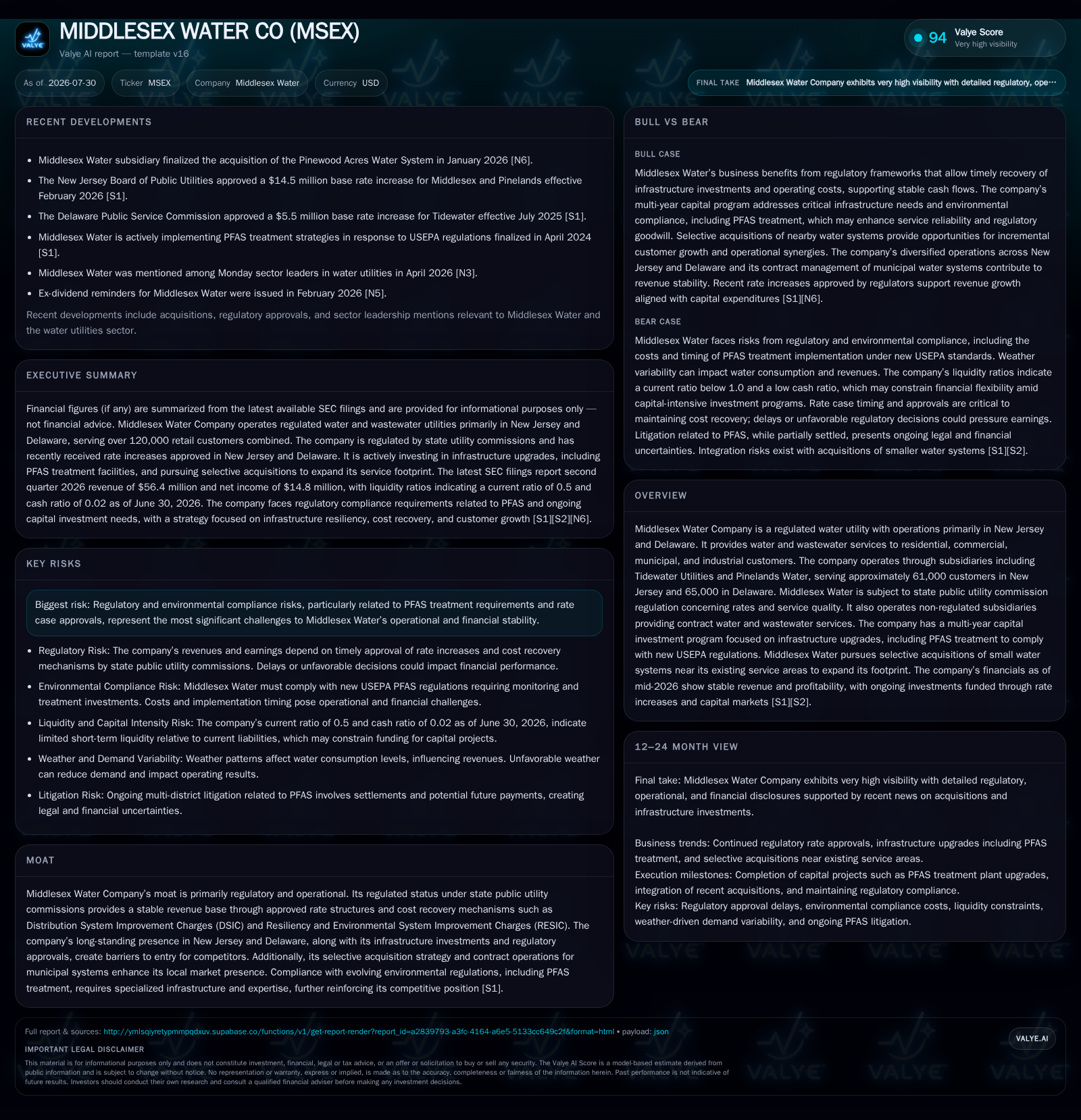
Middlesex Water Company’s latest quarterly update reveals a pivotal expansion in its regulatory-approved cost recovery tools and reinforces its multi-year capital investment program, primarily driven by environmental compliance challenges such as PFAS treatment. Operating across New Jersey and Delaware, Middlesex maintains a sizable regulated customer base supported by both traditional utility revenues and ancillary contract operations. While its regulatory moat remains strong with recently granted base rate increases and DSIC/RESIC surcharges, the company faces operational risks tied to regulatory delays and evolving environmental standards. Ongoing acquisitions of smaller utilities and contract service expansions complement growth prospects amid modest demand growth.
Regulatory Approvals Expand Cost Recovery Tools in Q2 Update
Middlesex Water's Q2 2026 filing reports key regulatory milestones cementing its revenue stability under a tightly controlled rate regime. The New Jersey Board of Public Utilities (NJBPU) authorized $14.5 million of base rate increases effective February 23, 2026, covering both Middlesex and its recently merged Pinelands subsidiary [S1]. Beyond base rates, foundational approvals for Distribution System Improvement Charges (DSIC) and Resiliency and Environmental System Improvement Charges (RESIC) were also granted. These surcharges enable Middlesex to recover discrete capital investments in distribution infrastructure and resiliency projects without waiting for full rate cases, reducing lag risks common in regulated utilities [S1].
These regulatory tools are critical in a capital-intensive sector where continual upgrades are mandated by degradation of aging pipelines and evolving environmental mandates. Securing these mechanisms ahead of significant expenditures effectively de-risks Middlesex's multi-year growth plans by assuring steady cash flow streams [S1]. Additionally, the company's participation and settlements in the PFAS-related multi-district litigation (MDL), which has secured recoveries from manufacturers like 3M slated for customer refunding, strengthen its regulatory standing by presenting proactive legal risk management aligned with state commission expectations
For context, such DSIC/RESIC programs are industry-standard ratemaking accelerators found among leading regulated peers like American Water Works or Aqua America. Middlesex's effective navigation of these approvals places it competitively within this cohort regarding regulatory recoupment frameworks.
Recovering Costs Through Strategic Capital Investments: PFAS Compliance Focus
Middlesex has articulated a substantial capital expenditure (CapEx) roadmap totaling approximately $506 million for 2026-2028 to modernize infrastructure dominated by water main replacements and production system upgrades including advanced PFAS treatment technology installations at the CJO treatment plant ($36M-119M annually across three years) [S1][S2][S22]. This outlay is necessary to comply not only with updated USEPA maximum contaminant levels (MCLs) set forth in April 2024 for PFAS compounds but also to enhance overall system resilience amid increasing environmental regulation complexity.
The CapEx split reflects roughly one-third towards distribution/network improvements focusing on pipe renewal (including the RENEW program committing ~$12 million annually) plus $2 million toward the Tidewater systems enhancements; the remaining amount addresses high-tech production capacity investments vital for contaminant removal compliance [S22]. These targeted investments underpin Middlesex’s strategy to preempt regulatory enforcement risks by maintaining water quality standards mandatory under state PUC oversight.
Capital recovery from these investments is augmented via DSIC surcharges and the RESIC mechanism explicitly designed for resiliency/environmental improvements. The existence of these off-rate-case charges minimizes erosion of operating margins during intense CapEx phases, a notable operational advantage over regulated peers lacking comprehensive surcharge rollouts. Execution pace on these projects will serve as an operating barometer for financial trajectory.
Operational Footprint: Weathering Demand in New Jersey and Delaware Service Territories
Operating primarily in central New Jersey (Middlesex System serving ~61,000 customers) along with Delaware branches (Tidewater plus Southern Shores totalling ~65,000 customers), Middlesex’s regulated footprint covers roughly 126,000 retail connections supplemented by additional contract water sales to municipalities representing populations of over 200,000 residents [S1]
Water service revenue reliability is closely tied to connection growth rates compounded with steady gallon sales volumes reflective of general regional economic activity and demographic trends. Although population-driven new connections provide structural upside potential, conservation trends driven by consumer behavior adjustments or drought protocols may dampen volume growth cyclically.
Given PUC oversight ensuring pricing power through approved tariff adjustments or surcharges, average revenue per customer remains stable barring extraordinary rate case outcomes. Close monitoring of gallons sold per connection paired with new housing starts or industrial usage shifts will be critical KPIs signaling demand resilience or vulnerability going forward.
Contract Operations: Municipal Partnerships Bolstering Revenue Mix
Beyond core regulated utilities business lines generating most revenue from direct customer tariffs calibrated under PUC guidelines, Middlesex also operates unregulated subsidiaries specializing in contract operations management of municipal water/wastewater assets primarily across New Jersey through entities like Utility Service Affiliates (USA), USA-PA (Perth Amboy operations), and White Marsh Environmental Services [S1]
These ancillary O&M contracts provide revenue diversification outside regulated tariffs yet benefit from complementary expertise leveraging physical infrastructure ownership knowledge applied in competitive municipal bids. The contracts typically extend over long durations (e.g., USA-PA managing Perth Amboy systems through 2028) providing recurring fee income insulated from commodity water consumption fluctuations.
This dual utility-operator model aligns Middlesex strategically as infrastructure asset managers alongside pure-play operators enhancing local presence while creating switching-cost barriers via integrated emergency response capabilities and capital project management obligations evident in contracts with Avalon and Highland Park municipalities [S1].
Growth Drivers: Rate Cases, Infrastructure Spend, and Acquisition Strategy Aligned to Regulation
Middlesex’s organic growth is anchored fundamentally on successful terminal rate cases augmenting base tariffs coupled with active deployment of DSIC/RESIC surcharge mechanisms accelerating capital recovery intervals. The company’s deliberate acquisition approach—evidenced by Tidewater’s recent Delaware asset acquisitions authorized by DEPSC—further enhances footprint consolidation efforts yielding incremental customer connection increments outside major urban centers [S1].
Population growth supportive of expanding service territories feeds direct customer additions while infrastructure modernization stabilizes or lowers leakage rates enhancing operational efficiency.
Peers similarly rely on this triad of reg-approved tariff escalations coupled with focused infrastructure spend funded via mixed sources including SRF loans under preferential credit terms granted regionally [S4][S22], emphasizing Middlesex operates within established sector norms balanced between regulated income assurance and measured exposure to market changes.
Potential Headwinds: Regulatory Delays, Environmental Risks, and Demand Shifts to Monitor
Key risk exposures entail protracted approval cycles hindering timely tariff adjustments causing temporary margin compression amid rising operating costs and CapEx commitments [S16]. Emergent contaminant regulation evolution beyond current PFAS frameworks could mandate unforeseen lifting of treatment standards inflating capital budgets beyond forecasts
Demand variability stemming from increased consumer conservation efforts or economic downturn-triggered usage decline introduces potential volume pressures warranting scrutiny against baseline assumptions.
Legal risks persist around ongoing MDL settlements related to PFAS liabilities despite initial claimant recoveries reinforcing a conservative risk posture essential when evaluating long-term financial sustainability under tightening environmental rulesets.
What Next: Critical Milestones in Rate Review Cycles and Capital Execution Updates Ahead
Upcoming events poised as catalysts include pending NJBPU hearings revisiting base rate structures or surcharge recalibrations essential to maintain free cash flow adequacy supporting debt servicing obligations against expanding utility plant net book value [S2][S3]. Renewals or extensions of municipal contract operation agreements carry incremental revenue visibility consequences especially as legacy contracts approach expiration horizons.
Execution progress updates on PFAS treatment plant installation phases will validate schedule adherence critical amid fiscal year guidance revisions impacting earnings benchmarks.
Monitoring announcements related to new acquisition approvals or divestitures will inform footprint expansion strategy continuity evaluated within broader competitive positioning parameters.
Financial Profile Discussion: Capitalization Strategy Fuels Multi-year Infrastructure Investments
As of June 30, 2026, Middlesex reports $402 million in total debt against a modest cash balance near $1.8 million resulting in a net debt position around $400 million [F1]. The current ratio stands at approximately 0.5, indicating limited short-term asset coverage relative to liabilities [F1].
Liquidity is supported by expanded committed credit lines recently raised from $148 million to $180 million, providing operational funding flexibility complemented by access to state revolving fund (SRF) loan programs offering below-market interest financing aligned specifically for qualifying water quality projects including PFAS treatment plant funding needs recognized in official NJBPU authorizations permitting borrowings up to $260 million through late 2028 [S4][S22]
The company’s balanced financing mix incorporating internally generated cash flow supplemented by selective common stock issuances under At-The-Market equity programs ensures capitalization alignment facilitating ongoing plant modernization without imposing excessive financial strain detrimental to allowed return on equity (ROE) expectations prescribed by regulators.
This analysis synthesizes publicly available SEC filings highlighting Middlesex Water Company's strategic focus areas within its highly regulated operating environment emphasizing its proactive regulatory engagement supporting infrastructure upgrade imperatives particularly related to emerging environmental regulations such as PFAS treatment requirements. The company's scale within New Jersey and Delaware service territories alongside diversified contract operations illustrate a mature utility profile balancing stability against pressing compliance-driven capital intensity risks. Key upcoming regulatory decisions around rate approvals remain critical watchpoints shaping near-term cash flow predictability underpinned by robust infrastructure renewal trajectories required for continued PUC compliance.
Disclaimer: This is research-only, informational analysis and not investment advice. It may include AI-generated interpretation and general industry context. Always verify important details using primary sources.

Comments