
DOMO Advances Integrated AI-Driven Data Platform Amid Liquidity Headwinds
The latest quarter shows continued growth in Domo’s cloud-based AI data platform alongside liquidity constraints and narrowing net losses.
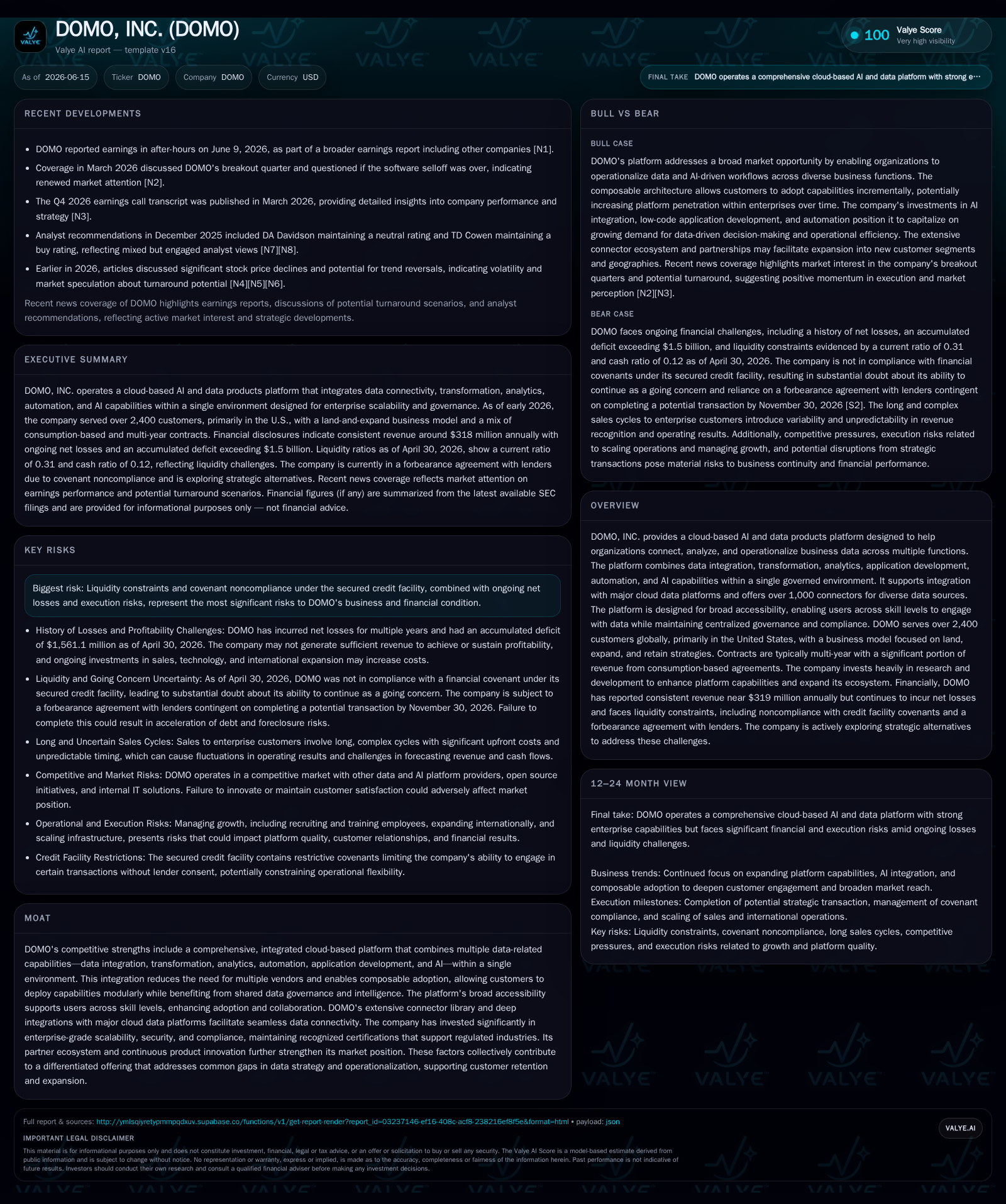
Domo’s Q1 fiscal 2027 results reveal steady traction in annual recurring revenue and consumption-based adoption of its integrated cloud-native data platform, demonstrating progress in customer engagement and platform capabilities. The company continues to operate at a net loss but has reduced quarterly net losses from $18.1 million to $14.2 million, reflecting improved operational execution. However, liquidity pressures remain significant due to its current ratio of 0.31 and net debt of approximately $93.6 million as of April 2026, placing emphasis on refinancing or capital raises through equity offerings. Domo’s strategic strength lies in its unified end-to-end AI-driven data product platform that supports diverse user skill levels with broad connectivity and governance, positioning it well amid competitive SaaS BI peers.
Latest Quarterly Operating Trends Highlight Execution Challenges
Annual Recurring Revenue (ARR) remained stable with a notable shift towards consumption-based pricing — now comprising approximately 84% of ARR — illustrating a strategic focus on usage-aligned monetization that can support broader engagement across varied user groups [S7]. Multi-year contract penetration increased to 76% dollar-weighted recurring revenue basis by January 2026 from prior years’ lower figures, aiding subscription revenue predictability despite the inherent variability introduced by consumption elements [S7]. This underscores Domo’s model balance between fixed contractual revenue and scalable usage fees.
Liquidity represents the primary near-term concern. As of April 30, 2026, Domo held roughly $43 million in cash but carried total debt of about $137 million, resulting in a stretched current ratio near 0.31 due to current liabilities exceeding $372 million [F1]. To address these constraints, Domo has activated an at-the-market equity offering program authorized for up to $150 million shares issuance to bolster capital flexibility if market conditions permit [S15]. Management commentary emphasizes reliance on completing potential strategic transactions or equity raises to maintain operating continuity [S22].
Integrated Cloud Platform Business Model Drives Broad Adoption
At the core of Domo's strategy is its comprehensive cloud-native AI and data products platform offering an integrated suite covering data ingestion (ETL), transformation, analytics visualization, low-code/no-code application development, workflow automation, embedded analytics and AI-powered decision workflows all housed within one governed environment [S4][S12][S13][S14]. This architectural unity addresses common pain points faced by enterprises using fragmented point solutions that increase complexity, duplication of effort and security risks.
The platform supports extensive connectivity through over a thousand pre-built connectors plus universal connectors enabling seamless integration into major public cloud data sources such as Snowflake, Databricks, Google BigQuery, Amazon Redshift among others—allowing customers to leverage existing investments rather than rip-and-replace critical infrastructure [S4][S26]. This comprehensive connector library bolsters Domo’s ability to act as a centralized control plane for enterprise data fabric initiatives.
Importantly, the product model embraces composable deployment where customers can implement specific capabilities independently — like advanced ETL pipelines or AI-driven insights modules — while benefiting from shared governance controls and intelligence layers that prevent redundancy or silos as adoption expands within organizations [S12][S26]. This flexible model fits diverse buyer personas ranging from line-of-business managers adopting analytics apps to IT executives seeking enterprise-scale governance.
Subscription revenues arise primarily through multi-year contracts typically invoiced annually in advance with auto-renewal terms providing renewal visibility; consumption-based fees linked to actual platform use augment this stability while enabling upside participation as clients scale deployments [S7][S12]. This dual-revenue approach aligns incentives around driving client value through increased usage while anchoring predictable base cash flows.
Domo supplements direct sales efforts via a meaningful partner ecosystem comprising system integrators, consulting firms, technology alliances and channel resellers who support go-to-market expansion domestically and internationally [S9][S26]. This indirect channel plays a crucial role given competitive SaaS BI markets where buyer relationships often require trusted advisory engagements.
Competitive Positioning Amid SaaS BI and Cloud Data Platform Rivals
In the crowded business intelligence space populated by peers like Snowflake (data warehousing with analytic integration), Tableau (visual analytics), Microsoft Power BI (enterprise BI suite), Alteryx (data prep/analytics) and Databricks (data engineering & AI), Domo’s differentiation stems from delivering a truly all-in-one cloud-native platform combining broad integration breadth with embedded AI capabilities in an intuitive interface designed for broad user bases.
Unlike pure-play visualization tools or specialized ETL providers that require stitching multiple vendors together horizontally increasing implementation complexity and governance challenges for enterprises aiming at holistic digital transformation programs, Domo offers composable but coherent value chain coverage from data ingestion through actionable insight automation [S14][S26].
Its governance-first architecture appeals strongly to regulated industries requiring fine-grained user permissions combined with scaled performance suitable for multi-trillion row interactive queries while maintaining sub-second response times via native optimizations layering atop third-party cloud platforms or its own managed warehouse environment [S1].
Consumption-based pricing enhances customer alignment sharing upside when client data volumes grow but creates some revenue predictability uncertainty compared with classic subscription-only peers; however robust multi-year contract coverage mitigates this risk partially permitting long-term planning [S7]
Partner ecosystem depth further strengthens go-to-market reach against competitors relying heavily on direct sales alone or limited integrations targeting particular segments rather than full-spectrum horizontal penetration.
Growth Drivers: Expanding Usage, Ecosystem Partnerships, and AI Features
Several structural industry tailwinds support Domo’s growth trajectory:
- Rising enterprise digital transformation spending pushing migration of siloed legacy BI towards integrated cloud platforms capable of real-time insight embedding across organizational workflows.
- Increasing volumes and heterogeneity of business data intensify demand for platforms that unify ingestion/transformation/analytics under governed control frameworks.
- Growing appetite for AI-driven automated research views embedded directly into business processes delivering measurable productivity improvements beyond passive dashboards.
- Expansion of consumption-based pricing aligning vendor success with customer utilization incentivizes deeper engagement increasing lifetime value per client.
- Adoption of low-code/no-code application development empowering broader user constituencies accelerates organic expansion opportunities within existing accounts.
- Ecosystem partnerships extend platform footings globally addressing localized compliance/regulatory needs plus accelerating solution innovation via third-party developers participating in the Domo Appstore [S14]
These drivers mutually reinforce one another creating compounding network effects where greater integration breadth yields stickier clients more likely to invest incrementally over time.
Risks: Liquidity Constraints, Contract Renewal Uncertainty, and Market Competition
Notwithstanding operating progress through Q1 FY27 highlighted by narrowed losses and ARR growth momentum supported by consumption pricing adoption there remain notable risks:
- Acute liquidity pressure evidenced by over-leveraged balance sheet with approx $93.6 million net debt after deducting cash from total debt exceeding $136 million versus underwhelming current assets leaves scant margin for error amid high current liabilities exceeding $370 million [F1].
- Ongoing net losses underscore negative free cash flow generation reflecting necessary investments in go-to-market scale-ups and platform R&D yet necessitating continued external funding raising dilution risk or potential viability concerns absent turnaround [S2].
- Multi-year contract auto-renewal clauses provide some revenue stability but headwinds persist related to churn risk particularly if macroeconomic conditions deteriorate or alternate offerings gain traction challenging retention/repeat renewals [S7].
- Intense competition from large well-capitalized cloud incumbents expanding embedded analytics capabilities threatens price compression or feature parity attenuation forcing continuous expensive innovation cycles.
- Customer onboarding/composability complexity may slow velocity against agile best-of-breed modular solutions favored by specific use cases within departments rather than integrated suites requiring longer ROI justification periods.
- Global expansion efforts conducted concurrently with direct sales scaling pose execution risks especially balancing cost control against market penetration urgency [S2].
Investor Watchlist: Upcoming Milestones and Capital Strategy
Key inflection points for investors will hinge upon:
- Completion status/timing of strategic alternatives explored including potential M&A transactions intended to alleviate financial strain or bolster scale [N1][S22].
- Effectiveness of ATM equity issuance program executing capital raises at acceptable valuations balancing dilution vs liquidity needs [S15][S22].
- Progress achieving sustainable positive cash flow driven by operating leverage improvements offsetting expanded sales/marketing spend.
- Customer cohort metrics such as ARR net retention rates confirming stickiness amidst rising consumption share maintaining above peer benchmarks around mid-to-high 90%s [S9].
- Product innovation cadence particularly leveraging AI/ML enhancements maintaining competitive differentiation.
- Regulatory/compliance certifications sustaining appeal to highly regulated verticals enhancing total addressable market expansion potential.
Monitoring management disclosures around these topics will provide clarity on operational resilience amidst external macro volatility impacting discretionary technology spends.
Financial Snapshot: Leveraging Investments Amid Balance Sheet Pressures
As reflected in Q1 FY27 filings ending April 30, 2026: Domo holds approximately $43 million in cash against total debt near $137 million equating to net debt around $93.6 million highlighting substantial leverage constraints; current liabilities surpass current assets dramatically producing a challenging current ratio near 0.31 posing short-term liquidity stress risks possibly requiring refinancing or asset sales if equity options are insufficiently executed [F1]. Quarterly net loss improvement from $18.1 million down to $14.2 million evidences operational tightening yet absolute profitability remains elusive emphasizing need for careful expense management alongside top-line growth acceleration initiatives [S2]. Subscription revenue growth fueled by rising consumption components supports durable recurring cash flow foundations though high churn sensitivity typical in SaaS BI sector necessitates continued focus on retention effectiveness [S7]. Capital expenditure focus remains heavy on R&D (~$1 billion cumulative since inception) underscoring commitment toward sustained product differentiation imperative given competitive intensity [S8]. Overall financial profile portrays a company balancing aggressive product/platform investment against acute near-term funding constraints amid uncertain financing markets.
Disclaimer: This analysis focuses solely on publicly available recent SEC filings and company disclosures without incorporating market speculation or forward-looking financial forecasts. It aims solely at providing a grounded operational assessment without any investment research view.
Disclaimer: This is research-only, informational analysis and not investment advice. It may include AI-generated interpretation and general industry context. Always verify important details using primary sources.

Comments