
Hammer Technology Holds Fintech Ambitions Amid Persistent Liquidity Risks
Hammer Technology advances its fintech mobile payments platform targeting emerging markets while grappling with critical liquidity challenges that threaten operational continuity.
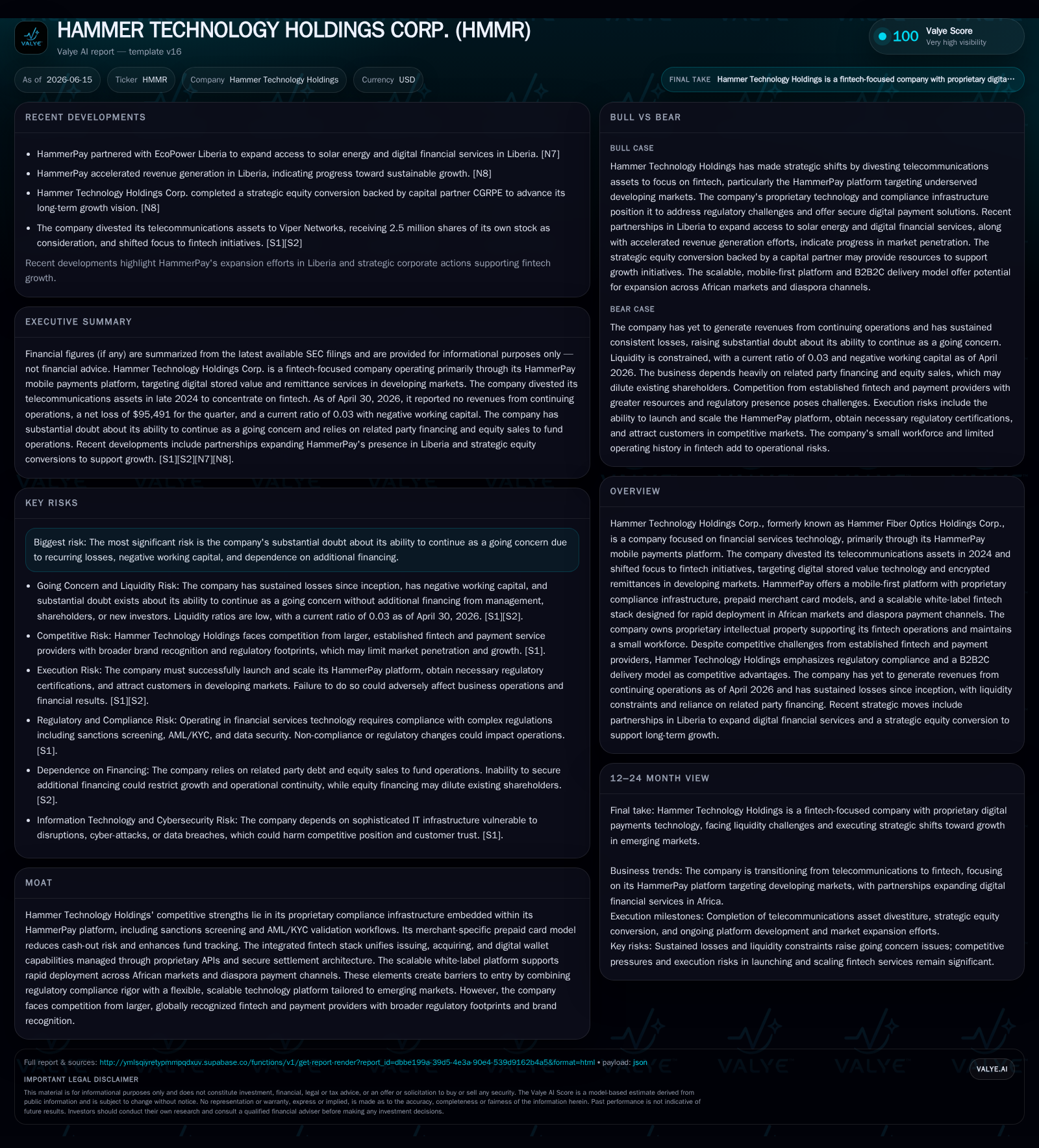
As of its June 15, 2026 quarterly filing, Hammer Technology Holdings Corp. reported zero revenues with a continued decline in operating expenses, driven mainly by reduced professional fees and intangible asset amortization. The company remains highly dependent on equity financing to sustain operations amid substantial negative working capital and unresolved going concern doubts. Transitioning from a telecommunications legacy to focus exclusively on the HammerPay fintech platform, the firm offers a proprietary compliance-embedded, white-label mobile payments technology targeting African markets and diaspora remittance corridors. While its compliance infrastructure and prepaid merchant card model create strategic differentiation, the company's near-term growth is constrained by limited capital resources and competitive pressures from established fintech players. Future progress hinges on securing additional funding and demonstrating traction in merchant and user adoption.
Quarterly Operating Update: Cost Reductions Without Revenue Evidence
Liquidity remains acutely stressed; cash on hand stood at just $17,459 versus current liabilities totaling approximately $685,843 at quarter-end — resulting in a razor-thin current ratio around 0.03 [S2],[F1]. Although negative working capital shrank by nearly $190K from July 31, 2025 levels due chiefly to forgiven related-party debt and reduced payables [S2], the gap still points to fundamental funding shortfalls necessary for everyday operation.
Management reiterated reliance on equity issuances to fund ongoing business activities but cautioned about uncertainties around raising sufficient capital under favorable terms or at all [S2]. These disclosures reinforce that the company continues to face substantial doubt about its viability absent additional financing [S2].
Strategic Realignment: From Telecommunications to Fintech Innovation
Hammer Technology's strategic transformation commenced with divesting its telecommunications assets in November 2024—including subsidiaries like 1st Point Communications LLC—and rebranding officially from "Hammer Fiber Optics Holdings Corp." to its current name in September 2025 [S1],[S20]. This move signaled a clear pivot from legacy telecom services toward concentrated investment in fintech innovation via its HammerPay mobile payments platform.
The company's fintech aim is to enable secure digital commerce using stored value technologies that facilitate encrypted remittances and banking transactions primarily focused on developing markets [S1],[S20]. This represents both an operational shift and repositioning within the financial technology sector—realigning corporate resources toward software-centric payment solutions rather than infrastructure-heavy telecom operations.
Business Model Insights: The HammerPay Platform and Compliance-Driven Competitive Edge
HammerPay stands as the core vehicle for value creation—a mobile-first financial services technology stack that integrates digital wallets with prepaid merchant cards underpinned by proprietary compliance infrastructure,[S1]. The prepaid merchant card model confines funds within restricted accounts tied to merchants, thereby mitigating common cash-out risks that hamper remittance traceability.
Embedded AML (Anti-Money Laundering) and KYC (Know Your Customer) frameworks are directly integrated into onboarding workflows along with sanctions screening across OFAC, EU, and UN lists [S11]. This regulatory rigor establishes technological barriers protecting against fraudulent or illicit use while enhancing trustworthiness essential for market acceptance.
The platform operates as a scalable white-label solution enabling partners—such as local banks or payment facilitators—to deploy branded mobile payments ecosystems quickly across targeted geographies like Africa and diaspora corridors,[S1]. APIs manage unified issuing, acquiring functions alongside secure settlement architecture ensuring transactional transparency. The B2B2C approach focuses on enabling business customers who then serve end-user populations where smartphone penetration is gradually rising.
Industry Context: Fintech Payments Targeting African Markets — Competitive Landscape
Within the fintech industry focused on emerging African markets and global remittances corridors, Hammer Technology competes indirectly with players such as Chipper Cash and Flutterwave who have broader scale and deeper regional penetration. Traditional remittance leaders like Western Union continue commanding sizeable market shares but face increasing pressure from digital alternatives providing lower friction cross-border payment experiences.
Regulatory complexity remains elevated given diverse AML/KYC standards embraced differently by jurisdictions involved. Compliance failures can lead not only to fines but erode consumer confidence critical for adoption.
Tasked with actuating growth in low-income segments reliant on mobile money solutions requires balancing affordability with robust security measures—areas where HammerPay's integrated compliance modules represent an asset but require validation through real-world usage patterns.
Growth Vectors: Market Penetration Drivers and Scalability of White-Label Solutions
Structural demand drivers underpinning Hammer Technology’s growth ambitions include expanding smartphone and internet access throughout targeted developing regions, most notably Sub-Saharan Africa. Consumers increasingly seek cashless options for day-to-day transactions plus remittance inflows from diaspora populations abroad.
Regulatory initiatives promoting financial inclusion augment uptake incentives while partnerships with local merchants help bootstrap ecosystem liquidity. The flexible SaaS-style nature of HammerPay's white-label platform enables faster geographic rollout compared to monolithic bespoke banking system builds.
Key operational metrics relevant here are merchant onboarding velocity—critical for network effect realization—transaction volume growth signaling consumer acceptance; likewise controlling customer acquisition cost (CAC) relative to average revenue per user (ARPU) will determine scalability economics over time.
Key Risks: Liquidity Woes, Competitive Pressure, and Execution Challenges
Foremost among risks is acute liquidity strain manifest across repeated equity sales dependency with dilution implications for existing shareholders [S2]. Continued funding uncertainty impairs ability to invest aggressively in user acquisition or scale out platform capabilities promptly.
Competitive pressures from globally established fintech firms possessing substantial regulatory footprints and brand equity complicate market entry prospects. The necessity of ongoing regulatory certification combined with complex multi-jurisdictional compliance add execution friction.
Additional vulnerabilities arise from potential technology security breaches or data privacy incidents inherent to digital wallet operations; failure herein could critically impair reputation.
Furthermore, customer adoption dynamics may falter due to behavioral inertia or alternative local payment preferences limiting rapid volume build-up before reaching positive cash flow breakeven thresholds.
What to Watch Next: Funding Milestones, Platform Launches, Customer Adoption Signals
Upcoming milestones central to hammering out Hammer Technology's sustainability profile include successful equity capital raises capable of bridging operational gaps until meaningful revenue generation materializes [S2]. Monitoring public disclosures of fundraising events will be key due diligence gauges.
Operational progress markers encompass evidencing completion of formal launch phases for HammerPay accompanied by measurable increases in merchant onboarding rates or active user counts. Early traction signals would lend credibility to scaling assumptions embedded in management’s strategy.
Additionally crucial are announcements regarding regulatory licenses obtained or expanded platform certifications enabling entry into additional African countries or diaspora markets which could materially widen addressable opportunity sets.
Financial Snapshot: Liquidity Status and Capital Raise Dependencies
As of April 30, 2026, Hammer Technology’s balance sheet reflects distressed liquidity conditions with cash reserves of just $17,459 against unfolding current liabilities nearing $685,843—yielding a precarious current ratio circa mere 0.03 [F1],[S2].
Negative working capital improved compared with twelve months prior due chiefly to forgiven related-party debt and reduced payables [S2], but remains significantly imbalanced highlighting ongoing solvency challenges.
In sum, while strategic reorientation positions Hammer Technology within high-growth fintech niches leveraging compliance moats and agile white-label platforms tailored for African markets’ unique demands—the overriding near-term constraint remains precarious liquidity underpinning fundamental survival questions pending demonstrable commercial progress.
Disclaimer: This is research-only, informational analysis and not investment advice. It may include AI-generated interpretation and general industry context. Always verify important details using primary sources.

Comments