
NextNav’s Strategic Shift to NextGen Platform Amid Operating Losses and 5G Spectrum Expansion
NextNav updates its positioning and timing technology with NextGen and manages substantial operating losses against a background of critical spectrum assets.
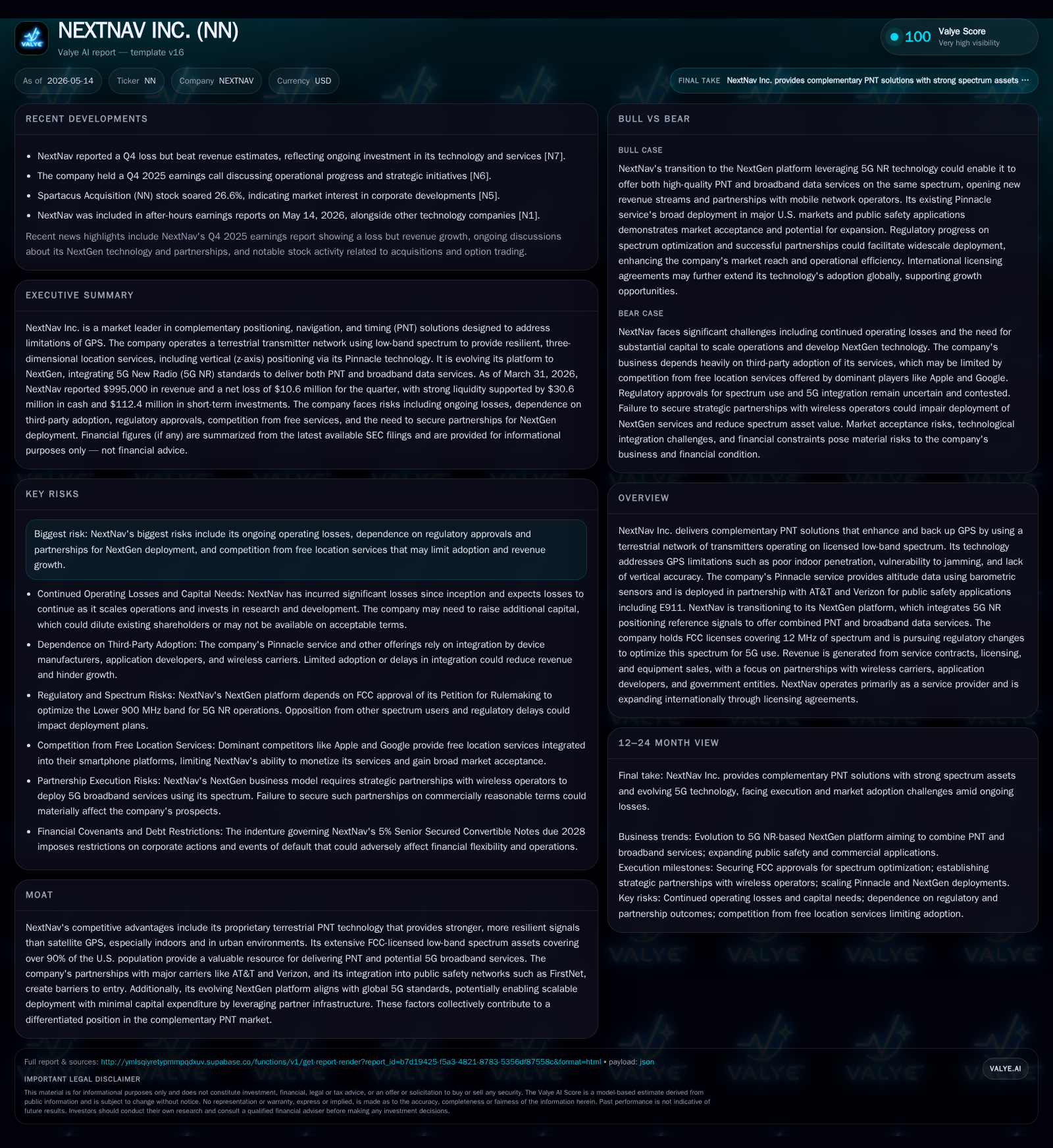
NextNav Inc., a provider of terrestrial positioning, navigation, and timing (PNT) solutions, reported ongoing operating losses in its latest quarterly filing while advancing its NextGen platform integrating 5G NR positioning reference signals. The company’s business is underpinned by FCC licenses covering over 90% of the U.S. population in low-band spectrum, facilitating indoor and resilient location services that complement GPS. Partnerships with major wireless carriers and public safety applications provide differentiation but require scaling and regulatory progress. Growth hinges on expanding deployment of NextGen capabilities and leveraging spectrum for complementary broadband services amid capital intensity and competitive pressures.
Recent Operating Update: Q1 2026 Filing Highlights
In its latest 10-Q filing dated May 14, 2026 [S2], NextNav disclosed a net loss of $10.6 million for Q1 2026, marking a significant reduction compared to the $58.6 million loss in the same quarter last year. This improvement reflects some operating leverage but still underscores ongoing investment challenges as the company scales its technology platforms.
The filing confirms NextNav's projection that it will remain unprofitable in the near term as it ramps up operations around its NextGen platform — a strategic evolution designed to integrate terrestrial PNT technology with emerging 5G New Radio (NR) positioning reference signals (PRS), aligning with global 3GPP standards [S1].
Financially, the company's balance sheet as of March 31, 2026 includes $30.6 million cash against $267.2 million total debt, yielding a current ratio of approximately 10.49 [F1]. This liquidity position appears sufficient to fund working capital needs for at least the next twelve months; longer-term sustainability depends critically on execution progress and capital raises if necessary.
Business Model Overview
NextNav creates revenue by selling complementary positioning, navigation and timing solutions that enhance or back up satellite-based GPS. It generates revenue mainly through three channels:
- Service contracts with major wireless carriers (notably AT&T and Verizon), who embed NextNav’s location services into their networks,
- Licensing proprietary technology including vertical 'z-axis' location algorithms leveraging barometric sensor data,
- Sales of network equipment supporting its terrestrial transmitter infrastructure.
The value proposition lies in mitigating fundamental GPS vulnerabilities such as poor indoor signal penetration, susceptibility to jamming/spoofing, and absence of vertical accuracy essential for emergency responders (E911) and applications like autonomous drones in urban canyons [S1].
The Pinnacle service exemplifies this offering by providing more accurate altitude data via combined low-band transmitters and barometric sensor fusion deployed at scale through carrier partnerships.
Industry Structure and Competitive Position
NextNav operates within the broader PNT industry which is deeply intertwined with cellular communications infrastructure. Its niche is complementary terrestrial PNT focused on resilient indoor coverage using licensed low-band spectrum (~900 MHz), differentiating itself from space-based GNSS providers by providing stronger signals indoors and robustness against jamming.
Strategically important are the company’s FCC licenses covering over 12 MHz spectrum blocks that reach more than 90% of the U.S. population [S1]. This national footprint spectrum portfolio constitutes a high barrier to entry for competitors seeking similar reach or reliability.
Major wireless carriers serve both as key customers and strategic partners due to their existing network infrastructure leveraged in deploying NextNav’s services; relationships with AT&T, Verizon, and integration into FirstNet public safety networks amplify this moat.
Competition arises not just from free global GNSS services but also from other emerging terrestrial PNT providers possibly leveraging alternative technologies or adjacent frequency bands.
Growth Drivers
NextGen Platform Deployment
The core growth driver is the transition from legacy Pinnacle services towards the NextGen platform that fuses terrestrial signals with standardized 5G NR PRS capabilities [S1]. This integration promises improved scalability through leveraging partner cellular infrastructure avoiding heavy capex burdens on NextNav itself.
Expanding Public Safety Applications
Enhanced E911 use cases represent a critical demand source where accurate vertical location saves lives—deployments via AT&T/Verizon’s public safety lines provide recurring contractual revenues.
Regulatory Advances & Spectrum Expansion
Recent acquisition of an additional complementary 4 MHz low-band spectrum block in 2025 (via Telesaurus/Skybridge) plus potential rights to another contested 2 MHz enable incremental capacity growth pending FCC resolution [S1]. These spectrum enhancements can unlock new service areas or improve existing coverage.
Increasing Ecosystem Adoption
NextNav anticipates growth through expanded adoption across multiple verticals including autonomous vehicles/drones requiring precise indoor/outdoor transitions, industrial IoT applications needing reliable timing synchronization beyond GPS alone, and consumer applications reliant on augmented location data.
Risks and Growth Constraints
Despite promising technology groundwork, multiple critical risks cloud the outlook:
- Continued Unprofitability: The company expects losses to persist given rising operating expenses tied to research & development and NextGen deployment costs [S2]. Failure to generate meaningful revenue growth could pressure cash reserves requiring equity/debt funding dilutions.
- Regulatory Dependency: Success hinges on timely FCC approvals relating to spectrum rights usage changes necessary for full-scale NextGen commercialization [S1]. Delays or unfavorable rulings could impair service expansion plans.
- Competitive Pressures: Availability of free GNSS limits pricing power unless customers perceive indispensable value in complementary PNT especially indoor/vertical accuracy aspects.
- Capital Intensity: Network build-outs involve upfront investments; reliance on partnerships mitigates but does not eliminate financial burdens.
- Partnership Execution Risk: Dependence on lead carriers’ cooperation means strategic alignment risk; loss or downgrading of key contracts could materially impact revenue streams.
What to Watch Next
Critical milestones investors should monitor include:
- Quarterly progress reports detailing incremental NextGen network deployments and service activations,
- Updates on FCC proceedings concerning spectrum license reinstatements or new rulemaking impacting low-band usage,
- Expansion announcements regarding carrier contracts beyond AT&T/Verizon or penetration into new vertical markets,
- Metrics showing acceleration in customer bookings or backlog,
- Cost management trends particularly R&D spend versus revenue growth trajectory,
- Cash runway estimations coupled with planned capital raises if any.
Financial Profile Summary
Latest financial snapshot
| Metric | Value | Period |
|---|---|---|
| Cash & equivalents | $31mm | |
| 2026-03-31 | ||
| Total debt | $267mm | |
| 2026-03-31 | ||
| Net debt | $237mm | |
| 2026-03-31 | ||
| Current assets | $148mm | |
| 2026-03-31 | ||
| Current liabilities | $14mm | |
| 2026-03-31 | ||
| Current ratio | 10.49x | |
| 2026-03-31 |
Source: SEC companyfacts cache [F1].
The financials highlight a high cash burn business model characteristic of deep technology commercialization efforts with significant debt leverage undertaken recently (e.g., issuance of $190 million senior secured convertible notes) to finance growth initiatives [S4][F1]. Margins remain negative due to scale-up phase expenses concentrated in R&D (+17% increase year-over-year) and SG&A (+18% increase). Depreciation also rose significantly reflecting ongoing capital investment in patented technologies [S20].
This analysis seeks to provide an informed perspective based strictly on current regulatory filings without investment recommendations or forward-looking financial forecasts beyond factual disclosures noted herein.
Disclaimer: This is research-only, informational analysis and not investment advice. It may include AI-generated interpretation and general industry context. Always verify important details using primary sources.

Comments