
Workhorse Group Advances Post-Merger Integration with Credit Facility Expansion and Lease Deferral
Recent filings highlight Workhorse Group's strategic financial adjustments and operational developments following its merger, setting the stage for scaling in electric commercial vehicles.
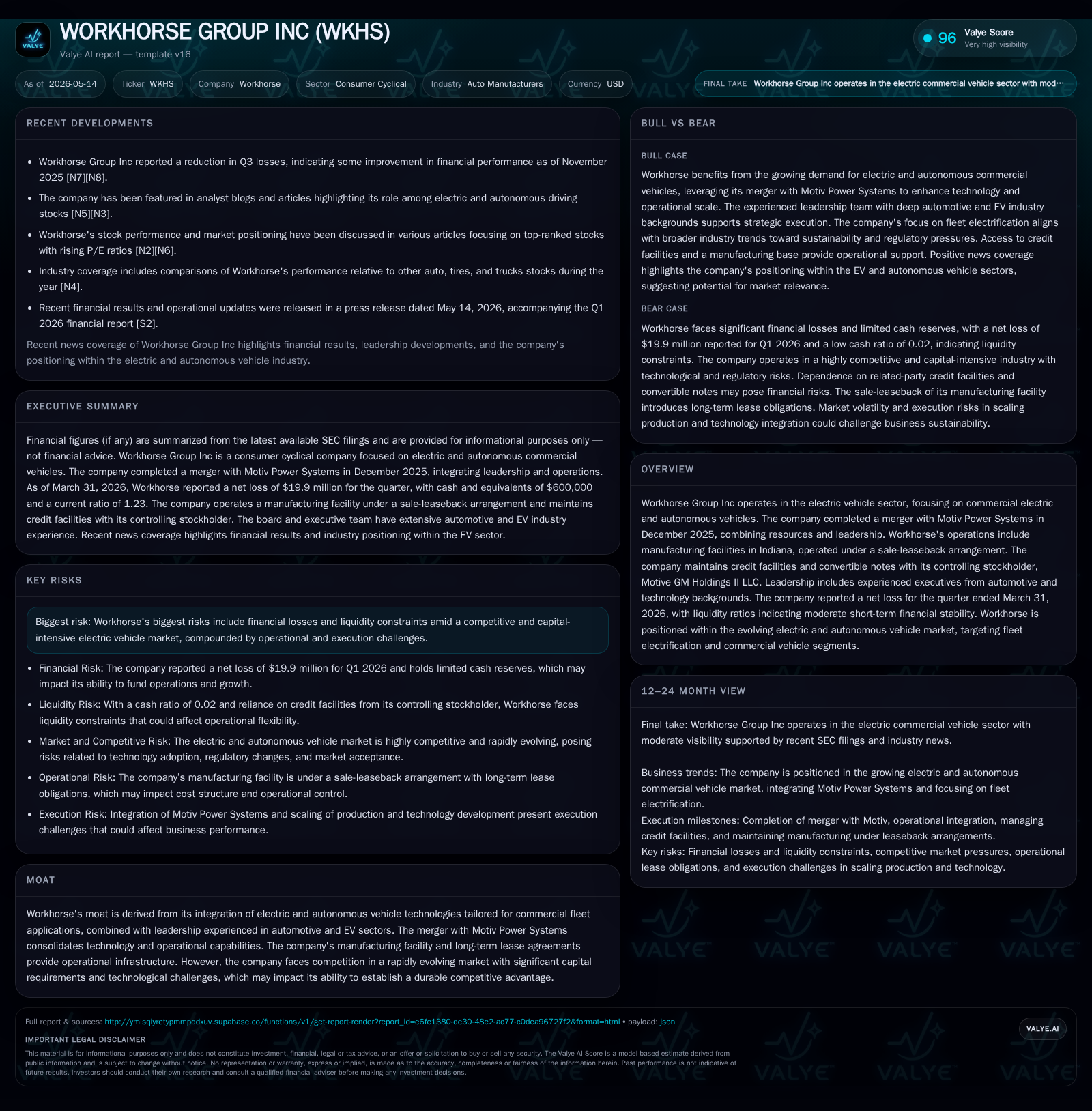
Workhorse Group Inc’s latest quarter did not shift risk factors materially but featured notable financial maneuvers including a credit line increase and lease payment deferral to manage liquidity. The company is consolidating its position in commercial electric and autonomous vehicles through the merger with Motiv Power Systems, leveraging new leadership and manufacturing infrastructure. Key growth drivers center on fleet electrification demand and autonomous tech integration amid a competitive, capital-intensive environment. Risks include ongoing net losses and cash constraints despite infrastructural advances. Upcoming milestones include monitoring debt facility utilization, lease repayment timing, and operational execution of merged assets.
Recent Operating Update
Workhorse Group Inc (WKHS) reported its latest quarterly results and filed a 10-Q on May 14, 2026 [S2], reinforcing that there were no material changes to its previously disclosed risk factors [S15]. However, its operating environment continues to feature strategic financial adjustments anchored around liquidity management amidst significant ongoing investments. Specifically, Workhorse entered into an Omnibus Amendment to its credit agreements on April 25, 2026 [S14], which increased its Cash Flow Credit Agreement commitment from $10 million to $20 million while reducing the Customer Order Credit Agreement commitment from $40 million to $30 million. This shift reflects a reprioritization towards more flexible working capital borrowing.
Simultaneously, the company secured a lease deferral arrangement for its Union City, Indiana manufacturing plant—post-sale-leaseback in August 2025 [S26]—deferring five months of rent starting May 2026 into a lump sum payable by the end of September 2026 [S19]. This maneuver is designed to alleviate near-term cash outflows while maintaining operations at the strategic manufacturing hub.
The first quarter ended March 31, 2026 closed with cash of approximately $600,000 against total debt near $15.7 million and a current ratio at 1.23 [F1]. These metrics signal constrained liquidity amid an extended path toward profitability as the company scales up production capacity and integrates recent acquisition assets. Workhorse also finalized settlement terms in April relating to litigation matters for $4.3 million, anticipated to be funded via existing credit lines [S16], underscoring ongoing financial stewardship amid legal contingencies.
Business Model Overview
Workhorse generates revenues primarily by designing, manufacturing, and selling electric vehicles (EVs) tailored for commercial fleets along with associated autonomous vehicle technologies. The business model hinges on specialized applications such as last-mile delivery trucks where electrification paired with autonomy delivers cost reduction and efficiency gains for fleet operators. Revenue drivers include vehicle sales backed by service contracts or leasing arrangements through their sale-leaseback facility model.
The merger with Motiv Power Systems in December 2025 materially expanded Workhorse’s technology portfolio and engineering depth [S1]. This consolidation brought complementary EV powertrain systems expertise and bolstered their commercial-grade autonomous vehicle solutions pipeline. Furthermore, owning operational control over their Indiana assembly plant allows cost control benefits alongside long-term certainty via that sale-leaseback plus multiple renewal options structure.
Pricing is influenced both by contract negotiations with large fleet customers as well as component supply costs within a highly competitive EV market facing material commodity inflationary pressures. Margins remain under pressure given the early-stage nature of their vehicle production ramp-up combined with development-heavy R&D expense allocations critical for technological differentiation.
Industry Structure and Competitive Position
Workhorse operates within the commercial EV sector, specifically focusing on electric delivery vans and medium-duty trucks augmented by autonomous driving features aimed at reducing labor costs and improving safety. The ecosystem is fragmented yet rapidly evolving with established automakers expanding EV offerings concurrently competing against dedicated startups aggressively pursuing fleet electrification niches.
Competitive advantages claimed rest on deep integration of autonomy software with custom-built electric chassis optimized for commercial logistics needs—leveraging synergies from Workhorse’s merger with Motiv Power Systems. Manufacturing scale though remains limited relative to incumbents such as Ford’s E-Transit or Rivian’s commercial ventures where global supply chains provide capacious competitive moats absent here.
Long-term lease agreements providing facility stability afford Workhorse operational continuity not always present among newer entrants reliant entirely on outsourced or third-party manufacturing partnerships. Leadership renewals featuring executives experienced in automotive electronics and EV powertrain development further strengthen positioning but must translate into market traction swiftly given capital constraints.
Growth Drivers
- Fleet Electrification Demand: Ongoing regulatory mandates globally require fleets to reduce emissions. Commercial operators seek electric alternatives especially in last-mile delivery where stop-and-go operations maximize EV advantages.
- Autonomy Integration: Incremental shifts toward autonomous driving features capable of reducing driver fatigue, accident rates and labor costs create differentiation versus battery-only competitors.
- Post-Merger Synergies: Combination of Workhorse’s platform with Motiv’s powertrain tech supports accelerated rollout of next-generation models fitting target customer profiles better.
- Manufacturing Scale-Up: Operational maturity at Union City plant along with enhanced borrowing capacity eases volume expansion bottlenecks.
- Strategic Financing Flexibility: Credit facility amendments allow bridging working capital gaps during volume ramp phases without immediate dilution or external equity raises.
These drivers align principally around structural trends rather than cyclical fluctuations given government-driven electrification incentives plus corporate sustainability commitments underpinning fleet upgrades.
Risks and Watchpoints
Key risks persist centered on:
- Financial Performance Pressure: Large net losses continue (-$64 million operating loss in FY25) coupled with tight liquidity create existential threats if growth milestones slip [F1].
- Execution Complexity: Integration challenges post-Motiv merger could disrupt supply chains or product development progress slowing delivery timelines.
- Capital Intensity: Significant R&D investment required to maintain competitiveness in autonomy software coupled with hardware innovation intensifies cash burn.
- Competitive Landscape: Larger OEMs’ rapid EV model introductions place pressure on Workhorse’s niche volumes potentially impacting pricing power.
- Regulatory Compliance Risks: Uncertainties surrounding evolving safety standards for autonomous features could delay market acceptance or trigger costly redesigns.
Monitoring how effectively Workhorse manages lease payment obligations deferred until late Q3 alongside increasing utilization of credit lines will inform assessment of financial robustness going forward.
What to Watch Next
- Quarterly updates on revenue recognition from expanded product sets post-merger clarifying order backlog conversion rates.
- Milestones on production output increments at Union City plant evidencing manufacturing scale capability improvements.
- Utilization rates and drawdowns under amended credit facilities reflecting liquidity cushion sufficiency.
- Updates on progress toward definitive settlement agreement finalizing litigation closure payments due May-end [S16].
- Management commentary concerning technology validation trials or autonomous pilot program feedback signaling product readiness trajectory.
These indicators will collectively govern momentum toward sustainable operations beyond reliance on interim financing measures.
Financial Profile Snapshot (As of March 31, 2026) [F1]
Latest financial snapshot
| Metric | Value | Period |
|---|---|---|
| Cash & equivalents | $600000 | |
| 2026-03-31 | ||
| Total debt | $16mm | |
| 2026-03-31 | ||
| Net debt | $15mm | |
| 2026-03-31 | ||
| Current assets | $47mm | |
| 2026-03-31 | ||
| Current liabilities | $38mm | |
| 2026-03-31 | ||
| Current ratio | 1.23x | |
| 2026-03-31 |
Source: SEC companyfacts cache [F1].
Liquidity remains stretched given minimal cash balances against sizable liabilities; however recent credit amendments bolster near-term financial runway if production milestones are met timely.
Disclaimer: This analysis is based exclusively on publicly available SEC filings dated up to May 14, 2026, combined with industry context. It does not constitute investment advice or recommendations related to securities of Workhorse Group Inc.
Disclaimer: This is research-only, informational analysis and not investment advice. It may include AI-generated interpretation and general industry context. Always verify important details using primary sources.

Comments