
AmeriServ Financial Confronts Rising Expense Pressures and Credit Challenges in Q1 2026
AmeriServ's Q1 2026 results reveal growing credit quality concerns and increased professional expenses impacting its regional banking operations.
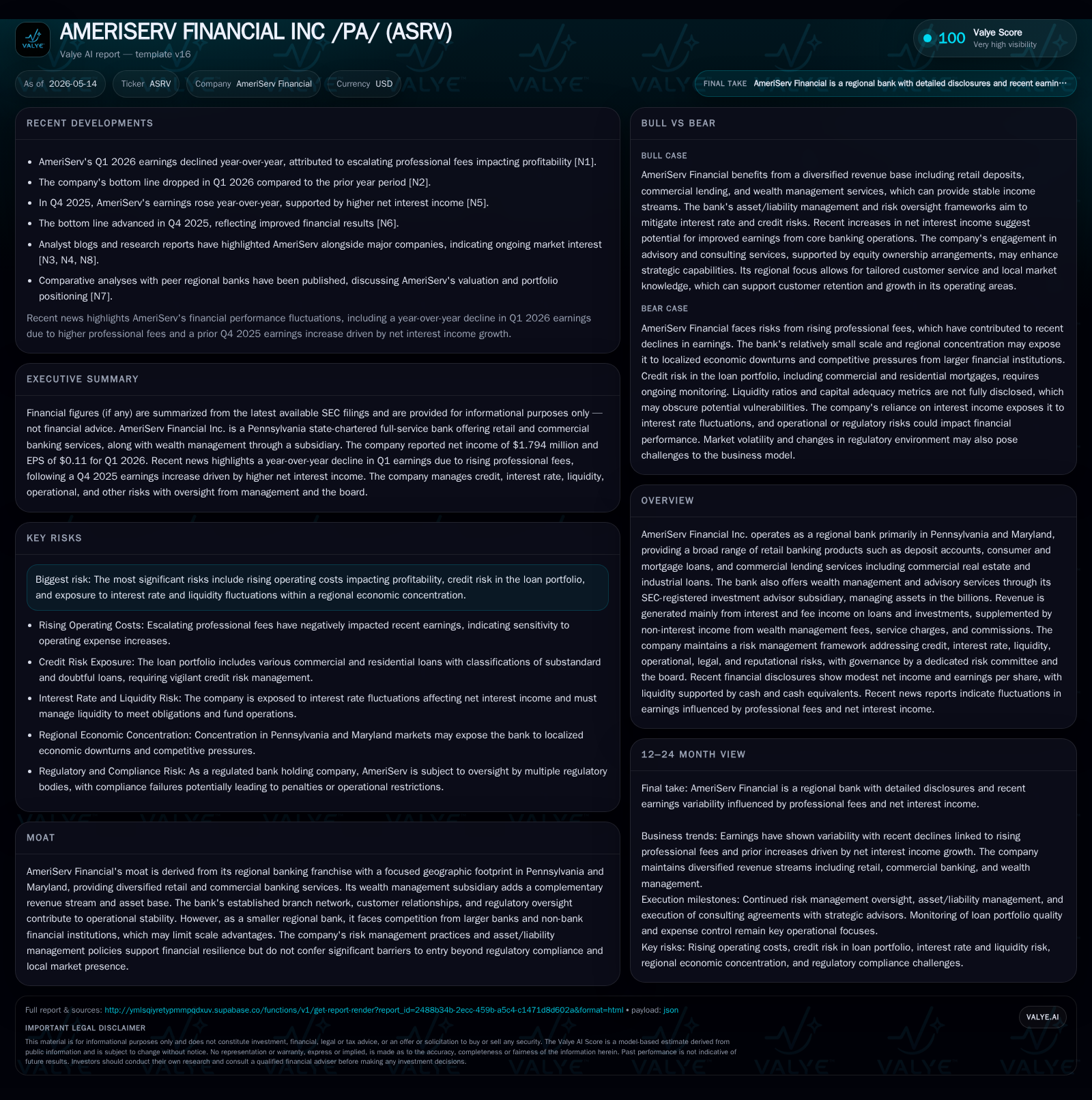
AmeriServ Financial reported a shift in credit risk recognition for Q1 2026 marked by the transfer of a $0.5 million corporate security into non-accrual status, triggering a $50,000 reversal of accrued interest income and necessitating an allowance for credit losses. Concurrently, escalating professional fees contributed to a decline in net income from the prior year’s quarter. The company continues to leverage its regional banking franchise across Pennsylvania and Maryland, combining diversified commercial lending and wealth management services. Yet, rising expense pressures and intensifying regulatory scrutiny on its commercial real estate portfolio pose notable operational risks ahead.
Q1 2026 Operating Update: Credit Loss Recognition and Expense Trends
In its latest quarterly filing ending March 31, 2026, AmeriServ Financial disclosed a significant shift in credit risk recognition within its investment portfolio. The company reported one available-for-sale (AFS) debt security had moved into non-accrual status valued at $500,000. This change prompted the establishment of an allowance for credit losses amounting to $34,000 associated with this security. Moreover, previously recognized interest income totaling $50,000 was reversed during the quarter due to unpaid interest on this security no longer being accrued [S2].
This development signals emerging stress within part of AmeriServ’s corporate bond holdings — a notable departure given the company's investment portfolio historically emphasized high-quality government agencies and mortgage-backed securities generally guaranteed by the U.S. government with negligible credit loss experience [S2]. The recognition of credit losses here introduces headwinds on investment income going forward.
Simultaneously, AmeriServ reported escalating professional fee expenses during the quarter which further pressured net income. The combined impact resulted in modest net income of $1.79 million for Q1 2026 compared to $1.91 million in the year-ago period [S2][N1]. This incremental cost increase highlights operational expense inflation as an emerging challenge amid flat revenue conditions.
AmeriServ’s Business Model: Regional Banking with Diversified Retail and Commercial Services
AmeriServ operates predominantly as a regional bank focused on Pennsylvania and Maryland markets. Its core revenue sources include net interest income generated primarily from commercial lending — notably commercial real estate loans — as well as consumer and mortgage loans. Deposits provide stable funding supporting these lending activities [S1].
Complementing lending operations is AmeriServ’s wealth management subsidiary functioning as an SEC-registered investment advisor managing billions in client assets. This division contributes non-interest fee income through advisory fees and commissions that supplement traditional banking revenues [S1].
The bank’s business model leans on localized branch networks that foster long-standing client relationships across retail consumers and small-to-mid-sized businesses within its footprint. This geographic concentration enables customer intimacy but limits scale advantages relative to larger regional or national banks [S1].
Revenue mechanics involve margin capture between loan yields (influenced by interest rates and credit pricing) and deposit costs. Wealth management fees provide diversification less correlated to interest rate cycles while service charges add supplementary non-interest income streams.
Competitive Landscape and Industry Positioning in Pennsylvania and Maryland
Within the banking landscape of Pennsylvania and Maryland, AmeriServ contends with competition from major national banks possessing wider geographic reach alongside more niche non-bank lenders offering tailored financing solutions. Its smaller footprint restricts economies of scale particularly impacting overhead absorption and technology investments [S1].
However, AmeriServ benefits from deep local market knowledge enabling competitive pricing power particularly in commercial real estate lending segments where relationship banking matters significantly. Regulatory oversight applicable to regional banks also ensures operational discipline though can impose compliance costs disproportionate to size [S1].
Pricing dynamics are impacted by industry concentration; pricing power in higher-risk commercial loan products is sensitive both to borrower credit quality trends and competitor aggressiveness.
Growth Drivers: Commercial Real Estate Lending and Wealth Management Expansion
Commercial real estate (CRE) lending constitutes a substantial portion of AmeriServ’s loan book including owner-occupied properties as well as retail, multi-family, and other investment property classes [S1][S9]. While CRE loans typically offer higher yields than residential mortgages or consumer loans reflecting elevated risk profiles, they require rigorous underwriting focused on debtor cash flow strength and collateral quality.
Management has emphasized enhanced risk management procedures with heightened scrutiny applied via periodic stress testing encompassing cash flow sensitivity analyses alongside monitoring debt service coverage ratios [S9]. Despite tightened underwriting standards responding to regulatory concerns over CRE sector risks, portfolio growth remains a key strategic priority given yield accretion potential.
Wealth management expansion acts as a complementary growth engine leveraging institutional asset administration capabilities paired with cross-selling opportunities across banking clients [S1]. Asset-based fee revenues provide stability less exposed to funding cost fluctuations.
Risks and Constraints: Credit Quality, Cost Inflation, and Regulatory Scrutiny
Key risks facing AmeriServ include potential deterioration in credit quality particularly related to CRE exposure which accounted for over half of the loan portfolio at year-end 2025 [S9]. Economic slowdowns or localized market downturns could strain borrower cash flows increasing nonperforming loans or necessitating expanded allowance for credit losses; evidenced recently by the downgrade of an AFS corporate security into non-accrual status [S2].
Simultaneously rising operating costs such as professional fees pose profit margin pressure highlighted by their material impact on Q1 results [N1]. Managing cost inflation is critical given limited scale economies.
Regulatory agencies have signaled concern around CRE portfolios prompting requirements for enhanced risk controls plus possible constraints on lending activities if deemed overly risky by supervisors [S1][S6]. Such scrutiny could translate into increased compliance costs or limitations jeopardizing growth initiatives.
Liquidity risks remain manageable supported by the company’s balance sheet strength but must be vigilantly monitored alongside changing interest rate environments affecting asset-liability management strategies [S5][F1].
Key Indicators to Monitor: Credit Trends, Fee Income Sustainability, and Regulatory Responses
Moving forward investors and analysts should observe:
- Levels of nonperforming assets including securities shifted into non-accrual status beyond the initial $0.5 million case.
- Evolution of allowance for credit losses especially given potential cyclical upticks affecting provisions.
- Trends in wealth management fee income reflecting client asset retention/growth mitigating core banking earnings pressures.
- Regulatory updates regarding capital adequacy requirements or restrictions imposed on CRE portfolio expansion.
- Operating expense trajectories focusing on professional fees’ share of total costs.
- Dividend declarations or capital plan adjustments communicated by board signaling confidence or caution under current conditions [S3].
Concluding Assessment: Balancing Local Franchise Stability Against Emerging Headwinds
AmeriServ Financial continues operating a stable regional banking franchise rooted firmly in Pennsylvania and Maryland markets with diversified revenue streams encompassing both commercial lending—largely anchored by higher-yield CRE exposures—and wealth management advisory fees. However, first-quarter 2026 disclosures spotlight emerging operational headwinds including initial impairment recognition within investment securities indicative of fragile credit conditions alongside escalating professional fees compressing net income margins.
While disciplined underwriting practices paired with local market expertise underpin AmeriServ’s competitive positioning, maintaining profitability amid intensifying regulatory scrutiny toward CRE portfolios will require vigilant portfolio monitoring coupled with tight cost control measures.
Future quarters’ performance will hinge critically on how effectively AmeriServ balances growth aspirations against tightening external constraints — with sustained attention warranted on credit metrics evolution alongside wealth management fee momentum providing offsetting revenue support under increasingly complex operating dynamics.
This analysis is based solely on publicly available information as of May 14, 2026. It does not constitute investment advice or recommendations.
Disclaimer: This is research-only, informational analysis and not investment advice. It may include AI-generated interpretation and general industry context. Always verify important details using primary sources.

Comments