
Hines Global Income Trust Navigates Portfolio Shifts and Market Dynamics
Recent portfolio activity and shareholder reinvestment initiatives underpin HGIT's stable NAV amid evolving real estate market conditions.
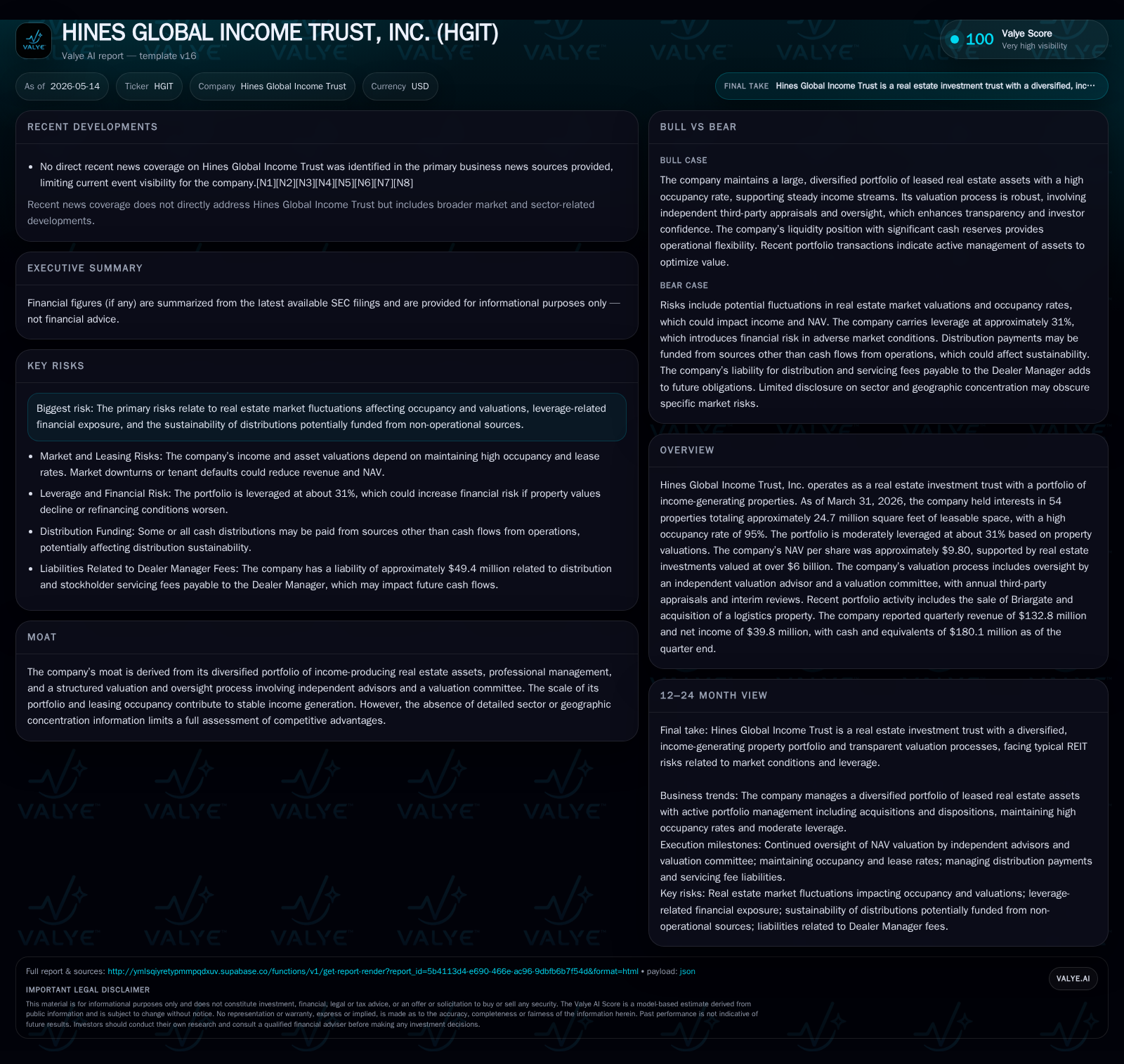
Hines Global Income Trust, Inc. maintains a robust real estate portfolio with high occupancy and moderate leverage as of Q1 2026, supported by recent asset disposition and acquisition moves. The company’s NAV per share remains stable around $9.80 despite ongoing market variability, bolstered by rigorous valuation oversight. Recent enhancements to its distribution reinvestment plan seek to strengthen shareholder participation while preserving capital for further portfolio optimization. Vigilance remains on leverage levels and distribution sustainability amid potential real estate cycles.
Latest Quarterly Operating Update: Portfolio and Shareholder Activity
Hines Global Income Trust reported in its May 14, 2026 Form 10-Q that its portfolio comprised interests in 54 income-producing properties aggregating roughly 24.7 million square feet of leasable space. Occupancy remained high at approximately 95%, reflecting continued tenant demand resilience across its property mix [S2]. Recent portfolio reshaping includes the disposition of the Briargate property for $150.7 million earlier in the year, complementing the addition of a logistical asset through acquisition in March 2026 — moves that underscore active asset recycling to optimize returns and positioning [S2][S13]. The resulting portfolio leverage stood near 31% based on valuations conducted at quarter-end [S2], modestly below prior levels as dispositions reduced debt load relative to asset value.
The company’s net asset value (NAV) per share remained effectively unchanged month-over-month from February to March 2026 at about $9.80 per share across all classes of common stock. This stability signals effective management of asset quality and valuation assumptions supported by rigorous third-party oversight from Altus Group and governance through an independent valuation committee tasked with ensuring robust NAV transparency [S3][S26]. In parallel with these operational developments, an update to the distribution reinvestment plan was disclosed in April — distributions payable from May 1 onward can now be reinvested into additional shares at prevailing transaction prices with associated share redemption options tied to liquidity provisions within the program [S3]. This adjustment aids shareholder capital recycling into the trust while providing controlled redemption liquidity pathways.
Business Model and Asset Quality: Income Generation Mechanics
HGIT operates as a real estate investment trust focusing on generating consistent income by holding and managing a diversified real estate portfolio with strong occupancy metrics. Its revenue streams derive primarily from leasing income paid by tenants across multiple property types including office, industrial logistics, retail, residential/living segments among others — although exact sector weights are not detailed explicitly in recent disclosures [S1][S3]. Maintaining near full occupancy (~95%) is critical for stable recurring cash flows that underpin distribution payments.
A structured valuation framework governs the company’s net asset value calculation process; properties undergo annual third-party appraisals supplemented by interim reviews to reflect any material changes. The valuation committee consisting of independent directors oversees methodologies applied by HGIT Advisors LP (the advisor) as well as Altus Group’s appraisal reviews ensuring credibility around asset pricing used for NAV reporting [S3][S26]. This process reduces uncertainty around underlying asset values especially during periods marked by broad real estate market fluctuations.
Financially, HGIT’s business model blends long-term lease contracts maintaining consistent income with periodic asset repositioning (sales & acquisitions) executed under disciplined underwriting standards aiming for enhanced portfolio yield optimization and risk management.
Industry Positioning and Competitive Context in Real Estate Investment Trusts
Within the REIT landscape, HGIT competes predominantly among publicly registered but non-traded REITs characterized by liquidity limitations relative to listed peers alongside regulatory rigor demanding transparent disclosures including NAV calculations and fee structures. Competitive dynamics hinge on tenant demand trends within office and industrial markets largely influenced by macroeconomic factors such as economic growth rates, interest rates affecting capitalization rates (cap rates), regional supply-demand balances causing shifts in rental rate inflation or compression.
Pricing power is therefore nuanced; tenants exercise negotiating leverage especially under softened demand conditions or increased supply availability impacting occupancy and rents. HGIT’s relatively stable occupancy indicates reasonable resilience but also underscores exposure to sector cyclicality typical for commercial real estate products. Regulatory compliance with SEC mandates requires detailed registration statements including prospectus suitability standards governing investor eligibility which adds operational complexity but bolsters investor confidence through structured governance [S1][S5][S27].
Growth Catalysts: Portfolio Optimization and Shareholder Programs
HGIT’s growth drivers are twofold: active portfolio management via continuous asset recycling combined with shareholder engagement initiatives such as the revamped distribution reinvestment plan facilitating capital retention.
Asset disposition activity like selling Briargate allows redeployment into higher-demand sectors exemplified by recent logistics property acquisitions reflecting secular demand shifts driven by e-commerce growth requiring modernized warehousing solutions [S2][S13]. Such recycling supports incremental NAV accretion if acquisitions offer superior yield or appreciation prospects compared with existing holdings.
On the shareholder front, the distribution reinvestment program encourages shareholders to compound investments without triggering immediate cash outflows for HGIT — this mechanism increases equity base improving financial flexibility while providing shareholders methodical participation at fair transaction prices aligned with contemporaneous NAV assessments [S3]. Moreover, share redemption provisions offer controlled liquidity permitting investors partial exit options within program limits balancing demand-supply equilibrium for shares.
These elements collectively position HGIT for measured expansion capacity notwithstanding overarching real estate cycle challenges.
Risks and Constraints: Market Sensitivity and Leverage Factors
Despite positive attributes, HGIT faces inherent risks reflective of real estate market volatility that poses threats to occupancy rates and property valuations leading to fluctuating earnings performance. Downturns in economy or localized overbuilding can exacerbate vacancy spikes compressing rental income adversely affecting distributable cash flow.
Financial leverage approximates one-third of portfolio valuation (~31%), introducing amplified sensitivity whereby declines in asset values or cash flow reductions may impair coverage ratios increasing refinancing or covenant breach risks [S2]. Leverage magnifies investment return swings raising vulnerability during cyclical troughs.
Relatedly, filings highlight that distributions paid may partially rely on sources other than direct operating cash flows - potentially drawing from offering proceeds or borrowing increasing distribution sustainability concerns if underlying lease revenues weaken materially [S1][S23]. Monitoring distribution funding quality is thus pivotal as sustained payout reliance on non-operational funds could pressure future dividends suspension or cutbacks.
Upcoming Milestones: Monitoring NAV Trends and Distribution Metrics
Looking ahead stakeholders should focus keen attention on forthcoming quarterly NAV updates which encapsulate any directional shifts induced by lease expirations/renewals affecting rental yield trends or changes in appraisal inputs driven by market conditions [S2][S3]. Lease renewal outcomes serve as critical short-to-medium-term indicators determining revenue stability.
Distribution declarations remain key barometers reflecting management confidence regarding operational income sufficiency versus external financing dependency given historical use of non-operational sources. Changes or reforms to reinvestment plan terms also warrant scrutiny as these impact shareholder equity dynamics influencing liquidity profiles.
Execution on further capital deployment strategies or selective acquisitions can signal proactive management adapting strategy responsive to evolving market landscapes supporting medium-term growth objectives.
Current Financial Snapshot: Liquidity, Debt, and Income Overview
Latest financial snapshot
| Metric | Value | Period |
|---|---|---|
| Cash & equivalents | $180mm | |
| 2026-03-31 | ||
| Total debt | $2.1bn | |
| 2026-03-31 | ||
| Net debt | $1881mm | |
| 2026-03-31 |
Source: SEC companyfacts cache [F1].
| Metric | Value (USD) | Period End |
|---|---|---|
| Cash & Equivalents | $180,143,000 | |
| 2026-03-31 | ||
| Total Debt | $2,061,070,000 | |
| 2026-03-31 | ||
| Net Income | $17,291,000 | |
| 2025-12-31 (latest reported) |
As of Q1’s end in March 2026, HGIT maintained a cash reserve of approximately $180 million whilst carrying around $2.06 billion in total debt implying net indebtedness near $1.88 billion based on current figures (debt less cash) [F1][S2]. This level reflects moderate leverage consistent with industry norms among diversified non-traded REITs managing scale portfolios valued over $6 billion in total property assets.
Reported net income during calendar year-end December 2025 was about $17 million reflecting stabilized operating profitability sustained through recurring rental streams less operating expenses indicating sound core earnings fundamentals supportive for dividend coverage despite some reported adjustments dating back several years showing past operating losses presumably related to restructuring phases [F1].
In aggregate financial health signals sufficient liquidity buffers mitigating short-term funding stress risks but underscores imperative for prudent leverage management aligning with cyclical sensitivities described above.
Disclaimer: This analysis is based exclusively on public SEC filings up through May 14, 2026 ([F1], [S1]–[S29]) without speculative assumptions beyond documented disclosures. It does not constitute investment advice or recommendations.
Disclaimer: This is research-only, informational analysis and not investment advice. It may include AI-generated interpretation and general industry context. Always verify important details using primary sources.

Comments